LinkToLooks · Guides · Creator Desk
Creator Desk
Why home decor affiliate income rests on very few retailers
Part of: For creators
Home decor order values are high — higher than in our apparel sample — and the CJ feed concentrates that value in very few retailers. In our 6 September 2026 CJ sample of in-stock US home listings, one marketplace, Wayfair North America, supplied most of the rows, and in furniture a single retailer held most of them. Wayfair’s own partner page says its affiliate programme also takes in AllModern, Joss & Main, Birch Lane and Perigold.
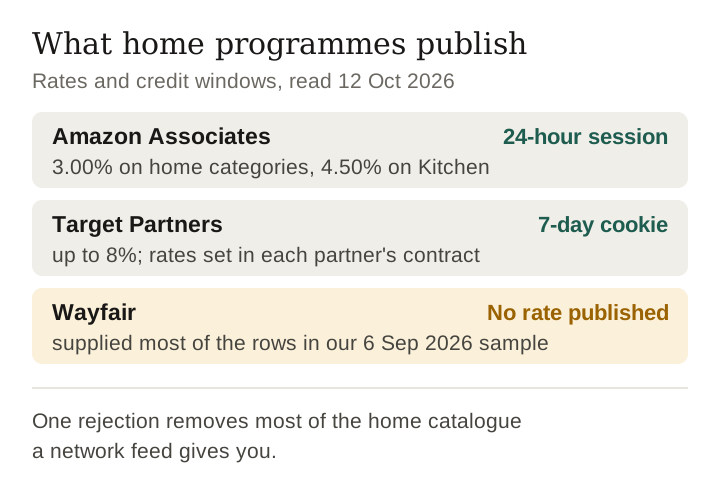
The practical consequence is that a single programme rejection removes most of the home catalogue a network feed gives you, which is not true in fashion or beauty. A second approval is worth holding, and Amazon Associates and Target Partners both publish their headline terms.
The order value is genuinely higher
In our 6 September 2026 sample of Home & Garden’s in-stock US listings on the CJ product feed, order values were high: most sampled rows were big-ticket items, and only a few were cheap.
Furniture, pulled separately, goes further still: nearly all of its sampled rows were big-ticket items. For a creator, that is the whole argument for the niche — the same click volume against a much larger basket.
The counterweight is patience. Furniture and lighting are considered purchases with long decision cycles, so a click today can convert well outside a short attribution window, and that purchase will not be attributed to you at all.
How short the window is, where a programme publishes it: Amazon Associates credits a session that lasts 24 hours from the click, and ends sooner if the customer places an order or clicks another Associate’s link; an item added to the cart in that session still counts if the order is completed within 89 days of the click (Associates Program Policies). Target Partners uses a 7-day cookie with last-click attribution (Target Partners FAQ). Both as published on 12 October 2026.

And it sits with very few retailers
In our Home & Garden sample, Wayfair North America alone supplied most of the rows. The other names in it included Lighting New York, Perigold and architectural house-plan sellers. In our furniture sample a single retailer held most of the rows. Compare beauty, where skincare alone returned many more distinct retailers in a smaller pull.
The concentration runs deeper than the feed’s retailer names suggest. Wayfair’s own partner page says its affiliate programme incorporates its specialty retail brands, including AllModern, Joss & Main, Birch Lane and Perigold. So Perigold, which appears under its own name in the feed, is one of the brands inside the same programme. The same page describes a separate Wayfair Creator Program, in which creators make affiliate links and earn commission on eligible sales.
What that means in practice, stated plainly:
- Your application to the dominant retailer is not one of several — it is most of the home catalogue a network feed gives you, in one decision.
- A programme term change hits nearly all of your links at once rather than a slice of them.
- Diversifying is harder than in fashion, because the alternatives genuinely hold less inventory. This is a structural feature of the niche and not something better research fixes.
Six subcategories, pulled live
| Subcategory | Supplier choice in our pull |
|---|---|
| Bedding | few retailers |
| Cookware | the widest of the six |
| Lighting | more than rugs or wall decor |
| Rugs | very few retailers, the fewest in the table |
| Wall Decor | few retailers |
| Storage | more than rugs or wall decor |
Method: CJ product API, US advertisers, in-stock only, keyword pulls filtered to titles containing the item type and de-duplicated by retailer and title, 6 September 2026. The supplier-choice column compares distinct retailers in the matched rows.
Rugs
- The starkest concentration in the table: the matched listings came from very few retailers.
- High value, almost no supplier choice. Build a rug series on one merchant and you have built it on one relationship.
Lighting
- Fixtures are specification purchases: dimensions, bulb type and finish do the converting, and a listing that omits them will not convert however good the photograph is.
Wall decor
- Little supplier choice: the matched listings came from few retailers.
Bedding
- Sizing and material are the whole recommendation, and both are searchable, which makes bedding one of the better evergreen-page subcategories in home.
Cookware
- The most diverse subcategory in home: more retailers than any of the other five.
- If concentration is the niche’s weakness, cookware is where it is weakest, which makes it a sensible place to hold a second and third programme approval.
What else is in the category
Worth knowing before you size the opportunity from a network’s headline listing count: a noticeable part of our sample came from architectural house-plan sellers. Those are digital drawings, not home goods.
They inflate both a network’s headline listing count for the category and its top-end prices. A creator recommending cushions and lamps is not competing for that inventory and should not include it when estimating what the niche holds.
How to play a concentrated niche
- Apply to the dominant retailer properly. When one approval is most of your catalogue, it is worth doing the application slowly and well rather than fast and five times.
- Hold a second approval where there is choice: cookware, the subcategory with the most retailers in our pull, or a general retailer whose terms you can read before applying, such as Amazon Associates or Target Partners. It is insurance, and it is cheap: Target says joining its programme is free.
- Write to specifications. Dimensions, materials and finishes are what home readers search and what converts them; a mood photograph without measurements is a post, not a recommendation.
- Expect long decision cycles. Considered purchases convert late, sometimes after the attribution window has closed. A purchase made a fortnight after the click falls outside Target’s 7-day cookie, and counts with Amazon only if the item went into the cart during the 24-hour session. That is a real cost of the high order value, not a problem with your content.
What the programmes publish
Commission rates are not in the CJ product feed. Introspecting the CJ product API on 6 September 2026 returned only product and feed queries, and a Product type with no commission field — there is no programme or terms query on it to read. So the terms below come from each programme’s own pages, as published on 12 October 2026. Where a programme does not publish a figure, the table says so rather than filling it in.
| Programme | Rate, as published | Credit window | Joining |
|---|---|---|---|
| Amazon Associates | 3.00% on Furniture, Home, Home Improvement and Lawn & Garden; 4.50% on Kitchen | 24-hour session from the click; an item added to the cart in that session counts if ordered within 89 days of the click | Sites Amazon classes as unsuitable are not eligible, including sites directed toward children |
| Target Partners | Up to 8%, a programme-wide headline rather than a home rate; specific rates and exclusions are set in each partner’s contract, and not all products qualify | 7-day cookie, last-click attribution | Apply through Impact and be accepted; family-friendly sites with mainly US-based viewership; free to join |
| Wayfair | Not published on its partner page | Not published on its partner page | One affiliate programme takes in AllModern, Joss & Main, Birch Lane and Perigold; a separate Creator Program pays commission on eligible sales |
Sources, fetched 12 October 2026: Amazon’s Associates Program Standard Commission Income Statement (rates) and Associates Program Policies, updated 14 April 2026 (session, eligibility); Target Partners (headline rate), its FAQ (cookie, attribution, network, eligibility, cost) and its terms and conditions (rates per partner contract); Wayfair’s Partner with us page. Target’s terms point to a separate standard-rate page, which could not be opened on 12 October 2026, so no Target category rate is given here.
Read next to the concentration above: the marketplace that dominates the home feed does not publish its rate on its partner page. Of the general retailers that do publish terms, Amazon lists its home categories at 3.00% and 4.50% and Target advertises up to 8%, with credit windows of hours or days against purchases that can take weeks.
Last verified 6 September 2026 against live CJ product-feed pulls of the Home and Garden and Furniture categories (in-stock US listings) and six subcategory keyword pulls. In the subcategory pulls too, most priced rows came from a single homeware marketplace.
Frequently asked
Is home decor a good affiliate niche?
Its order values are high, and higher still in furniture, and very few retailers hold them. It rewards creators who can win and keep one or two programme relationships, and punishes those who cannot.
Which home subcategory has the most retailers?
Cookware, in our 6 September 2026 pull. Rugs came from very few retailers and wall decor from few, which is the concentration problem in one comparison.
How much is a home decor affiliate sale worth?
The order value times the programme’s rate for that category, and only some programmes publish the rate. As published on 12 October 2026, Amazon Associates pays 3.00% on Furniture, Home, Home Improvement and Lawn & Garden and 4.50% on Kitchen; Target Partners advertises up to 8% and sets specific rates in each partner’s contract; Wayfair’s partner page publishes no rate. The sources are linked under the table above.
Why do home affiliate links convert late?
Furniture and lighting are considered purchases. A reader clicks, measures the room, thinks for a fortnight and buys — sometimes after the attribution window has closed, in which case the sale is real and the commission is not. Amazon’s session lasts 24 hours from the click and Target’s cookie 7 days.
Sources and scope
- Order values, retailer concentration and subcategory supplier choice: CJ product API, US advertisers, in-stock only, pulled 6 September 2026.
- Programme terms (rates, credit windows, joining rules, the brands in Wayfair’s programme): each programme’s own pages, fetched 12 October 2026 and linked under the table in What the programmes publish.
- Attribution windows and what closes them: affiliate cookie windows explained.
- A commission rate appears on this page only where the programme itself publishes it; none is inferred.
Keep reading
How this page was made. Drafted with AI (Claude); not yet independently re-checked. How we work