LinkToLooks · Guides · Reference Desk
Reference Desk
How do you date and grade a cassette tape?
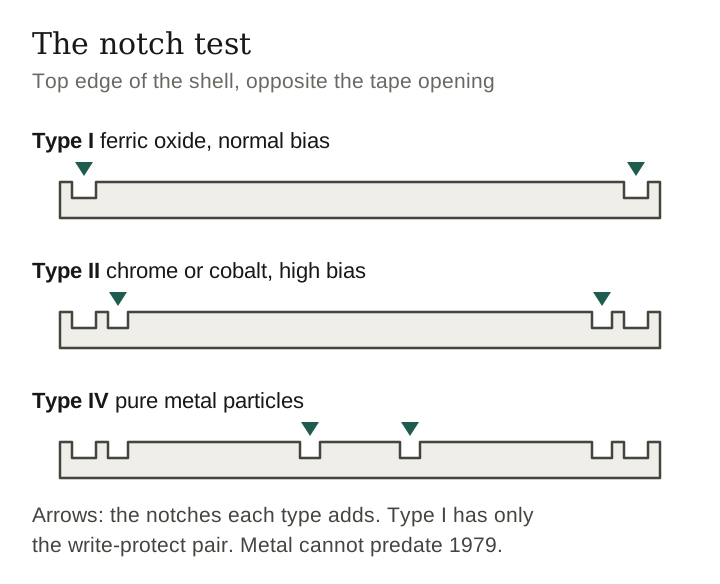
Every cassette shell looks the same from a metre away. Up close there are four things that date and grade a tape: the notches on the top edge, the coating chemistry the label claims, the noise-reduction logo, and whether it is a Musicassette or a blank somebody recorded. This guide covers all four, and ends with what you can actually still buy.
The notch test: reading a tape type off the shell
This is the only identification that requires no label and cannot be faked by a marker pen. Look along the top edge of the cassette, the side opposite the tape opening.
| Notches on the top edge | IEC type | Coating | Bias / EQ |
|---|---|---|---|
| Write-protect notches only, at the two corners | Type I | Ferric oxide (Fe2O3), often with cobalt | Normal |
| A second pair immediately beside the write-protect notches | Type II | Chromium dioxide or cobalt-adsorbed ferric | High / chrome |
| A third set near the middle of the top edge | Type IV | Pure metal particles | Metal |
Those notches exist so that a deck can detect the tape and switch its bias and equalisation automatically. Simple voice recorders and earlier decks are built for standard ferric and ignore them entirely, which is why a metal tape played on a cheap machine sounds dull rather than better. The standard is IEC 60094.
Type III existed on paper — ferrichrome — and is vanishingly rare in the wild. If you think you have found one, check the label rather than the notches.
The coating timeline
| Year | What appeared | Who |
|---|---|---|
| 1963 | The Compact Cassette itself, introduced in August | Lou Ottens and his team at Philips |
| 1966 | The format freely licensed to other manufacturers | Philips |
| 1968 | Chromium dioxide manufacturing commercialised | DuPont |
| 1970 | The first CrO2 cassette | Advent, later backed by BASF |
| c.1970 | Cobalt volume-doping plus double-coating, sold as High Energy | 3M, under the Scotch brand |
| 1974 | Cobalt-adsorbed iron oxide, sold as Avilyn | TDK |
| 1979 | Type IV pure metal particle tape, sold as Metafine | 3M |
The practical consequence for dating: a metal tape cannot predate 1979, and a chrome tape cannot predate 1970. If a listing describes a metal-bias cassette as a 1970s artefact, it is being generous with itself at the early end.
Worth knowing before you pay a premium for chemistry: most cassettes sold as "normal" or "chrome" today are ferric oxide and cobalt mixed in varying ratios. Very few tapes on the market use a pure chromium dioxide coating at all.
The era timeline: what the format was for, when
- 1963–1965, dictation. The Compact Cassette was designed for dictation and portable use. The audio quality of early players was not suited to music, and nobody pretended otherwise.
- Late 1965, the first Musicassettes launch in Europe. Mercury, the US Philips affiliate, brings them to America in July 1966 with an initial catalogue of 49 titles. British labels follow in October 1967.
- 1971, the format becomes hi-fi. The Advent Model 201 deck pairs Dolby B noise reduction with chromium dioxide tape on a commercial-grade transport from 3M’s Wollensak division. This is the moment the cassette starts being taken seriously for music.
- Mid-1970s, Dolby B goes mainstream and tape hiss stops being the deciding objection.
- 1979 onward, the Walkman. Portable listening turns the cassette into the dominant format and cassette sales overtake LPs.
- 1983–1991, the peak. For nine years the cassette is the most popular audio format for new music sales in the United States.
- 1990s, the cassette single has its moment while the CD takes the album.
- 2015 onward, the revival. Urban Outfitters begins selling new pre-recorded cassettes, blanks and players; sales rise through 2016, 2017 and 2018. UK cassette sales in 2021 reach their highest level since 2003. Maxell reports selling 8 million tapes a year in Japan.
Musicassette or home recording?
Two things separate a commercial release from a blank somebody filled, and both survive in a photograph:
- The label is printed on, not stuck on. Commercial cassettes are printed directly onto the shell. A paper label with handwriting is a blank.
- A catalogue number appears on the spine and the shell. Home recordings have no catalogue number because there is nothing to catalogue.
Then there is a third tell people miss: commercial pre-recorded cassettes usually have their write-protect tabs intact because nobody expected you to record over an album. A tape with both tabs punched out and a printed label is a commercial release somebody deliberately protected — usually because it mattered to them.
What you can still buy, checked today
We read 699 unique cassette-titled listings from 35 US advertisers on 1 September 2026. The result is narrower than the revival coverage suggests.
| What | Where | Price |
|---|---|---|
| Maxell UR Type I blank, 90 minute, normal bias, single | Zoro | $5.15 |
| RTM Fox C-60 audio cassette | Full Compass Systems | $6.50 |
| Maxell UR 90, two-pack, normal bias | Zoro | $10.25 |
| Maxell UR Type I, five-pack, 90 minute | Zoro | $28.39 |
| Cassette head cleaner and demagnetiser | Books-A-Million | $16.99 |
Our editorial view: that absence is the single most useful fact on this page. The revival has restored the object — the shell, the player, the ritual — without restoring the chemistry that made the format worth arguing about. A Type I blank in 2026 is roughly the tape a 1972 buyer would have called adequate.
Frequently asked about dating cassettes
How do I tell what type a cassette tape is?
Look at the top edge of the shell. Type I has only the two write-protect notches. Type II adds a second pair right beside them. Type IV, metal, adds a third set near the middle of the top edge. This is defined by IEC 60094 and lets a deck set bias and equalisation automatically.
When were cassette tapes invented?
The Compact Cassette was invented by Lou Ottens and his team at Philips and introduced in August 1963. Philips licensed the format freely to other manufacturers from 1966.
What is the oldest a metal cassette can be?
1979. Type IV pure metal particle tape was introduced that year by 3M under the trade name Metafine. Chromium dioxide tape goes back further: DuPont commercialised the process in 1968 and Advent released the first CrO2 cassette in 1970.
When were cassettes the most popular music format?
From 1983 to 1991 the cassette was the most popular audio format for new music sales in the United States. It overtook the LP after the 1979 launch of the Walkman.
Can you still buy blank cassette tapes?
Yes, but only Type I. Across 699 cassette-titled listings from 35 US advertisers on 1 September 2026, the blanks available were Maxell UR normal-bias tapes at $5.15 to $28.39 and the RTM Fox C-60 at $6.50. Neither supplier's blanks appear in a 17 September 2026 re-pull, so that availability finding is dated to 1 September rather than re-asserted for today. No Type II, Type IV, chrome or metal blank appears anywhere.
How can I tell a commercial cassette from a home recording?
A commercial release has its label printed directly onto the shell and carries a catalogue number on the spine. A home recording has a stuck-on paper label, usually handwritten, and no catalogue number.
Last verified 1 September 2026. Dates and technical detail are from the sources below; the availability table and the Type II/IV finding are computed from 699 unique cassette-titled listings pulled from 35 US advertisers on that date.
Sources
- Wikipedia, Cassette tape — the 1963 Philips introduction and Lou Ottens attribution, the 1966 free licensing, the late-1965 European and July 1966 US Musicassette launches with 49 initial titles, the October 1967 British release, the 1971 Advent Model 201 with Dolby B and CrO2, the mid-1970s Dolby B adoption, the 1983–1991 US format leadership, the IEC 60094 notch scheme for Types I, II and IV, the 1968 DuPont CrO2 commercialisation, the 1970 Advent CrO2 cassette, 3M’s c.1970 High Energy cobalt doping, TDK Avilyn in 1974, 3M Metafine Type IV in 1979, the note that most modern coatings are ferric-plus-cobalt rather than pure CrO2, and the 2015-onward revival including Urban Outfitters, the 2021 UK sales high and Maxell’s 8 million tapes a year in Japan.
- Wikipedia, Walkman — the 1979 TPS-L2 launch and cassette sales overtaking LPs.
- CJ Affiliate product feeds, US advertisers, queried 1 September 2026 — the 699-listing census, the availability table and the absence of any Type II or Type IV blank.
Read next
Are cassette tapes still made? · Which Sony Walkman is this? · Where to buy a cassette player
How this page was made. Drafted with AI (Claude); not yet independently re-checked. How we work