LinkToLooks · Guides · Reference Desk
Reference Desk
Is this ornament a real Christopher Radko?
A Christopher Radko ornament is mouth-blown glass, not moulded plastic or machine-pressed glass, and the company has been making them since 1984. The line is still in production: current-season designs were on sale at a US department store for $44.10 to $85.40 on 28 September 2026, against list prices of $63 to $122.
That is the number that settles most identification questions. If the ornament in front of you carries a design that is not in this year's catalogue, it is a retired Radko, and retired Radkos asked a median of $179.95 on the replacement market on 2 September 2026 — well above what the current line costs new.
What tells you it is a Radko
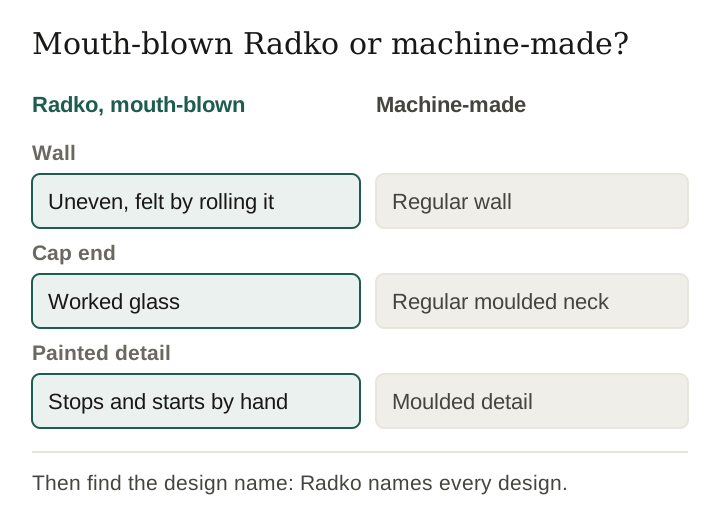
- Weight and wall. Mouth-blown glass has an uneven wall thickness you can feel by rolling the ornament in your palm. Machine-made glass does not.
- The area at the cap end where the glass was worked, rather than a perfectly regular moulded neck.
- Painted detail that stops and starts by hand, with glitter applied over the paint rather than moulded into it.
- A design name. Radko names every design, and the replacement market trades on those names — not on descriptions of what the ornament looks like.
Boxed or not, and how much that is actually worth
| How it is offered | Listings priced | Cheapest | Median | Dearest | Average |
|---|---|---|---|---|---|
| With its box | 43 | $49.99 | $179.95 | $999.95 | $259.02 |
| No box | 211 | $39.99 | $179.95 | $799.95 | $193.60 |
Re-read on 28 September 2026, far deeper (2,331 replacement listings), the unboxed median settled at $159.95 while the boxed median had not settled, reading $199.95 to $219.95 across the deepest reads. The table above is the 2 September reading, and what follows describes it.
On 2 September the medians were identical, $179.95, and the averages were not: boxed pieces average $259.02 against $193.60. Read that carefully, because it is the opposite of the usual collector rule of thumb. On an ordinary Radko the box adds nothing. On the scarce ones — the tail that drags the average up — it adds a great deal. If you are selling a common design, do not hold out for a box premium that the middle of this market does not pay.
The origin story, and why it matters to identification
In 1984 the Radko family's fourteen-foot Christmas tree came down and destroyed roughly two thousand heirloom mouth-blown European ornaments. Christopher Radko went looking for replacements, found Polish craftsmen who could still make them, and sold $25,000 worth door-to-door to Manhattan retailers in his lunch breaks in the first year. By 1997 the company was doing $50 million. He sold the business to Rauch Industries in 2005; a non-competition agreement expired on 15 August 2021, and in 2022 he won the right to use his own name on a new line.
The practical consequence: the name Christopher Radko on an ornament does not by itself tell you which company made it or when. The design name and the season it belongs to do.
Last verified 28 September 2026: the listed offer and six current-season department-store listings re-checked against the CJ product feed (US advertisers); the offer is unchanged, and the current line is now quoted at the sale price a shopper pays. The box table is as of 2 September 2026. Across 51 live US listings pulled on 2 September 2026, the cheapest was $39.99 and the median $239.95. Peer-to-peer marketplace asks of $500 or more are excluded as seller placeholders, as are repdigit asks such as $999 and $9,999 wherever they appear; retailer prices are what a shopper pays, the sale price where one is set.
Frequently asked
How can I tell if an ornament is a real Christopher Radko?
Radko ornaments are mouth-blown glass with an uneven wall thickness, hand-applied paint and glitter, and a named design. Machine-made glass has a regular wall and moulded detail.
Are Christopher Radko ornaments still made?
Yes. Current-season Radko designs were on sale at a US department store for $44.10 to $85.40 on 28 September 2026, against list prices of $63 to $122.
Does the box matter for a Radko?
Only at the top of the market. On 2 September boxed and unboxed listings shared the same median, $179.95, but boxed pieces averaged $259.02 against $193.60 unboxed. A deeper 28 September read put boxed pieces above unboxed at the median too, so treat the box as worth something — the premium sits in the scarce designs.
When did Christopher Radko start making ornaments?
1984, after the family Christmas tree fell and broke about two thousand heirloom European glass ornaments.
Sources
- Wikipedia, Christopher Radko — the 1984 tree collapse and roughly 2,000 destroyed heirloom ornaments, the Polish craftsmen, $25,000 in first-year door-to-door sales, $50 million by 1997, the 2005 sale to Rauch Industries, the non-competition agreement that expired 15 August 2021 and the 2022 judgment on the use of his name
- CJ Affiliate product feeds, US advertisers, queried 31 August 2026 — every price statistic on this page is computed from that pull
Read next
What is a Radko ornament worth? · Which Lenox Holiday pattern is it?
How this page was made. Drafted with AI (Claude); not yet independently re-checked. How we work