LinkToLooks · Guides · Reference Desk
Reference Desk
How do Criterion Collection spine numbers work?
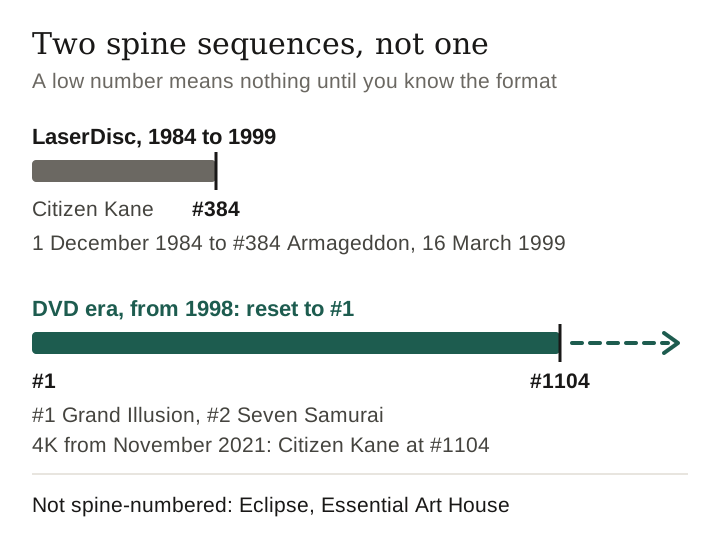
Every main-line Criterion release carries a number on its spine. The numbers are the skeleton of the collection: they are how collectors describe what they own, how shelves get ordered, and how you tell a real Criterion release from the several things that look like one. This guide is how the system actually works, what it does not cover, and where it breaks.
Where the numbers came from
- Criterion was founded in 1984 by Robert Stein, Aleen Stein and Joe Medjuck, later joined by Roger Smith.
- The first release was a LaserDisc of Citizen Kane on 1 December 1984. The LaserDisc line ran to spine #384, Armageddon, on 16 March 1999.
- The DVD line began in 1998 and reset the numbering to 1. This is the single most important fact on this page: there are two separate Criterion spine sequences, and a low number means nothing until you know which format you are holding.
- Grand Illusion was designated spine #1 in the DVD sequence but was delayed a year while its restoration was completed. Seven Samurai at spine #2 therefore reached buyers first.
What a spine number does and does not tell you
| The number tells you | The number does not tell you |
|---|---|
| Roughly when the title entered the DVD-era collection — low numbers are late 1990s, four-digit numbers are recent | Anything about which edition you hold. A title reissued on Blu-ray or 4K normally keeps its original spine number |
| That it is a main-line Criterion release rather than a sub-label | Rarity. Criterion prints to demand and reprints steadily |
| Where it sits if you shelve numerically, which is what most collectors do | Whether the disc is in print. Out-of-print titles keep their numbers |
The four-digit era is recent and worth anchoring: Citizen Kane was spine #1104 when Criterion moved into 4K. Announced in August 2021, the Ultra HD Blu-ray line began publishing in November 2021. Any four-digit spine is a release of roughly the last few years.
The three things that are not spine-numbered Criterions
1. Eclipse
Eclipse is a separate Criterion product line, sold in themed box sets with its own Eclipse Series numbering rather than Criterion spine numbers, and without the restorations, essays and supplements that define a main-line release. Eclipse sets turn up in every Criterion search and are priced comparably — the Agnès Varda in California set in this pull asks $51.99 — so read the box before you buy the number you think you are buying.
2. Essential Art House
Another Criterion line, drawn from Janus Films, and again not part of the main spine sequence.
3. Box sets that carry one number, or none
5 of 683 priced Criterion listings in this pull are sets, collections or multi-title boxes. The anniversary box in this pull asks $919.99, which is 20 times the $45.99 median for a single disc — both figures re-read on 8 September 2026 and unchanged from a week earlier. Sets do not slot into a numeric shelf the way single spines do, which is a genuine practical annoyance nobody warns new collectors about.
How to read a shelf, in order
- Find the crescent C. Top left of the sleeve on main-line releases.
- Read the spine strip. Number down the left edge of the front face and on the spine itself.
- Check the format band. A Blu-ray or 4K reissue keeps the original spine number, so the number will not distinguish your edition — the format banner will.
- If there is no spine number, ask which line it is. Eclipse and Essential Art House both look like Criterion because they are Criterion, just not the numbered sequence.
Last verified 8 September 2026. Spine-system facts are sourced to Wikipedia's Criterion Collection article as cited below; price figures are computed from 683 priced Criterion listings from US advertisers in the CJ product feed on the same date, read to a depth of 800 rows for the keyword “criterion collection”. Every price figure on this page was re-read on 8 September and none of them had moved: the $45.99 single-disc median, the $919.99 anniversary box and the $51.99 Eclipse set all still read as they did on 1 September. The listing count is larger only because this read went further into the same feed than that one did.
Frequently asked about Criterion spine numbers
What is a Criterion spine number?
The sequential number printed on the spine and front-left edge of a main-line Criterion release. The DVD-era sequence began in 1998, when Criterion reset its numbering to 1; the earlier LaserDisc sequence ran separately to #384 with Armageddon in March 1999.
What is Criterion spine number 1?
Grand Illusion, in the DVD sequence begun in 1998. Its release was delayed a year while restoration was underway, so Seven Samurai at spine #2 reached buyers first. In the earlier LaserDisc sequence the first release was Citizen Kane, on 1 December 1984.
Do Blu-ray and 4K reissues get new spine numbers?
Normally no — a reissued title keeps its original spine number, which is why the number cannot tell you which edition you are holding. Read the format banner instead. Criterion announced its move to Ultra HD Blu-ray in August 2021 and began publishing 4K in November 2021, with Citizen Kane at spine #1104.
Are Eclipse box sets part of the Criterion spine numbering?
No. Eclipse is a separate Criterion line with its own Eclipse Series numbering, sold without the restorations and supplements of a main-line release. Essential Art House, drawn from Janus Films, is likewise outside the spine sequence.
Sources
- Wikipedia, The Criterion Collection — the 1984 founding by Robert Stein, Aleen Stein and Joe Medjuck with Roger Smith; the 1 December 1984 Citizen Kane LaserDisc; the final LaserDisc Armageddon at spine #384 on 16 March 1999; the 1998 DVD-era numbering reset with Grand Illusion at #1 delayed a year for restoration and Seven Samurai at #2; the Eclipse and Essential Art House lines; the August 2021 announcement and November 2021 start of Ultra HD Blu-ray publishing with Citizen Kane at #1104; and the Criterion Channel launch on 8 April 2019.
- CJ Affiliate product feeds, US advertisers, queried 1 September 2026 — all price figures.
How this page was made. Drafted with AI (Claude); not yet independently re-checked. How we work