LinkToLooks · Guides · Reference Desk
Reference Desk
How do you tell vintage Pyrex from a reissue?
Three checks in order, four traps, and the price gap that makes getting it wrong expensive in both directions.
Check three things in order. The logo case: lowercase pyrex was introduced in 1975, so a lowercase kitchen mark rules out everything earlier. The pattern: each ran for a known span, and Butterprint ended in 1968. The shape: a spouted, handled Cinderella bowl cannot predate 1957.

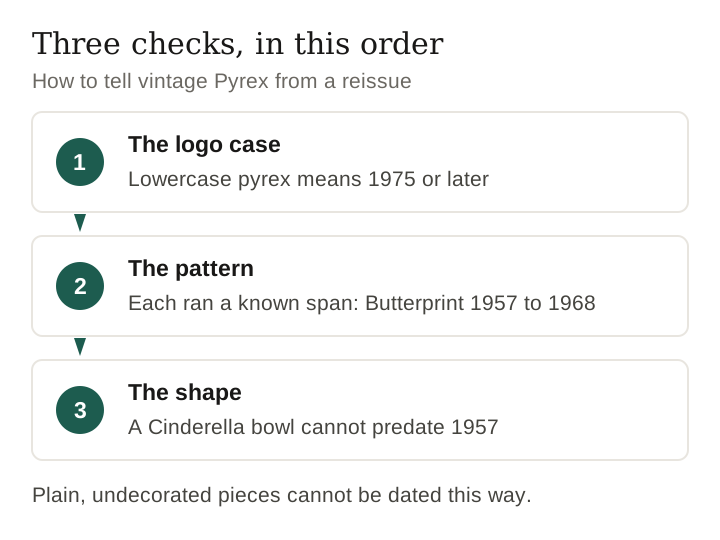
The three checks
1. The logo case
Uppercase PYREX on kitchenware predates the lowercase mark, which was introduced in 1975 and has been carried by US kitchenware since. Uppercase PYREX on laboratory glass is a different product line entirely and tells you nothing about kitchenware age.
2. The pattern
| Pattern | Manufactured | Ends before |
|---|---|---|
| Pink Daisy | 1956 to 1962 | 1963 |
| Butterprint | 1957 to 1968 | 1969 |
| Gooseberry | 1957 to 1966 | 1967 |
| Early American | 1962 to 1971 | 1972 |
Source: the Corning Museum of Glass Pyrex pattern library, read 2 September 2026. Only patterns we read directly are listed.
3. The shape
Cinderella bowls — nested mixing bowls with a spout on one side and a handle on the other, designed by John Philip Johnson — were introduced in 1957 carrying Butterprint and Gooseberry. Oval Decorator Casseroles with clear covers arrived in 1956, square Space-Savers in 1957 and oval divided bakers in 1958. A shape cannot be older than its introduction.

How rare current production actually is
The number worth carrying into a shop: of 490 live US Pyrex kitchen listings pulled on 2 September 2026, just 16 named a current production line such as Prepware, Smart Essentials, Easy Grab or Deeper. Reissues and current stock are a small minority of what is offered under this brand online, and they are usually identifiable by line name alone.
Last verified 2 September 2026 against 490 live US Pyrex listings pulled from affiliate product feeds, and the Corning Museum of Glass pattern records read on the same date
Four traps
- Reused prints. Anniversary and retro releases have revived historic patterns, so a familiar print on a lowercase mark is a modern piece wearing an old design.
- Promotional colourways. Butterprint was issued in orange and pink promotional variants in the late 1950s and early 1960s that its headline description does not cover, so an unfamiliar colour is not proof of a fake.
- Laboratory glass in vintage searches. Uppercase PYREX beakers and flasks appear constantly under $10 in these results and are not kitchenware at all.
- Plain pieces cannot be dated this way. No pattern, almost no shape change, and measuring cups in particular look much the same across decades.
Undecorated coloured pieces have no pattern to date them by, and are priced that way: an amber Pyrex square casserole on Poshmark in September 2026 asked $7.00.
What the difference is worth
| Slice | Median asking price |
|---|---|
| Current production lines, 16 listings | $20.48 |
| All Pyrex kitchen listings, 490 | $49.99 |
| Butterprint turquoise mixing bowls, by size | $79.95 (5″) to $299.95 (10″) |
Method: CJ product API, US advertisers, pulled 2 September 2026. Asking prices, not sold prices.
The gap is the whole reason this question is worth answering carefully. Getting the identification wrong in either direction costs real money: paying a discontinued-pattern price for a reissue, or selling a 1960s Cinderella bowl at a current-line price.
Frequently asked
How can you tell vintage Pyrex from a reissue?
Check the logo case first: lowercase pyrex was introduced in 1975, so a lowercase kitchen mark is 1975 or later. Then check the pattern against its manufactured dates, and last check the shape, since Cinderella bowls did not exist before 1957.
Do reissues use the same patterns?
Some do. Anniversary and retro releases have reused historic prints, which is why the pattern alone is not sufficient and the logo is checked first.
Is old Pyrex worth more than new?
Usually, and by a lot. In our pull the current-line median was $20.48 against $49.99 for all Pyrex kitchen listings, with discontinued Butterprint mixing bowls asking $79.95 to $299.95 by size.
Does the glass type tell you the age?
Only roughly. Early Pyrex was borosilicate and all American-made kitchen Pyrex since 1998 is tempered soda-lime, but you cannot tell them apart by eye and we would not advise trying to test it at home.
What is the fastest check in a shop?
Look at the mark. Uppercase on kitchenware means it predates the 1975 lowercase change; a lowercase mark rules out everything earlier in one glance.
Sources and scope
- Pattern dates and shape introductions: the Corning Museum of Glass Pyrex pattern library, read 2 September 2026.
- Logo case and glass composition: Pyrex.
- Prices and counts: CJ product API, US advertisers, pulled the same day.
How this page was made. Drafted with AI (Claude); not yet independently re-checked. How we work