LinkToLooks · Guides · Reference Desk
Reference Desk
Y2K accessories: is new retail cheaper than resale?
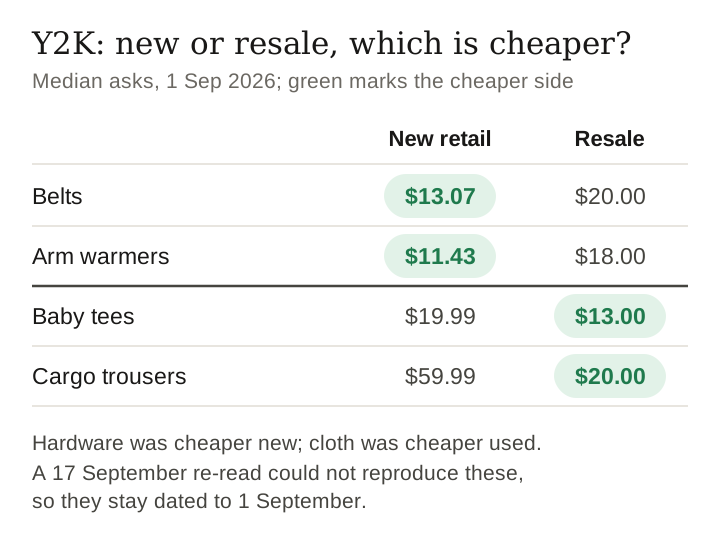
It depends on the object, and the split is sharp. As of 1 September 2026, hardware-bearing accessories were cheaper new: belts asked $13.07 new against $20.00 resale, arm warmers $11.43 against $18.00, mini backpacks $7.99 against $17.00. A re-read on 17 September 2026 could not reproduce these comparisons: the new-retail side is three to thirty listings deep and moves with which shops a keyword happens to reach, and at the published sample sizes the resale side does not hold either (belts read $29.00 against $20.00, mini backpacks $25.00 against $17.00). The figures below are therefore left as they were measured on 1 September rather than restated from a read we do not trust.
Garments were cheaper used on the same date: baby tees asked $19.99 new against $13.00 resale, and cargo trousers $59.99 against $20.00.
On this page
Seven categories, both channels
Same feed, same day, same filters. The ratio column is resale median divided by new-retail median: above 1.00 means new is cheaper.
| Category | New retail (n, median) | Resale (n, median) | Ratio | Cheaper |
|---|---|---|---|---|
| Mini backpacks | 3 — $7.99 | 198 — $17.00 | 2.13 | new |
| Arm warmers | 32 — $11.43 | 207 — $18.00 | 1.57 | new |
| Belts | 144 — $13.07 | 707 — $20.00 | 1.53 | new |
| Hoop earrings | 1 — $13.99 | 257 — $15.00 | 1.07 | too few to call |
| Hair clips | 23 — $11.60 | 417 — $10.00 | 0.86 | resale |
| Baby tees | 20 — $19.99 | 192 — $13.00 | 0.65 | resale |
| Cargo trousers | 18 — $59.99 | 831 — $20.00 | 0.33 | resale |
Method: new retail is every advertiser that is not a peer-to-peer marketplace; resale is the peer-to-peer marketplaces. Medians only, because the means in both channels are dragged by luxury outliers. Rows with fewer than three new-retail listings are marked as uncallable rather than reported as a finding.
The rule that explains the split
Look at what changes hands in each row and the pattern resolves. Objects made of hardware are cheaper new. Objects made of cloth are cheaper used.
The mechanism is not mysterious. A belt, an arm warmer or a small bag is cheap to manufacture at scale and is still in production, so new supply is elastic and the price sits near the manufacturing floor. Meanwhile the resale price of the same object is set by an individual who paid retail for it and does not want to feel like they lost, so it anchors near what they paid.
A garment is the opposite. New clothing prices reflect brand positioning, seasonal collections and margin; the new listings in the cargo row are current-season Madewell at $59.99, not a 2003 mall cut. The resale listings are somebody's actual trousers. Those are not the same product, and the price gap is mostly that.
Where new wins hardest
Belts are the cleanest case because both channels are deep: 144 new listings and 707 resale ones. 74.1% of resale belt listings ask more than the new-retail median. The arm-warmer figure is even starker at 77.3%, and mini backpacks hit 94.9% — though that row rests on three new listings and should be treated as indicative rather than settled.
The editorial judgment: for these three categories, buying resale is a decision about getting a specific object, not a decision about saving money. That is a perfectly good reason — a printed strap or a discontinued colourway is worth paying for — but it should be a conscious one.
Where resale wins hardest
Cargo trousers are the extreme: a 0.33 ratio, meaning resale asks a third of new retail. Only 6.6% of the 831 resale listings ask more than the new-retail median of $59.99. Baby tees follow the same direction at 0.65, with 22.9% of resale listings above the new median.
The caution that belongs with those numbers: the new-retail listings in both rows are current fashion, not reproductions of period cuts. You are comparing a 2026 Madewell cargo trouser to a secondhand one of unknown vintage. The resale price is genuinely lower; the products are genuinely different.
What this comparison cannot see
- Shipping. Feed prices exclude it. On a $10 hair clip that is a large proportion of the total, and it moves the hair-clip row.
- Condition. Resale listings span new-with-tags to visibly worn, and the feed does not encode which.
- Sold prices. Everything here is an ask. Resale asks are negotiable in a way that retail prices are not, which structurally overstates the resale side.
- Returns. New retail carries a returns policy and resale usually does not. That is worth real money on anything sized.
Last verified 1 September 2026 against 2,570 live US listings across seven accessory and garment categories from 40 advertisers in the CJ product feed, split by channel. 36 keyword queries against US affiliate product feeds on 1 September 2026, 9,977 raw rows deduplicated to 3,980 unique listing URLs across 40 advertisers. Peer-to-peer asks of $500 or more are dropped as seller placeholders, as are repdigit asks such as $99 and $999. Re-checked 17 September 2026: neither the new-retail nor the resale medians could be reproduced at a comparable sample from that run's seeds, so both are left dated to 1 September rather than restated. These are asking prices on this date, not sold prices.
New or used, asked plainly
Is new retail cheaper than resale for Y2K clothing?
For accessories with hardware, yes, as measured on 1 September 2026: belts asked $13.07 new against $20.00 resale, and arm warmers $11.43 against $18.00. For garments, no: baby tees asked $19.99 new against $13.00 resale and cargo trousers $59.99 against $20.00.
Which category has the biggest gap?
Cargo trousers, where resale asks a third of the new-retail median. Only 6.6% of the 831 resale listings ask more than the $59.99 new median.
How often does resale ask more than retail for belts?
74.1% of the time. Of 707 live resale belt listings on 1 September 2026, 524 asked more than the $13.07 new-retail median.
Why would anyone buy resale if new is cheaper?
To get a specific object. Printed straps, discontinued colourways and constructions that are no longer manufactured only exist secondhand, and no new-retail price competes with not existing.
Sources
- CJ Affiliate product feeds, US advertisers, queried 1 September 2026 — every median, count and ratio on this page is computed from that single pull.
More price comparisons →
Read next
What a studded belt is worth · Who holds resale inventory · Y2K gifts under $40
How this page was made. Drafted with AI (Claude); not yet independently re-checked. How we work