LinkToLooks · Guides · Reference Desk
Reference Desk
Why is a composition book cover marbled? A 19th-century shortcut
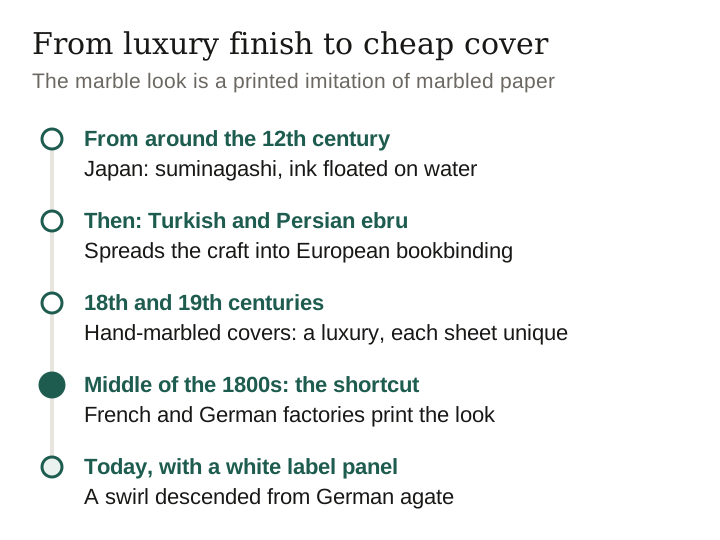
The black-and-white splatter on a composition book is printed imitation marbled paper. Real marbling — floating pigment on a thickened bath and lifting it onto a sheet — was the expensive finish on 18th and 19th-century book covers and endpapers. When French and German factories mechanised notebook production in the middle of the 1800s they printed the pattern instead, because it looked like the costly binding and cost almost nothing.
The specific swirl on a US composition book descends from the German agate marbling pattern. It survived because it is cheap, it hides scuffs and thumbprints, and no one has had a reason to change it.
What makes it a composition book and not just a notebook
| Feature | Composition book | Why it matters |
|---|---|---|
| Binding | Sewn through the fold, then taped | Opens flat and survives a backpack; spiral wire does not |
| Trim size | 9¾ × 7½ in (250 × 190 mm), or 8½ × 6⅞ in (220 × 170 mm) | The two standard US sizes; the smaller one is the “half” size |
| Sheet count | 20, 40, 80 or 100 sheets | 80 is the school-list default |
| Cover | Printed marbled board, blank white label panel | The label panel is why the design never modernised |
The label panel is the detail people forget. Every element of the cover exists to be written on and thrown in a bag: a dark busy pattern that hides wear, with one white rectangle where the subject goes.

Where the pattern actually comes from
Marbling itself is much older than the notebook. The Japanese technique suminagashi — ink floated on water — is documented from around the 12th century, and Turkish and Persian ebru marbling spread the craft into European bookbinding. Hand-marbled paper stayed a luxury because every sheet is unique and has to be pulled one at a time. Industrial printing removed the uniqueness and kept the look, and the notebook trade in 1800s France and Germany took it up exactly because it read as expensive at a low unit cost.
What one costs today
Last verified 30 September 2026: 9 listed offers re-checked by exact link against the CJ product feed (US advertisers) — 1 unchanged, 5 repriced to what a shopper pays today, 3 shown as of 2 September 2026 (one no longer returned by the feed, two returned with a sale price above their list price, which is not a price we can stand behind). In the 2 September 2026 pull, across 61 live US listings, the cheapest was $1.74 and the median $16.23. Prices move; read them as the market on that date, not a promise. Peer-to-peer marketplace asks of $500 or more are excluded as seller placeholders, as are repdigit asks such as $1,234 and $9,999 wherever they appear; retailer prices are used as published.
Buying judgment: the multi-packs from discount sellers are priced per bundle, not per book, and once you divide them out they are rarely cheaper than a single Roaring Spring book at an office retailer. Roaring Spring is one of the last US mills still making them domestically, which is the reason we would pay the extra dollar.
Frequently asked
Why are composition notebooks black and white?
Because they imitate hand-marbled bookbinding paper, which industrial printers copied in the 1800s as a cheap way to look expensive. Dark, busy covers also hide wear.
What is the marbled pattern called?
The family it descends from is the German agate pattern, one of the classic bookbinding marbling styles.
What size is a standard composition book?
9¾ by 7½ inches (250 by 190 mm) is the full size; 8½ by 6⅞ inches (220 by 170 mm) is the smaller standard.
Sources
- Wikipedia, exercise book — the composition-book trim sizes, sheet counts and sewn-through-the-fold binding
- Mental Floss, the long history of the marbled composition book
- University of Washington Libraries, decorated paper collection — on marbling technique
- CJ Affiliate product feeds, US advertisers, queried 31 August 2026
Read next
Which 90s school supplies you can still buy · Which markers smell like fruit
How this page was made. Drafted with AI (Claude); not yet independently re-checked. How we work