LinkToLooks · Guides · Reference Desk
Reference Desk
What PSA will not grade, and why
Nine codes, five routes to an Authentic Altered holder, one that can never be encapsulated — and six of the nine always charge you the fee.
PSA publishes nine reasons it will return a card without a numeric grade, labelled N1 to N9, and the most important thing about them is that most still cost you the grading fee. The company states plainly that it will not grade cards bearing evidence of trimming, re-colouring, restoration, any other form of tampering, or of questionable authenticity.
Five of the nine can instead be encapsulated as “Authentic Altered” at the grader’s discretion, if you selected that as your minimum grade on the submission form. Two — miscut and minimum size — can be encapsulated as “Authentic”. One, questionable authenticity, can never be encapsulated under any circumstance, and the fee still applies.
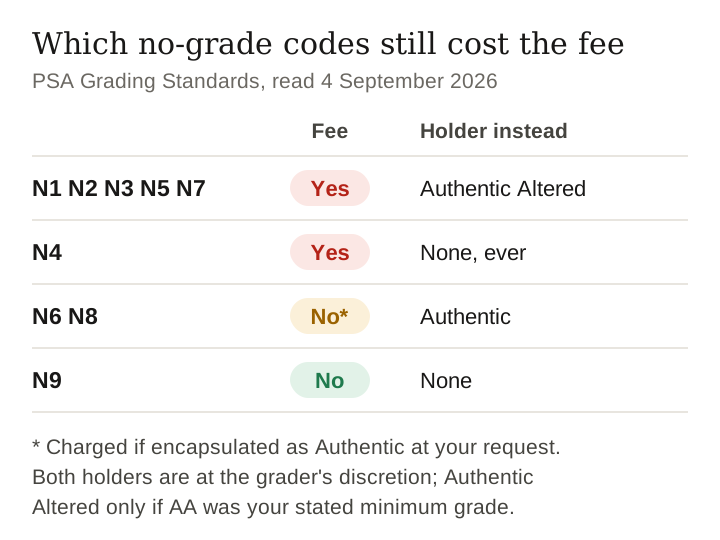
The nine no-grade codes
| Code | PSA’s reason | Alternative encapsulation | Fee charged |
|---|---|---|---|
| N1 | Evidence of trimming — an edge appears altered | Authentic Altered, at grader discretion | yes |
| N2 | Evidence of restoration — paper stock built up | Authentic Altered, at grader discretion | yes |
| N3 | Evidence of recolouration — colour artificially improved | Authentic Altered, at grader discretion | yes |
| N4 | Questionable authenticity — the card or autograph appears not genuine | none, ever | yes |
| N5 | Altered stock — crease pressing, scratch removal, enhanced gloss, foreign substances | Authentic Altered, at grader discretion | yes |
| N6 | Minimum size — significantly undersized against factory specification | Authentic, at grader discretion | not unless encapsulated |
| N7 | Evidence of cleaning — whitener on borders, solutions removing wax, gum or tobacco stains | Authentic Altered, at grader discretion | yes |
| N8 | Miscut — the factory cut is abnormal for the issue | Authentic, at grader discretion | not unless encapsulated |
| N9 | Do not grade — oversized or obscure issues PSA does not encapsulate | none | no |
Source: PSA, Grading Standards, read 4 September 2026.
Last verified 4 September 2026 against PSA's own published grading standards page
N9 carries a route back that is easy to miss: PSA states the decision could be reversed on resubmission if additional information from two or more verified or hobby-approved resources is provided for the issue, and that a research request can be submitted in advance through its Customer Request Center.
Which ones still cost you the fee
Read the fee column above again, because it is the part that surprises people. Six of the nine outcomes always leave you paying the grading fee for a card that came back with no grade on it.
- N4, questionable authenticity, is the worst case: no encapsulation is possible under any circumstance and the applicable fee still applies.
- N6 and N8 are the mild ones: PSA states you will not be charged the grading fee for a miscut or an undersized card — unless it is encapsulated as Authentic at your request, in which case you are.
- The Authentic Altered route is opt-in in advance. It applies only if “AA” was listed on the submission form as your desired minimum grade. That is a decision you make before you know the outcome.
- Minimum grade is not available on every service level. PSA notes the option appears on the submission form only where the service level offers it.
Keep identifying
What a PSA 10 actually requires
The company’s own definition of Gem Mint 10, quoted from the same page, is more specific than the hobby shorthand suggests:
- “Virtually perfect”, with four perfectly sharp corners, sharp focus and full original gloss.
- Free of staining of any kind.
- An allowance may be made for a slight printing imperfection if it does not impair overall appeal.
- Centring within approximately 55/45 on the front and 75/25 on the reverse.
That centring tolerance is the number worth carrying. It is the one objective, measurable criterion in the definition, and it is the commonest reason an otherwise flawless card does not reach 10.
One separate designation to know: MK. PSA states that any card with writing, ink marks, pencil marks, or evidence of the impression left by writing will be designated MK. That is a qualifier on a graded card rather than a no-grade.
PSA on its own subjectivity
Worth quoting because it is unusually candid for a company whose product is authority. PSA writes that while a large part of grading is objective — locating print defects, staining, surface wrinkles, measuring centring — another component is somewhat subjective, and defines that element by asking what the market will accept for a particular issue.
Take that at face value and two things follow. Resubmitting the same card can produce a different grade, because part of the judgment is not a measurement. And a grade is a statement about a card within its issue, which is why grading standards for a 1950s issue and a modern one are not comparing the same physical qualities.
PSA also publishes distinct standards for hand-cut cards, and for pins and coins, where it notes eye appeal carries more weight because the material wears far less than cardboard. Pins and coins do not receive half-point grades.
What we could not verify about other graders
We set out to compare three grading scales and could only read one. Stating that plainly is more useful than filling the gap from memory.
| Grader | What happened when we fetched its published scale | Status |
|---|---|---|
| PSA | HTTP 200, standards text readable | quoted throughout this page |
| Beckett | HTTP 403 Forbidden to our request | not quoted — unverified |
| CGC | the connection timed out | not quoted — unverified |
So this page is about PSA specifically and should not be read as a description of grading in general. We have not paraphrased the other two scales from secondhand summaries, because a scale quoted from somebody else’s article is exactly the kind of detail that is wrong by one increment and impossible to catch.
One further limit worth naming: everything here is PSA’s own published policy. We hold no submission data, no grade-population data and no experience of the process — we have never submitted a card.
Frequently asked
What does N5 mean on a PSA return?
Altered stock. PSA gives examples including paper restoration, crease or wrinkle pressing, scratch removal, enhanced gloss, and any foreign substance applied to the surface such as cleaning spray or wax.
Will PSA grade a trimmed card?
No. It states it will not grade cards bearing evidence of trimming. The card can be encapsulated as Authentic Altered at the grader’s discretion if AA was your stated minimum grade, and the fee applies.
Do I pay if my card comes back ungraded?
Usually yes. PSA states the fee is not charged for N6 minimum size and N8 miscut — unless the card is encapsulated as Authentic at your request — and not for N9. The other six carry the fee.
What centring does a PSA 10 require?
Approximately 55/45 on the front and 75/25 on the reverse, per PSA’s own Gem Mint 10 definition.
Is grading objective?
Partly. PSA itself writes that a large part is objective and another component is somewhat subjective, defined by what the market will accept for a particular issue.
Method and sources
All quotations and codes are from PSA’s Grading Standards page, fetched on 4 September 2026 with an ordinary browser user agent. Only the Gem Mint 10 definition is present in the fetched document; the remaining numeric grade definitions load in a JavaScript carousel our fetch could not read, so this page does not describe them. Beckett returned HTTP 403 to our request and CGC timed out, so neither scale is quoted or characterised here. Policies change without notice — check the grader’s own page before submitting anything. We have never submitted a card for grading and hold no grade-population data.
How this page was made. Drafted with AI (Claude); not yet independently re-checked. How we work