LinkToLooks · Guides · Creator Desk
Creator Desk
Can anyone actually tell you affiliate commission rates by category?
Many affiliate guides publish a rate table. We tried to source one from four public routes in a single afternoon and could not, so this is the log of where each attempt stopped and what can honestly be measured instead.
Part of: The business of being a creatorFor creators
Nobody can hand you one verified table of affiliate commission rates by category across programmes: eBay Partner Network, for one, publishes its own rate card; others keep the rate in terms you see only after acceptance; and a table that mixes them without dates cannot be checked. On 2 September 2026 we tried four public routes to a rate and recorded where each one stopped: the product API we query exposes ten queries and thirty-six product fields with no commission field among them; one large retailer’s rate card redirected to a sign-in page; two affiliate programme pages described commissions without printing a number. For those four, the rate lives in the programme terms you see after acceptance.
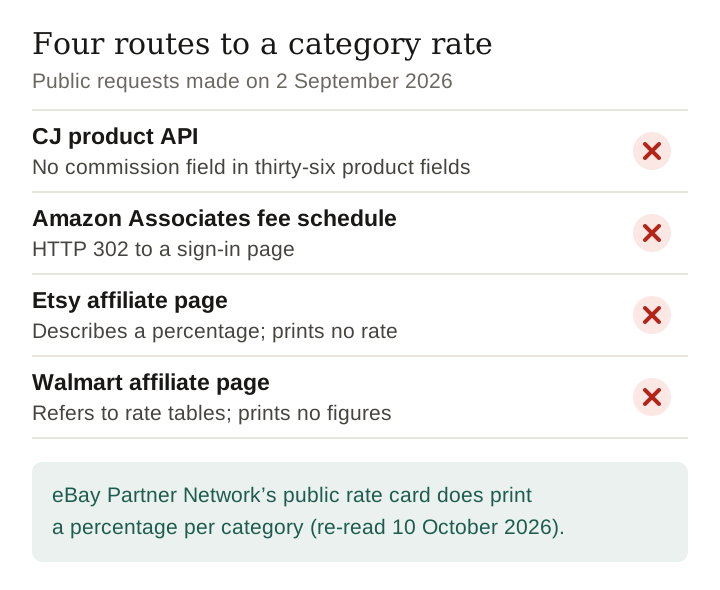
Four routes to a rate, and where each stopped
This is not a survey of the affiliate industry. It is a log of four requests made during one run, with the outcome of each written down as it happened. We publish it because the useful finding is negative.
| Route | What we asked for | Outcome, 2 September 2026 |
|---|---|---|
| CJ product API | any commission or payout field on the product type or query root | No such field. Ten queries on the root, all product or feed queries; thirty-six fields on the product type, none commission-related. |
| Amazon Associates fee schedule | the published standard rate table | HTTP 302 to a sign-in page. Not readable without an account. |
| Etsy affiliate page | a rate or a rate range | None published. The page describes a percentage of revenue and states that commissions are typically validated 30 days after the sale date. |
| Walmart affiliate page | category rate tables | The page refers to commission-rate tables in general terms and prints no figures. |
Method: one request per route, made on 2 September 2026, recorded whether or not it succeeded. A fifth route, eBay Partner Network, did not respond within a 60-second timeout on two attempts on 2 September and was excluded rather than reported as a refusal. Re-read on 10 October 2026, its public rate card does print a commission percentage for each category.
Four routes, zero published category rates. That is a small sample and we do not claim it is the whole market — a programme can print its numbers on a public page, as eBay Partner Network does. The claim is narrower and firmer: these four public sources do not add up to a rate table, so anyone who published rates for them either had accounts we do not have, or did not check. Where a programme does publish a card, as eBay Partner Network does, cite the card and the date you read it.
What the network API actually exposes
Worth being specific, because this is the part people assume works. We hold a CJ developer credential and query its product API. Introspecting its schema on 2 September 2026 returns:
- Ten queries on the root, every one a product or feed query: products, shoppingProducts, travelExperienceProducts, their three application-scoped variants, shoppingProductFeeds, financeProducts, financeCreditCardProducts and productFeeds.
- Thirty-six fields on the product type — title, brand, price, sale price, discount percentage, image, last-updated, advertiser name and so on. Searching them for commission, rate or payout returns nothing.
- No advertiser or programme query at all. Nothing in the schema represents the commercial terms of a programme.
So the catalogue is open and the terms are closed. Terms can also differ by publisher: eBay Partner Network’s public rate card says there may be exceptions for certain partners, and Amazon’s fee-schedule address now redirects to a per-account rate card. It means the rate you are offered may not be the rate the creator next to you is offered, which is the most under-reported fact in this subject.
Keep reading
Why the tables you have read are unreliable
Three failure modes, in the order they do damage.
They are undated
A commission rate is a live commercial term. A table without a read-date cannot be aged, so a rate cut two years ago still reads as current. If a page gives you a rate and no date, you have been given a rumour with a decimal point in it.
They average across categories that behave differently
A band like “home: 3-8%” is not one number, it is a range wide enough to contain two different businesses. The same is true of every band in every table of this kind, and the width is never explained.
They describe the rate and ignore the base
Commission is paid on what the buyer pays for the item, before tax and shipping (Amazon and Etsy both exclude those). A discount moves the base under the rate without touching the rate itself.
What can be measured instead
The half of the equation that is public is the order value: every listing in the feed carries a price, and a median of those prices by subcategory is the number a commission would be a percentage of. It does not hold still. This page first printed seven subcategory medians from a 2 September pull; read again on 10 October 2026 with the same kind of keyword search and title filter, five of the seven had moved, so they are not reprinted here. Take your own category’s median on the day you need it, and note how many listings you read.
Last verified 10 October 2026 against schema introspection of the CJ product API and four affiliate programme pages requested individually and recorded as they responded; all four outcomes re-read and unchanged on 10 October 2026.
The arithmetic that makes a rate meaningless alone
Take two offers a creator might actually be weighing. Programme A pays 10% in a category where a typical order is $17. Programme B pays 4% in one where it is $110. Per sale:
- Programme A: 10% of $17 = $1.70
- Programme B: 4% of $110 = $4.40
The lower rate pays 2.6 times more per sale. Now apply a discount, which is where the second-order effect lives: if the B item is on promotion at 25% off, the base falls to $82.50 and the commission to $3.30 — still ahead, but a quarter of the earnings has gone without the rate moving by a single point.
What to do this week
- Stop looking for one table across programmes. Where a programme publishes a rate card, read it there and note the date; otherwise the rate is in the terms, and an hour spent looking is an hour not spent applying.
- Apply to two programmes in the category you post about, and read the rate in the terms once you are in.
- Write the rate down with the date you read it and the page it was on. That is the whole discipline; it takes a minute and it is what lets you notice a cut.
- Re-read those terms quarterly. Change notices are easy to miss: Amazon, for one, posts them on its Associates site or emails them, and they can take effect two business days later.
- Track your own realised rate — commission divided by order value on statements you have actually been paid. That number is true for you, which no published table can be.
Frequently asked
Where can I find affiliate commission rates by category?
In each programme's own rate card or terms. eBay Partner Network, for one, publishes a public card that lists a percentage per category; others show the rate only after you are accepted. On 2 September 2026 we checked four public sources and none published a category rate table: the network API we query has no commission field at all, one retailer's rate card sat behind a login, and two affiliate pages described rates without printing any.
Why do so many articles publish rate tables then?
Because a table is easy to write and hard for a reader to check. A rate given without the programme page it came from and the date it was read cannot be checked, which is the difference between a figure and a memory.
Is a higher commission rate always better?
No. Commission is a percentage of what the buyer actually pays for the item. A 10% rate on a $17 order pays less per sale than 4% on a $110 order, and discounting cuts the base further.
What should I record when I do get a rate?
The programme, the rate, the category it applies to, the date you read it and where it was written. Rates change, change notices are easy to miss, and a dated note is how you will notice.
Sources and scope
- Schema introspection: CJ product API, 2 September 2026; re-run on 10 October 2026 with the same result.
- Programme page outcomes: single requests to the Amazon Associates fee schedule, the Etsy affiliate page and the Walmart affiliate page, made and recorded on 2 September 2026.
- No commission rate is quoted on this page: the four routes above printed none, and eBay Partner Network’s public rate card is best read at the source, with its date.
Keep reading
How this page was made. Researched and drafted with AI (Claude); checked by a separate automated pass on 10 October 2026. How we work