LinkToLooks · Guides · Creator Desk
Creator Desk
What can a vintage resale creator actually link to?
Part of: For creators
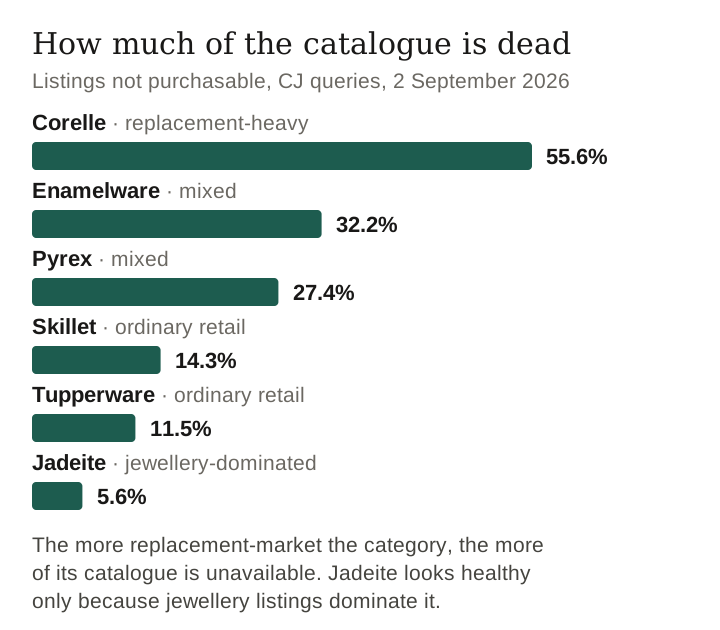
Two kinds of retailer, and both sell one-of-one stock. Peer-to-peer marketplaces are deep and seller-titled — 289 of 315 matched jadeite rows came from one. Replacement specialists are narrow and catalogued — all 45 genuine jadite glass rows came from one. The cost of both is measurable: 55.6% of catalogued Corelle listings were not purchasable when we checked, against 11.5% for Tupperware.
The two businesses that hold vintage inventory
Across every vintage-adjacent pull we ran, linkable inventory came from exactly two kinds of retailer, and they behave completely differently.
Peer-to-peer resale marketplaces
- Deep, chaotic and genuinely vintage. In a jadeite pull, 289 of 315 matched rows came from one such marketplace.
- Listings are seller-written, so titles carry the seller's guess at the maker, pattern or era rather than catalogue data.
- Every item is one-of-one. The link has a lifespan measured in the time it takes one person to buy one thing.
- Prices are asking prices, not transacted ones. You can measure what sellers want; you cannot measure what buyers paid.
Replacement specialists
- Narrow, deep and orderly. They exist to hold one of every discontinued piece in a line.
- Titles are catalogue data: maker, pattern, form. In a Corelle pull the titles gave us 51 named patterns inside a 60-row sample.
- Also one-of-one, but restocked as pieces are sourced — a dead listing can come back.
- Pricing reflects scarcity of the specific pattern and form, which is why the same mug is $4.99 in one pattern and $79.95 in another.
Marketplace stock is seller-titled and one-of-one; replacement stock is catalogued by maker and form. Both are vintage, but only the replacement specialist restocks, so only its listing can come back under the same description.
Link rot, measured rather than asserted
This is the number to plan around. We ran identical category queries twice, once filtered to in-stock listings and once not, and the difference is the share of catalogued listings that are not currently purchasable.
| Search | Listings catalogued | In stock | Not purchasable |
|---|---|---|---|
| Corelle (replacement-heavy) | 11,525 | 5,113 | 55.6% |
| Enamelware (mixed) | 3,658 | 2,480 | 32.2% |
| Pyrex (mixed) | 4,568 | 3,317 | 27.4% |
| Skillet (ordinary retail) | 10,179 | 8,724 | 14.3% |
| Tupperware (ordinary retail) | 1,982 | 1,754 | 11.5% |
| Jadeite (jewellery-dominated) | 6,884 | 6,498 | 5.6% |
Method: CJ product API, US advertisers, paired keyword queries run with and without the in-stock filter, 2 September 2026.
The gradient is the finding. The more genuinely replacement-market a category is, the more of its catalogue is already unavailable — 55.6% for Corelle against 11.5% for Tupperware. If your content is built on the first kind of category, roughly half of any link list you assemble is already stale by the time you publish unless you filtered for stock.
The jadeite row is the exception that explains the rule: it looks healthy at 5.6% precisely because it is dominated by jewellery listings from active sellers rather than by discontinued goods.
Last verified 2 September 2026 against paired live CJ product-feed queries across six product families, run with and without the in-stock filter
Brand-name search fails in this niche, specifically
Four searches we ran, and what actually came back:
| You search | You get |
|---|---|
| griswold | Albums by a musician named Griswold, an electrical parts line, a t-shirt, textbooks |
| wagner | Opera recordings and automotive parts from a truck-parts retailer |
| fireking | Fireproof filing cabinets and security safes from a different company of that name |
| jadeite | Jade jewellery — 289 of 315 matched rows |
Three practical rules follow, and they are the difference between an afternoon of work and a wasted one.
- Search the form, not the brand. Reamer, spice shaker, mixing bowl, canister. Forms are unambiguous; brand names collide with bands, composers and unrelated companies.
- Search the collector spelling. ‘Jadite’ surfaced 45 rows of genuine green kitchen glass; ‘jadeite’ surfaced almost none. Collector orthography is what the specialist catalogues index on.
- Treat a zero as a search failure until proven otherwise. We ran a control: a milk-glass query returned one match in 400 rows despite live milk-glass listings existing. Absence from your search is not absence from the market.
What to write instead of a link list
If half your links die, the answer is not to write faster. It is to write the thing that does not expire.
- Identification and dating guides. A page explaining that Fire-King with a hyphen is 1942–1952 is as true next year as today. Listings inside it can be refreshed; the page keeps its traffic either way.
- Form-and-price explainers. Why a spice shaker is $349.95 and a dinner plate $49.99 is a durable explanation of a market, not a snapshot of it.
- Where-to-look guides rather than what-to-buy lists. Naming the kind of retailer that holds a category survives individual listings selling.
- Dated snapshots, labelled as such. A price table with the date on it ages honestly. A price table without one just becomes wrong.
Any single listing will sell. The explanations of why a reamer costs six times a plate, and why one Corelle pattern costs six times another, will not.
Keep reading
Frequently asked
Can vintage resale creators use affiliate links?
Yes, with one structural caveat: most resale inventory is one-of-one. A link points at a single item, and when that item sells the link is dead. That is a content-planning problem before it is a revenue problem.
Which retailers actually carry vintage inventory?
In our 2 September 2026 pulls the answer was consistently two kinds of business: peer-to-peer resale marketplaces, and replacement specialists that hold discontinued china, crystal and silver. A jadite pull returned 45 glass rows and every one came from a replacement specialist.
How dead is a vintage affiliate link, really?
Measurably. We ran identical queries with and without an in-stock filter: 55.6% of catalogued Corelle listings were unavailable, against 14.3% for skillets and 11.5% for Tupperware.
Do brand-name searches work for vintage?
Often not. Searching the historic cast iron makers returned a musician's back catalogue and automotive parts; searching 'fireking' returned fireproof filing cabinets; searching 'jadeite' returned jade jewellery.
Is vintage worth writing about if the links die?
Yes, if you write the object rather than the listing. An identification or dating guide keeps its traffic when the listing goes; a page that is only a list of links does not.
Keep reading
How this page was made. Drafted with AI (Claude); not yet independently re-checked. How we work