LinkToLooks · Guides · Creator Desk
Creator Desk
What happens when an affiliate link goes dead?
Part of: For creators
It converts at zero and it keeps taking clicks. A dead affiliate link does not warn you, does not fall back to a category page, and does not show up in a payout report — because a click that lands on a 404 produces no sale to be missing from it. The only way you find out is by checking.
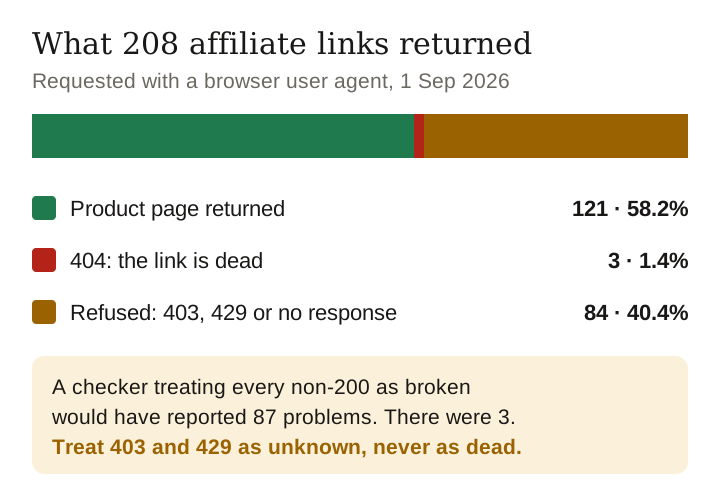
So we checked. On 1 September 2026 we sampled 208 live affiliate destination URLs across 14 US advertisers and requested every one of them with an ordinary browser user agent. This page is what came back.
The measured result
| Outcome | Links | Share of sample |
|---|---|---|
| Answered normally and returned the product page | 121 | 58.2% |
| Answered and returned 404 — the link is dead | 3 | 1.4% |
| Refused the request (403, 429, or no response at all) | 84 | 40.4% |
Among the 124 links from the 8 advertisers that answered at all, 3 were dead — 2.4%. That is a low number and it comes with an important shape: 2 of the 3 were on a single peer-to-peer marketplace, which was the only advertiser in the answering set with more than one dead link in its sample.
Compare one bag, one owner, one URL — it disappears when the bag sells — with a catalogue title that has stock behind it. The catalogue link outlives the resale link by design, not by luck.

Why resale links die and retail links do not
A retail listing is a product with a stock level behind it. Sell out, restock, the URL persists. A peer-to-peer listing is a specific object owned by a specific person: there is exactly one, and when it sells the page it lived on is removed rather than marked unavailable.
3,671 of the 8,596 rows in this pull are peer-to-peer. Any creator working in vintage, Y2K fashion or resale is building on that foundation whether they have thought about it or not, and the honest planning assumption is that those links are perishable by design — not a quality problem with the marketplace, just what one-of-one inventory is.
The trap in checking: most retailers will not answer a script
84 of the 208 links — 40.4% of the sample, spread across 6 advertisers — came back 403 Forbidden, 429 Too Many Requests, or failed to connect. Those links are not dead. We simply could not see them.
| What you get back | What it means | What to do |
|---|---|---|
| 404 or 410 | The link really is gone | Replace or remove it |
| 403 Forbidden | The retailer is blocking automated requests, not telling you the page is missing | Open it in a browser before you touch anything |
| 429 Too Many Requests | You are checking too fast for that host | Slow down and re-check; treat as unknown, never as dead |
| No response at all | Network, DNS or host trouble at the time of the check | Re-check later before concluding anything |
| 200 with 'no longer available' in the body | A soft 404: the server says fine, the page says gone | Read the body, not just the code |
A link checker that treats every non-200 as broken would have reported 87 problems here when there were 3. That is a false-positive rate high enough to make the tool worse than not checking, because it trains you to ignore the report.
What we would actually do
- Route every outbound link through a redirect you own. When a destination dies you repoint the redirect; the published post never changes. This is what we do on this site.
- Keep the list. You cannot audit links you cannot enumerate. The redirect layer gives you the enumeration for free.
- Check on a schedule, and check like a browser. Send a real user agent, follow redirects, rate-limit yourself per host, and read the body for soft 404s.
- Treat 403 and 429 as "unknown", never as "dead". Queue them for a human to open.
- Prefer restockable inventory for anything evergreen. Resale links are for posts with a short life.
Last verified 1 September 2026. 208 destination URLs sampled from a 8,596-row CJ product feed pull across 14 US advertisers, each requested once with a browser user agent, redirects followed, response bodies scanned for soft-404 phrasing.
Frequently asked about dead affiliate links
What happens when an affiliate link 404s?
Nothing visible. The click still happens, the reader hits a missing page, no sale is generated and nothing appears in your reporting to flag it — a click that produces no sale leaves no trace in a payout report. Dead links are found by checking, not by noticing.
How often do affiliate links die?
In our sample of 124 checkable links on 1 September 2026, 3 had 404'd — 2.4% — and they were concentrated on a peer-to-peer marketplace rather than spread evenly. Retail advertisers in the sample had none.
Why do peer-to-peer marketplace links break more often?
Because each listing is one specific object owned by one person. When it sells the page is removed rather than marked out of stock, so the URL stops existing instead of staying put with an unavailable badge.
Should I use a link checker on my affiliate links?
Yes, but read the status codes properly. 40.4% of the links in our sample returned 403, 429 or no response because the retailer blocks automated requests. Those links were not dead; a checker that calls them broken will bury the ones that are.
Sources
- CJ Affiliate product feeds, US advertisers, queried 1 September 2026 — the row and advertiser counts. Link liveness, blocking behaviour and response codes measured directly during the same run against 208 live destination URLs.
How this page was made. Drafted with AI (Claude); not yet independently re-checked. How we work