LinkToLooks · Guides · Reference Desk
Reference Desk
Air Jordan numbering and eras, dated
The numbers run in order and almost nothing else about this line does, which is why dating a pair from the model number alone goes wrong.
The numbered models run in release order from 1984 to the present, one per year for most of the run. The Air Jordan I was designed by Peter Moore and reached the public on 1 April 1985; the XI arrived in 1995, the XXIII in 2008 and the XXX in 2016.
The model number dates the design, not the shoe in front of you. Most Air Jordans on sale today are Retros — re-releases of an older model — and the details that date a Retro are the branding and the materials, not the number on the box.
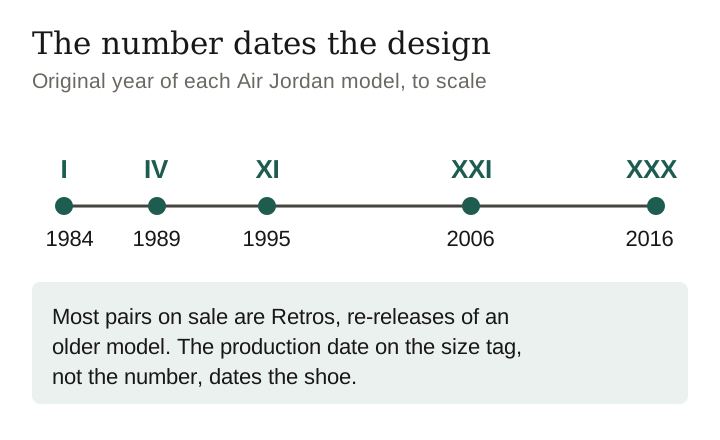
The numbered line, with its gaps
| Model | Original year | Designer, where the reference states one |
|---|---|---|
| Air Jordan I | 1984 (public release 1 April 1985) | Peter Moore |
| Air Jordan II | 1986 | Peter Moore and Bruce Kilgore |
| Air Jordan III | 1988 | Not stated in our source |
| Air Jordan IV | 1989 | Tinker Hatfield |
| Air Jordan V | 1990 | Tinker Hatfield |
| Air Jordan VI | 1991 | Not stated in our source |
| Air Jordan VII | 1992 | Not stated in our source |
| Air Jordan VIII | 1993 | Not stated in our source |
| Air Jordan IX | 1993 | Not stated in our source |
| Air Jordan X | 1994 | Not stated in our source |
| Air Jordan XI | 1995 | Tinker Hatfield |
| Air Jordan XII | 1996 | Not stated in our source |
| Air Jordan XIII | 1997 | Tinker Hatfield |
| Air Jordan XIV | 1998 | Tinker Hatfield and Mark Smith |
| Air Jordan XV | 1999 | Not stated in our source |
| Air Jordan XX | 2005 | Not stated in our source |
| Air Jordan XXI | 2006 | D'Wayne Edwards |
| Air Jordan XXIII | 2008 | Tinker Hatfield |
| Air Jordan XXX | 2016 | Tinker Hatfield |
Years and designers as given in the general reference article on the Air Jordan line. Rows marked 'not stated' are gaps in that source, left visible rather than filled from memory.
We have left the blank designer cells visible rather than filling them in. Sneaker reference material is heavily copied between sites and a confident attribution that traces back to nothing is worse than an acknowledged gap. If you need those attributions, go to the original release material rather than to a table like this one.
Retro, OG and what the words commit to
- Retro means a re-release of an earlier model. It appears in the product name itself and is the most reliable free dating clue you get: a shoe labelled Retro is not from the model's original year.
- OG is used two ways, which is where confusion starts — sometimes an original production run, sometimes a re-release in the original colourway. The word alone does not settle which.
- High, Mid and Low describe the collar height on the Air Jordan 1. In current retail these sat within about $10 of one another in our own 2 September 2026 pull, so the cut is a style decision rather than a price tier.
- SE, Alt and similar suffixes mark a variant of the standard make-up. They are not a quality grade.
Keep reading
Dating a pair by its details
The tells that actually separate one era of the same model from another:
- Heel branding. Reference material notes that 2013 Air Jordan 1 retros used the Jumpman logo on the heel where the 2000 retros used the Nike Air logo. Heel branding is the first place to look on a retro of any vintage.
- The production date on the size tag. Inside the shoe, and the only place the shoe states its own year rather than its model's.
- The style code. Also on the tag, and specific enough to identify the exact make-up when a photograph is not.
- Materials and stitch density. These vary between production runs of the same retro, which is why enthusiasts argue about years that share a model number.
What this means practically: a listing that says only "Air Jordan 1" has told you almost nothing about the age of the object. The number is a design lineage. The tag is the shoe.
The story on the I, checked
The Air Jordan I's reputation rests on a specific and verifiable episode. Nike built the shoe in red and black team colours with only about 23% white, against an NBA requirement that shoes be 51% white. Jordan was fined $5,000 per game, and Nike advertised the conflict directly: its ad gave 15 September as the day Nike created a revolutionary new basketball shoe, then added "On October 18th, the NBA threw them out of the game."
The commercial outcome is documented too: an initial 50,000 pairs, and more than $150 million in sales.
We have flagged one thing our source does not settle. The article gives 1984 for the model and states a public release of 1 April 1985; both dates circulate and they describe different events. We have printed both rather than picking the tidier one.
What the current catalogue looks like
One observation from the catalogue, because it changes how you read any listing. Of the Air Jordan listings we pulled from US retailer feeds on 2 September 2026, 209 were Air Jordan 1s and only a handful carried any other model number — a single Air Jordan 12 and a single Air Jordan 5 among them.
The numbered line has more than thirty entries. Current retail, at least through affiliate product feeds, is overwhelmingly one of them. If you are looking for a IV or an XI, you are looking at the resale market, and that is a fact about availability rather than about desirability.
Frequently asked
What year did each Air Jordan come out?
The I dates to 1984 with a public release on 1 April 1985, the IV to 1989, the XI to 1995, the XXI to 2006, the XXIII to 2008 and the XXX to 2016. The numbered line runs broadly one model per year.
What does Retro mean on an Air Jordan?
It is a re-release of an earlier model. A shoe labelled Retro is not from its model's original year, which makes the word the most reliable free dating clue on a listing.
How do I date an Air Jordan retro?
By the production date and style code on the size tag inside the shoe, and by heel branding. Reference material notes that 2013 Air Jordan 1 retros carried the Jumpman logo on the heel where 2000 retros carried Nike Air.
Why was the Air Jordan 1 banned?
It used red and black team colours with only about 23% white against an NBA requirement of 51% white. Jordan was fined $5,000 per game and Nike advertised the ban directly.
Is High, Mid or Low worth more?
Not systematically at retail. In our 2 September 2026 pull the three cuts sat within roughly $10 of each other, so the choice is a style decision rather than a price tier.
Method and scope
- Model years, designers and the 1985 release, ban and sales figures come from the general reference articles on the Air Jordan line and the Air Jordan I, read 2 September 2026 and cited in the body.
- Designer cells our source does not fill are marked 'not stated' rather than completed from memory.
- The 1984 model year and the 1 April 1985 public release both appear in that source and describe different events; both are printed.
- Catalogue observations come from CJ product feeds pulled live on 2 September 2026 with advertiser country set to the United States.
- We have not handled any of these shoes. Dating advice here describes marks and documentation, not physical inspection we performed.
Last verified 2 September 2026 against published Air Jordan reference material and 222 live US Air Jordan listings
How this page was made. Drafted with AI (Claude); not yet independently re-checked. How we work