LinkToLooks · Guides · Reference Desk
Reference Desk
Belt drive or direct drive: which turntable am I looking at?
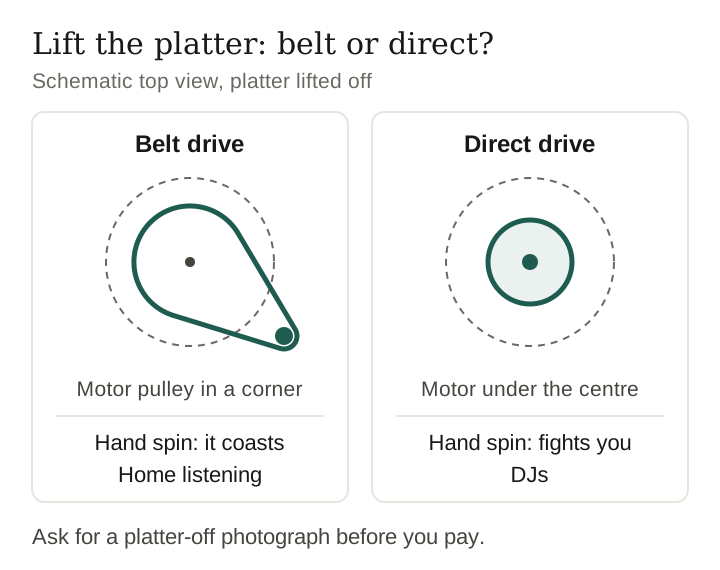
Take the platter off. A belt-drive turntable has a rubber belt running from a motor pulley to the underside of the platter; a direct-drive turntable has the motor directly beneath the platter centre with no belt at all.
Direct drive is what DJs use, because the platter keeps its speed when a hand touches it. Belt drive is what most home listening decks use, because a belt absorbs motor vibration.
The three-second check
- Belt drive: the platter lifts free, a flat rubber loop sits around the inner platter rim and a small motor pulley in one corner. Spin the platter by hand and it coasts.
- Direct drive: the motor spindle is the platter bearing. Lift the platter and you find a magnet ring and a stator board, no belt. Spin it by hand and it fights you.
- Idler wheel: the third and oldest design, a rubber wheel pressed between motor shaft and platter rim. Almost nothing new is built this way; if a listing says idler, it is vintage.
On a photograph, look at the platter edge and the plinth corners. A direct-drive deck built for DJs also carries a pitch fader beside the platter and a target light; a listening deck rarely does.
Why the difference exists at all
In a direct-drive design the motor sits under the centre of the platter and turns it without any coupling. That gives higher torque, so the platter reaches speed almost immediately and holds it when a stylus, or a hand, drags on the record. It also puts a spinning motor directly under the record, which is a vibration problem engineers spend money solving.
A belt takes the motor off-centre and swallows its vibration on the way to the platter. The cost is start-up time, torque, and a rubber part that perishes. Backspinning or scratching a belt deck stretches or snaps the belt, which is exactly why turntablism standardised on direct drive.
What each type asks right now
| Drive type | Listings priced | Cheapest | Median | Dearest |
|---|---|---|---|---|
| Belt drive | 0 | — | — | — |
| Direct drive | 0 | — | — | — |
| Suitcase and portable decks | 8 | — | — | — |
| Every turntable in this pull | — | — | — | — |
Withdrawn 10 September 2026. On 8 September this table carried a $95.99 median for all turntables. It was wrong, and we published it. A keyword pull for a physical object returns one large furniture advertiser’s catalogue of artwork and spare parts named after that object — 80% of those 398 rows were a single advertiser, including “Mini Cookie Turntable” and “SHAFT, TURNTABLE”. The figure was stable across read depths, which is exactly why our depth check passed it: a contaminated population settles beautifully. Caught by our own refresh run, which hit the same trap and read the rows before publishing.
Do not read a drive-type premium into that table. The two ranges sit on top of each other: belt drive runs from a $39.99 suitcase deck to a $2,000.00 acrylic plinth, direct drive from $109.99 to $1,299.99, and the direct-drive median rests on ten priced listings. What actually moves price here is who the deck is built for — a DJ booth, a hi-fi rack, or a bedside table.
The editorial judgment, for what it is worth: at the bottom of this market the drive type is the least of your problems. A $73.49 suitcase deck with a ceramic cartridge and a fixed tracking force wears records, and that is true whichever way its platter is turned.
Last verified 10 September 2026 against 49 live US turntable listings from 16 advertisers in the CJ product feed, after removing wall art, jewellery and appliance parts that share the word turntable. Peer-to-peer asks of $500 or more are excluded as seller placeholders, as are repdigit asks such as $999 and $9,999. Asking prices are what sellers want on this date; they are not sold prices.
Frequently asked about turntable drive types
How do I tell if a turntable is belt drive or direct drive?
Lift the platter off the spindle. A belt drive has a thin rubber belt looping from a motor pulley at the edge to the underside of the platter; a direct drive has the motor sitting under the platter centre with nothing between them. If the platter will not lift, look for the words in the listing: sellers state the drive type, because buyers filter on it.
Which is better, belt drive or direct drive?
Neither, in the abstract. Direct drive gives higher torque, faster start-up and survives backspinning, which is why turntablism runs on it. Belt drive isolates the platter from motor vibration. Buy direct drive to scratch or beat-match, belt drive to sit still and listen.
Are direct-drive turntables more expensive?
On 8 September 2026 not one listing in this pull names belt drive or direct drive in its title, so neither median can be measured at all. That is a fact about how retailers write titles rather than about the market, and it is the more useful finding: the specification a buyer most wants is the one sellers least often state. The honest reading is that the two ranges overlap almost completely and drive type is not what sets the price.
Can you scratch on a belt-drive turntable?
You can, and the belt will not thank you. Backspinning stretches and eventually breaks belts, and lower torque means the platter does not recover speed quickly. The reason direct drive took over DJ booths is that the motor keeps turning while the record is held.
Sources
- Wikipedia, Direct-drive turntable — the three drive designs, the motor-under-platter arrangement, torque and start-up behaviour, belt wear from backspinning, and Technics as the first direct-drive series.
- Wikipedia, Phonograph — platter, mat and tonearm terminology used above.
- CJ Affiliate product feeds, US advertisers, queried 1 September 2026 — every price figure on this page is computed from that pull.
Read next
Where to buy a turntable before Black Friday · How record grading actually works · Where to buy vinyl record storage
How this page was made. Drafted with AI (Claude); not yet independently re-checked. How we work