LinkToLooks · Guides · Reference Desk
Reference Desk
What do the vinyl grades M, NM, VG+ and VG actually mean?
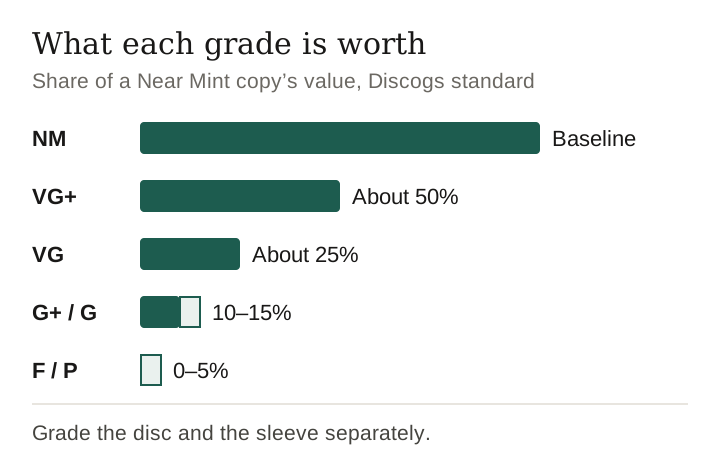
Record grading runs Mint, Near Mint, Very Good Plus, Very Good, Good Plus, Good, then Fair and Poor. The scale was standardised by the price guides of the 1970s and is used today almost everywhere records are traded.
The steps are not decorative: VG+ is worth roughly half a Near Mint copy, VG about a quarter, Good 10 to 15%, and Poor almost nothing.
The ladder, and what each rung is worth
| Grade | Worth, relative to Near Mint | What it means |
|---|---|---|
| Mint (M) | Reference point, rarely used | Absolutely perfect in every way. Almost certainly never played, possibly still sealed. Meant to be used sparingly, if at all. |
| Near Mint (NM or M-) | The working top of the market | A nearly perfect record that has more than likely never been played, with no obvious signs of wear. An LP cover has no creases, folds, seam splits or cut-out holes. |
| Very Good Plus (VG+) | About 50% | Played and handled by someone who took care. Slight scuffs or very light scratches that do not affect listening; slight warps that do not affect the sound; barely noticeable ring wear. |
| Very Good (VG) | About 25% | The VG+ defects, more pronounced. Surface noise is audible in soft passages and at intros and fades. Groove wear noticeable; scratches deep enough to feel with a fingernail. |
| Good (G) and Good Plus (G+) | About 10-15% | Plays through without skipping, but with significant surface noise, scratches and visible groove wear. Sleeve seam splits, tape, writing. |
| Fair (F) and Poor (P) | 0-5% | Cracked, badly warped, skips or repeats. The cover barely keeps the record inside it. |
Two things about that table repay attention. First, the percentages are the point: a grading argument between VG+ and VG is an argument about half the money. Second, the ladder compresses at the bottom — everything from Good downwards is within a few percent of worthless unless the record itself is scarce.
What sellers actually write
Almost nothing. Of 13 peer-to-peer vinyl listings in today's pull, 4 state a grade anywhere in the title or description — one 45 described as NM, one LP as VG with an NM sleeve, and two more as VG. 2 say sealed instead, which is a claim about packaging rather than a grade.
The rest describe condition in ordinary language, or not at all. That is not dishonesty; it is a marketplace whose sellers are clearing a shelf rather than trading with collectors. It does mean the burden is on the buyer, and that the right question is specific rather than general: not what condition is it in but hold it to a light and tell me if the scratches catch a fingernail.
Four questions worth asking before you buy
- Grade the disc and the sleeve separately. One number for both is not a grade, it is an impression.
- Does anything catch a fingernail? Light scuffs are cosmetic; a scratch deep enough to feel is what moves a record from VG+ to VG.
- Has it been played, and on what? A record played on a suitcase deck with a ceramic cartridge and a fixed tracking force wears differently from one played on a counterweighted arm.
- Is there a spindle mark ring or writing on the label? Both are visible in a photograph, and both are grade-relevant. Labels marred by writing, tape or stickers pull a record down to VG.
Last verified 1 September 2026. Grade definitions and the relative-value percentages are quoted from the Discogs Marketplace grading standard, which codifies the Goldmine scale. Listing counts come from 13 live peer-to-peer vinyl listings in the CJ product feed on that date.
Record grading, asked plainly
What does VG+ mean on a record?
Very Good Plus: a record that has been played and handled carefully. It shows light scuffs or very light scratches that do not affect listening, and slight warps that do not affect the sound. As a rule of thumb it is worth about 50% of the same record in Near Mint.
What is the difference between Mint and Near Mint?
Mint means absolutely perfect in every way, almost certainly never played and possibly still sealed; it is meant to be used sparingly, if at all. Near Mint, written NM or M-, is the practical top grade: a record that has more than likely never been played, with no obvious signs of wear.
Is a Very Good record worth buying?
For a common record, rarely. VG is worth roughly 25% of Near Mint value, surface noise is audible in quiet passages and intros, and groove wear is starting. For a scarce record it may be the only copy you will see; for a record pressed in millions it is not worth the postage.
Are the record and the sleeve graded separately?
Yes, and that is the most common mistake in a listing. A record can be Near Mint inside a Good sleeve with seam splits and ring wear. A seller who gives one grade for both is telling you about the half they looked at.
Sources
- Discogs, Marketplace Standards: Grading and Condition — the grade definitions and the relative values quoted above (VG+ about 50% of Near Mint, VG about 25%, Good 10-15%, Poor 0-5%), and the rule that sleeve and disc are graded separately.
- Wikipedia, Record collecting — how grading became standardised across the hobby through the price guides published from the 1970s, Goldmine among them.
- CJ Affiliate product feeds, US advertisers, queried 1 September 2026 — the listing counts above.
Read next
Where to buy record storage · Belt drive or direct drive? · Record Store Day releases still in stock
How this page was made. Drafted with AI (Claude); not yet independently re-checked. How we work