LinkToLooks · Guides · Creator Desk
Creator Desk
What is deep linking, and how do creators break it?
Part of: For creators
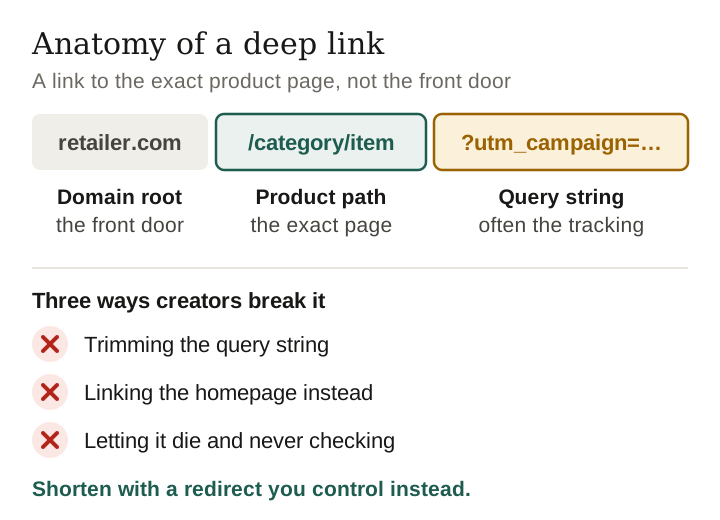
A deep link is a link to the exact product page rather than to a shop's front door. That is the whole definition, and it is also the whole reason affiliate revenue either happens or does not: a reader who lands on a homepage has to find the thing again, and most of them will not.
This page is what deep linking actually looks like in the data — product rows from US advertisers pulled on 1 September 2026 — and the three ways creators break it.
What a product feed actually hands you
Every row in an affiliate product feed carries a destination URL, and those URLs are already deep by construction — most rows in this pull point at a path several levels below the domain root rather than at the domain itself. The feed is not the hard part. What creators do to the link afterwards is the hard part.
A large share of these URLs already carry a query string, and the parameters in it are not decoration — they are how the merchant and the network agree on who sent the visit.

The three ways creators break a deep link
1. Trimming the query string because it looks ugly
It is the most common and the most expensive. The characters after the question mark are frequently the tracking. Strip them and you have built a link that works perfectly for the reader and pays nobody. If a URL looks too long to post, shorten it with a redirect you control, not by deleting the tail.
2. Linking to the homepage and describing the product in words
Every extra step between the click and the checkout costs conversions. This one costs several: the reader lands on a front page, has to search, gets a different result, and buys something else or nothing.
3. Letting the destination die and never checking
We measured this rather than asserting it. In a sample of live destination URLs from this pull, some had already 404'd. A dead deep link is worse than a homepage link, because it converts at exactly zero and it tells the reader the page is stale.
When a product is not findable from a retailer's homepage in under three clicks, the deep link is the reader's direct route to it, which is the entire argument for pointing at the page rather than the shop.
Why a redirect you control is worth building
Point your posts at a URL on your own domain that forwards to the merchant. It costs a little infrastructure and it buys three things that matter more each year:
- You can change the destination without editing the post. When a product goes out of stock or a programme changes, you repoint the redirect. The post stays as published.
- You can count the clicks yourself rather than waiting for a network dashboard, which is the difference between knowing a post worked this morning and knowing next month.
- You can find every dead link in one pass, because you hold the list.
The counter-argument, honestly: a redirect adds a hop, and a hop can break. Ours is the approach we run here — every outbound product link on this site goes through a first-party redirect — and it has already earned its keep in link repairs.
The part nobody mentions: some of these retailers will not let you check
When we checked those URLs, some advertisers refused the request entirely — links that returned 403 Forbidden, 429 Too Many Requests, or nothing at all, to an ordinary browser user agent. Their links may be perfectly alive. We simply cannot tell from a script.
The practical consequence for a creator running a link checker: a red row in your report is not proof of a dead link, and a checker that treats 403 as broken will send you chasing links that were never broken. Check the status code, not the colour.
Last verified 1 September 2026 against product rows from US advertisers in the CJ product feed, plus a live check of a sample of their destination URLs made during the same run.
Frequently asked about deep linking
What is a deep link in affiliate marketing?
A link to the specific product page rather than to the merchant's homepage or a category page. Affiliate product feeds supply these directly: most of the rows in this pull point at a product path rather than a domain root.
Can I remove the tracking parameters from an affiliate link?
No. The query string after the question mark is frequently the tracking itself, and removing it produces a link that works for the reader and credits nobody. Shorten with a redirect you control instead.
Should creators use their own redirect domain?
It is worth the setup. You can repoint a destination without editing published posts, count clicks without waiting on a network dashboard, and audit every link you have ever placed in one pass. The cost is an extra hop.
Why do my link checks show errors on links that work?
Because many retailers block automated requests. In our check, some advertisers returned 403, 429 or nothing to a scripted request with an ordinary browser user agent, so their links could not be verified either way.
Sources
- CJ Affiliate product feeds, US advertisers, queried 1 September 2026 — the URL structure described on this page. Link liveness and blocking behaviour measured directly during the same run.
How this page was made. Drafted with AI (Claude); not yet independently re-checked. How we work