LinkToLooks · Guides · Reference Desk
Reference Desk
Is this hobnail milk glass Fenton?
Hobnail milk glass is opaque white glass moulded with rows of raised bumps. At least four American factories made it, several made near-identical shapes, and almost none of it is marked. Here is how the identification actually works, and where it honestly stops.
First: hobnail is a pattern, not a maker
People say "Fenton" the way they say "Hoover", and it is costing them money. Fenton began selling Hobnail in 1940 in French, green and cranberry opalescent, and it became the company's best-selling line — but Westmoreland, Smith Glass and Anchor Hocking all produced hobnail milk glass too, and modern factories still press the pattern today. A photograph of bumps identifies nothing.
What the maker is actually worth
| Maker named in the listing | Listings priced | Cheapest | Median | Dearest |
|---|---|---|---|---|
| Fenton | 804 | $4.99 | $41.00 | $849.95 |
| Anchor Hocking | 21 | $4.99 | $19.99 | $99.95 |
| Westmoreland | 98 | $3.99 | $19.99 | $159.95 |
| Smith Glass | 105 | $3.99 | $23.99 | $139.95 |
That table is the reason identification matters. Fenton-named pieces ask a $41.00 median against $19.99 for Westmoreland and $23.99 for Smith Glass — roughly double, for glass that can be difficult to tell apart across a room. That gap is the durable finding: it read the same way a week earlier, at $39.99 against $19.99 and $19.99. The top of the Fenton range is $849.95; the top of the Westmoreland range is $159.95.
Marks: what to look for, and why it usually fails
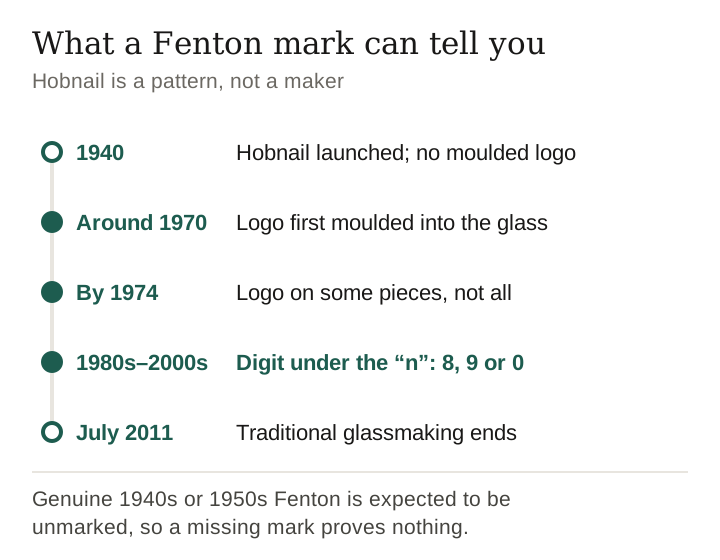
- Fenton did not mould its logo into glass until around 1970, and was only doing it on some pieces by 1974. A genuine 1940s or 1950s Fenton hobnail piece is therefore expected to be unmarked, and its absence proves nothing.
- When the moulded mark does appear, it carries a decade digit: an 8 under the "n" for the 1980s, a 9 for the 1990s, a 0 for the 2000s. That is the single most useful mark in this whole category, because it dates the piece outright.
- Early Fenton identification often depended on a paper oval sticker, which almost never survives a lifetime of washing up.
- Fenton stopped traditional glassmaking at Williamstown, West Virginia in July 2011. Nothing genuinely Fenton has been pressed since.
What actually distinguishes the makers
With no mark, you are working from the object. Check the shape against a known catalogue form rather than the pattern; check the rim treatment, since crimped, ruffled and plain rims differ by factory and by decade; check the foot, since a moulded ring foot and an applied foot are different manufacturing decisions; and check the weight, since post-war pressed glass runs heavier than 1970s and later output.
Our position, stated plainly: unmarked hobnail milk glass cannot be attributed from a photograph, and we do not attribute it. If a seller names a maker on an unmarked piece, they are telling you what they believe, not what they know. Buy unmarked hobnail because you like the shape and at the $19.99 to $23.99 end of the market, not the $41.00 end.
The reproduction problem
136 hobnail pieces in this pull are current retail stock from ordinary home retailers, at a $28.99 median. Several of their titles use the word "vintage" as a style descriptor. They are not deceptive — they are new goods described by their look — but a resold one, in a listing photo, looks the same as a genuinely old piece.
What the forms cost
| Form | Listings priced | Cheapest | Median | Dearest |
|---|---|---|---|---|
| Vase | 114 | $2.79 | $39.99 | $179.95 |
| Bowl | 155 | $6.99 | $49.99 | $649.95 |
| Basket | 86 | $15.99 | $67.45 | $539.95 |
| Epergne† | 8 | $11.99 | $47.99 | $339.95 |
Last verified 8 September 2026 against hobnail and milk glass listings from US advertisers in the CJ product feed, read to a depth of 800 rows for each of the keywords “fenton glass”, “milk glass” and “hobnail” and restricted to titles that also name a glass form, which keeps Fenton-branded lighting and a typeface of the same name out of the maker rows. The listing counts here are larger than 1 September’s because this read went further into the same feed; the medians do not depend on that depth and held to within a dollar across the last three depths of the pull. † The epergne row is the exception and is still 1 September’s figure: its median was still moving with depth tonight, on sixteen listings, so it was not restated. Maker rows count listings whose seller names that maker; they are not authenticated attributions. Peer-to-peer asks of $500 or more and repdigit asks are dropped as placeholders.
Frequently asked
How can I tell if my hobnail milk glass is Fenton?
Look for a moulded Fenton logo on the base. Fenton only began moulding its logo around 1970 and was doing so on some pieces by 1974, so genuine earlier Fenton is normally unmarked and cannot be attributed from a photograph.
What does the number under the Fenton logo mean?
The decade. An 8 under the "n" means the 1980s, a 9 the 1990s and a 0 the 2000s. It is the most reliable dating mark in hobnail milk glass.
Who else made hobnail milk glass besides Fenton?
Westmoreland, Smith Glass and Anchor Hocking all did, and modern factories still press the pattern. In this pull Westmoreland pieces ask a $19.99 median against $41.00 for Fenton-named ones.
Is hobnail milk glass still being made?
The pattern is. Fenton itself stopped traditional glassmaking in July 2011, but 136 new hobnail pieces from ordinary US home retailers appear in this pull at a $28.99 median, some of them described as vintage-style.
Sources
- Wikipedia, Fenton Art Glass Company — the 1905 founding, the 1940 Hobnail launch, the logo moulding from around 1970 and on some pieces by 1974, the decade-digit system, and the July 2011 end of traditional glassmaking at Williamstown.
- CJ Affiliate product feeds, US advertisers, queried 1 September 2026 — every price figure here.
Read next
Where to buy milk glass vases · Tiffany-style or real Tiffany? · What is Spode Christmas Tree china worth?
How this page was made. Drafted with AI (Claude); not yet independently re-checked. How we work