LinkToLooks · Guides · Reference Desk
Reference Desk
Tiffany-style or real Tiffany: how to tell
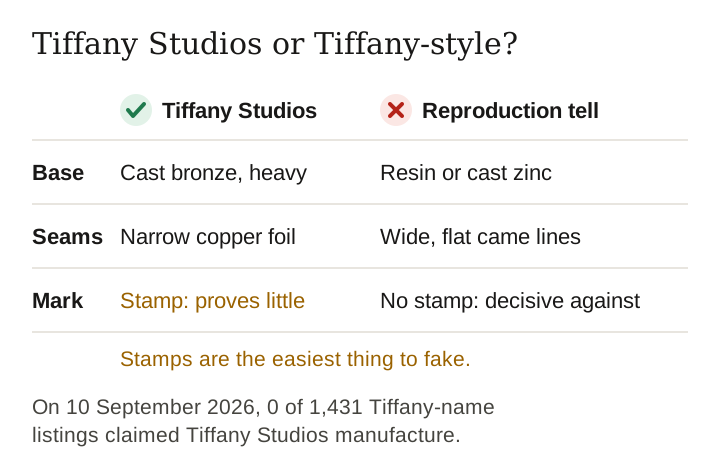
A reference for telling Tiffany Studios lamps from the Tiffany-style lamps that fill the retail market. Last verified 10 September 2026.
The finding that frames everything
Across 1,431 priced lamp listings using the Tiffany name from 14 US advertisers on 10 September 2026, 0 claim to be Tiffany Studios. Not one mentions L.C.T., Favrile or Louis Comfort Tiffany. That was 0 of 146 when this page was written on 1 September; re-reading the category ten times as deep returns the same answer over ten times the listings. The entire affiliate retail market in this category is reproductions, and it is not hiding that — the listings say "Tiffany-style", which is accurate.
Exactly one listing in the 1,431 uses the word authentic: a $54,478.99 table lamp described as an "Authentic Tiffany Turning Leaf Table Lamp". Read it carefully and it still does not claim Tiffany Studios manufacture — authentic is doing the work that Tiffany-style does everywhere else on the shelf, at a price where a buyer might reasonably think it meant provenance. It does not. The base and the solder lines are still the test.
The price table above keeps its 1 September date. A 10 September pull on the Tiffany-lamp keyword returns a dearer population than the one that table was built from — a $329.99 category median against $138.99, and no read depth of tonight's pull produces the old figure — and the page does not record which query produced its 146 rows, so there is no way to re-measure the same selection. Replacing the numbers would be answering a different question in the old question's row, so they stand with the date they were true on.
So the practical question is almost never "is this retail lamp genuine". It is "is the lamp at the estate sale genuine", and that is answered from the object.
What a genuine Tiffany Studios lamp is
- Made between roughly 1893 and the late 1920s by Tiffany Studios in New York.
- Assembled with the copper-foil technique, not traditional lead came. Each glass piece is wrapped in copper foil and soldered, which gives finer, more even seam lines than came work.
- Bronze bases cast in-house. The base is part of the object, not a bought-in fitting.
- Marked. Early pieces carry Favrile marks; later ones carry L.C.T., the initials of Louis Comfort Tiffany.
- Largely designed by Clara Driscoll, identified in 2007 by the Rutgers scholar Martin Eidelberg as the designer behind the most creative and valuable of the leaded-glass lamps — an attribution that rewrote the field.
Five checks, in order
- Lift the base. Bronze is heavy and cold. Resin, spelter and cast zinc are not. 11 listings in this pull name resin outright, at a $112.99 median.
- Look for a stamp on the base underside — Tiffany Studios New York with a model number, or L.C.T. Absence is decisive against; presence proves less than people think, because stamps are the easiest thing to fake.
- Read the seam lines. Copper foil gives narrow, even solder lines that follow the glass. Wide, flat came lines mean a different construction method entirely.
- Hold the glass to light. Tiffany used opalescent and mottled glass with colour and texture within the sheet. Painted or surface-coated glass is a reproduction tell.
- Check the price you were quoted. Genuine Tiffany lamps have sold for $770,000 in 1992, $2.8 million in 1997 and $4.4 million in 2025. Nobody is selling one at an estate sale for four figures.
What the reproduction market costs
| Type | Listings priced | Cheapest | Median | Dearest |
|---|---|---|---|---|
| All Tiffany-name lamps, as of 1 Sept | 146 | $66.99 | $138.99 | $3187.56 |
| Table lamps, as of 1 Sept | 111 | $66.99 | $132.99 | $1645.08 |
| Floor lamps, as of 1 Sept | 11 | $156.56 | $219.99 | $599.99 |
| Dragonfly pattern, as of 1 Sept | 24 | $71.99 | $126.99 | $484.99 |
| Wisteria pattern, as of 1 Sept | 3 | $129.99 | $165.99 | $573.86 |
Dragonfly and Wisteria are Tiffany Studios designs, and as of 1 September 2026 the reproduction market reproduced them by name at $126.99 and $165.99. A pattern name is therefore not evidence of anything — it is the most-copied part of the whole design.
Our position
Nothing is wrong with a Tiffany-style lamp. Meyda and Dale Tiffany have made stained-glass lighting since the 1960s and some of it is good. What is wrong is the word "Tiffany" doing two jobs, and the second job being worth six figures. Our rule: a lamp is Tiffany Studios when it is marked, bronze, copper-foiled and provenanced. Three out of four is a nice lamp.
Last verified 10 September 2026 against 1,431 priced Tiffany-name lamp listings from 14 US advertisers, matched inside a 3,000-row CJ product-feed pull, 0 of them claiming Tiffany Studios manufacture. The price table keeps its 1 September figures and date, for the reason stated beside it. Auction records are from published reporting, not from this feed.
Frequently asked
How can I tell a real Tiffany lamp from a Tiffany-style one?
Check the base first: genuine Tiffany Studios bases are cast bronze and heavy, and reproductions commonly use resin or cast zinc. Then look for a Tiffany Studios New York or L.C.T. stamp underneath, and for the narrow, even solder lines that copper-foil construction produces.
What does "Tiffany-style" mean?
It means a leaded or stained-glass lamp in the Tiffany manner made by someone else, from the 1960s onward. It is an accurate description, not a deception, and it covers every Tiffany-name lamp in this pull of 1,431 priced US listings.
How much is a real Tiffany lamp worth?
Six and seven figures. Recorded sales include $770,000 for a cobweb lamp in 1992, $2.8 million for a lotus table lamp in 1997 and $4.4 million for a magnolia floor lamp in 2025.
Who actually designed Tiffany lamps?
Many of the most valuable leaded-glass designs were the work of Clara Driscoll, identified in 2007 by Martin Eidelberg of Rutgers as the master designer behind them, rather than Louis Comfort Tiffany personally.
What does L.C.T. mean on a lamp?
The initials of Louis Comfort Tiffany, used as a mark on later Tiffany Studios pieces. Earlier work carries Favrile marks instead.
Sources
- Wikipedia, Tiffany lamp — the 1893 to late-1920s production window, the copper-foil technique, in-house bronze bases, the Favrile and L.C.T. marks, Clara Driscoll's 2007 attribution by Martin Eidelberg, the 1992, 1997 and 2025 auction records, and the 1960s origin of Tiffany-style reproductions.
- CJ Affiliate product feeds, US advertisers, queried 1 September 2026 — every price and listing count on this page.
Read next
Mid-century lamps under $200 · Is this hobnail milk glass Fenton? · Solid brass or brass plated?
How this page was made. Drafted with AI (Claude); not yet independently re-checked. How we work