LinkToLooks · Guides · Reference Desk
Reference Desk
Fountain pen nibs, identified
Point size, point shape and metal are three separate markings — and only one of them is standardised at all.
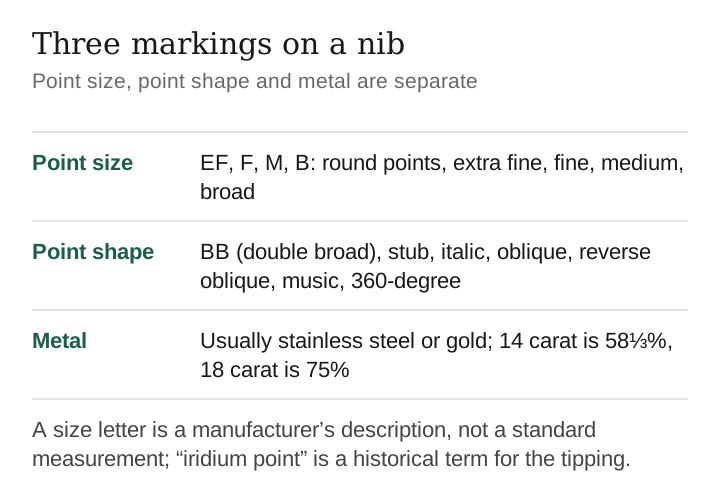
A fountain pen nib carries three separate pieces of information: the point size, the point shape, and the metal. Round points run extra fine, fine, medium and broad; other shapes include double broad, music, oblique, reverse oblique, stub, italic and 360-degree. The metal is usually stainless steel or gold, and the two most common gold alloys are 14 carat (58⅓%) and 18 carat (75%).
This is a reference page rather than a recommendation. Everything about the objects comes from Wikipedia’s fountain pen article and its article on nibs, both fetched on 4 September 2026.
Point sizes and shapes
Most nibs end in a round point in one of four sizes, with a longer list of specialist shapes alongside them.
| Marking you will see | What it is |
|---|---|
| EF, F, M, B | Round points: extra fine, fine, medium, broad |
| BB | Double broad |
| Stub | A flat point smaller than a broad, giving line variation |
| Italic | A flat, sharper-cornered point for calligraphic hands |
| Oblique / reverse oblique | Points ground at an angle, for writers who rotate the pen |
| Music | A nib whose line varies from broad to fine, suited to writing musical scores |
| 360-degree | Listed among the available specialist shapes |
Last verified 4 September 2026 against the cited Wikipedia articles, fetched 4 September 2026
One caution for anyone shopping by letter: a size letter is a manufacturer’s description, not a standard measurement, and the source does not give millimetre equivalents. Two pens marked M can differ.
Broad, pointed and stub: three different tools
Broad nib
- Also called broad-edge or chisel-edge, and described as the older of the two main nib types.
- Rigid, with a flat edge.
- Held at a constant angle; thick and thin strokes come from changing the direction of the stroke, not the pressure.
Pointed nib
- Flexible, coming to a sharp point rather than a broad edge.
- Line width comes from pressure: pushing down splays the tines and widens the slit, letting more ink through.
- Lighter pressure flexes the tines less and gives a finer line.
Stub nib
- Described as lying somewhere between a broad and a pointed nib.
- Comes to a flat point like a broad nib, so a downstroke is wider than a cross-stroke.
- Generally smaller than a broad nib, though the source notes the difference is one of degree rather than kind.
Keep identifying
What the metal stamp tells you
Nibs today are usually stainless steel or gold, and the article gives the most popular gold alloys as 14 carat — 58⅓% — and 18 carat, 75%. Titanium is described as a less common nib metal. Gold is described as the optimum metal for flexibility and corrosion resistance, with the article adding that corrosion resistance matters less today than it once did.
So a 14K or 18K stamp tells you the alloy and, by implication, something about flexibility and price. It does not tell you the point size or shape, which is why nibs usually carry a separate letter.
Tipping, and why iridium is on the box
Gold and most steel and titanium nibs are tipped with a hard, wear-resistant alloy — the tipping is the part that actually touches the paper. The history explains the vocabulary: the modern nib is traced back to a gold nib with a tiny fragment of ruby attached as a wear-point, and after the platinum-group metals were discovered, iridium was used on the iridium-tipped gold dip pen nibs of the 1830s.
That is why “iridium point” is stamped on so many pens. It is a historical term for the tipping, and the source does not say that modern tipping alloys are iridium.
What makes a nib flexible
Flexibility is given to nibs in several ways, and the article names two directly:
- The thickness of the metal. Thickly pressed nib alloy gives a hard nib; thinly pressed gives a more flexible one. Nibs can be pressed thinner at the tip and thicker at the feed to soften stiffness or give a more controlled flex.
- The curve of the nib, which partly determines how it behaves under pressure.
A practical consequence for anyone buying secondhand: flex is a property of the nib’s geometry and metal, so it cannot be adjusted by ink or paper, whatever a listing implies.
What pens cost right now
From our pull of 89 US fountain pen listings on 4 September 2026: a $21.24 median, most listings between $3.69 and $225.00, across 16 retailers.
Feed listings very rarely state the nib size, let alone the shape or alloy, so the product page is where you have to look:
Black - Clarity Fountain Pen
- Listed by Hobby Lobby at $8.39 against a $13.99 list price
- Availability as the retailer states it: in stock
- View the listing at Hobby Lobby
Fountain Pen - Women's XL
- Listed by Woot! at $19.00
- Availability as the retailer states it: in stock
- View the listing at Woot!
Frequently asked
What do EF, F, M and B mean on a fountain pen?
They are round point sizes — extra fine, fine, medium and broad. They are manufacturers’ descriptions rather than a standardised measurement.
What does “iridium point” mean on a nib?
It is a historical term for the hard, wear-resistant tipping alloy. Iridium was used on iridium-tipped gold dip pen nibs in the 1830s; our source does not say modern tipping is iridium.
Is a gold nib better than steel?
Gold is described as the optimum metal for flexibility and corrosion resistance, with the caveat that corrosion resistance matters less now. The common alloys are 14 carat and 18 carat. We have not used any pen and make no recommendation.
What is the difference between a stub and an italic nib?
Both come to a flat point. A stub is described as lying between a broad and a pointed nib and is generally smaller than a broad nib; italic is listed among the specialist shapes alongside stub.
Sources and limits
Object facts: Fountain pen and Nib (pen), both fetched 4 September 2026, both HTTP 200. Prices: CJ shoppingProducts, our companyId, keywords: “fountain pen”, twelve pages of 100 rows, US view post-filtered on each row’s own targetCountry.
What we cannot tell you. We have not written with, handled or inspected any pen or nib, so nothing here ranks one against another. Nib size letters are not standardised and the sources give no millimetre equivalents, so this page cannot tell you how wide a particular M nib writes. Brand-specific conventions vary and are outside what these sources cover.
How this page was made. Drafted with AI (Claude); not yet independently re-checked. How we work