LinkToLooks · Guides · Creator Desk
Creator Desk
How many affiliate networks does one storefront need?
The number of networks you need is decided by the shape of your own link list. Here is how to measure that shape, and the part of it nobody can cover.
Part of: For creators
The short answer. Usually one network, chosen against your own link list, and a second chosen for the gap the first leaves. Stop counting networks and look at the shape of your list first, because the shape decides the answer: how many retailers it takes to carry half your links, four fifths of them, and nineteen in twenty. The honest ending is that the last slice is not coverable at any number of networks, and that is a fact about long tails rather than a planning failure.
Mercari’s help centre last checked 8 September 2026.
Find your own curve
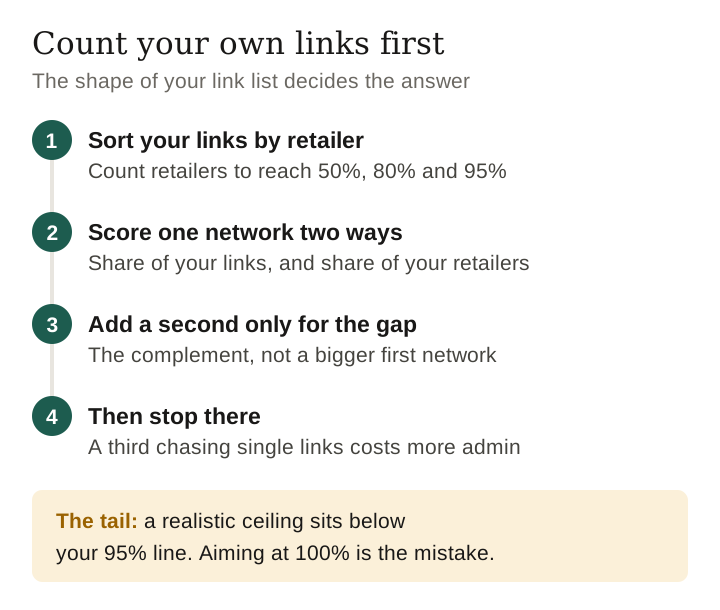
Export every link you have published to a retailer, reduce each one to its registrable domain, count links per retailer and sort from most to least. Then walk down the sorted list with a running total and write down how many retailers it takes to reach each line below. The shape is what you are after; nobody else’s numbers will tell you yours.
| To cover this share of your links | Count the retailers it takes | What the count tells you |
|---|---|---|
| 50% | Your first count | If it is a handful, half your links sit with a few companies. |
| 80% | Your second count | Compare it with the first: a small jump means your list is concentrated. |
| 90% | Your third count | If it is far above the 80% count, the curve has flattened and each new retailer buys very little. |
| 95% | Your fourth count | The line past which an application buys a sliver of your links. |
| 99% | Your fifth count | If it is close to your whole list, that remainder is the tail. |
The interesting part is the gaps between your counts. If reaching 80% takes a short list and getting from 95% to 99% takes most of the rest, that is not a gentle diminishing return, it is a cliff, and it is the reason “how many networks do I need” has no answer until you have looked at your own distribution.
While you are there, count the retailers that appear exactly once. Whatever you do about networks, single links are never going to repay an application each.

Score one network two ways
Take the network you are considering and mark every retailer on your list that it carries, confirming each match with a destination URL from its catalogue. Then compute two numbers: the share of your links that go to a covered retailer, and the share of your retailers it covers.
Those two numbers are the same fact seen from two ends, and the gap between them is the whole story of this page. A single network can reach most of your volume while covering a minority of the names, because volume concentrates at the head and names spread across the tail.
So: if your question is “how much of what I have already published could start earning”, the link share is the answer. If your question is “how often will I write about something I cannot link”, the retailer share is.
When a second network is worth it
The arithmetic is unromantic. A second network is worth applying to when the retailers it adds carry enough of your links to beat the cost of running a second dashboard, a second payment threshold and a second set of terms.
Three questions settle it, in order:
1. What do the uncovered retailers actually carry?
Add up the links that go to retailers the first network does not carry, and look at how they are spread. A second application is worth it when that slice is a real share of your output and concentrated enough at its own head that a few names carry most of it.
2. Does the candidate network actually carry them, or merely look plausible?
Check by name and then confirm by destination URL, because directory search misleads in both directions. This is the step that turns a plausible second network into a verified one, and it is the step people skip.
3. Is the overlap with network one large enough to be pointless?
Two networks that both carry your top five and neither of which carries your tail is one network with extra admin. What you want from number two is the complement, not a bigger version of number one.
The part no number of networks reaches
There is a floor under this exercise and it is worth naming, because planning around it is cheaper than discovering it.
Some retailers have no creator programme at all. Not on a network you have not tried — none. We looked for one at Mercari on 8 September 2026 and found no affiliate or creator-earnings section anywhere in its own help-centre navigation. A link there cannot be monetised by joining anything.
Some programmes exist and are empty. A network directory can list an advertiser whose product catalogue carries nothing. An approval into one of those buys nothing, so look at the catalogue before you apply.
And coverage is not approval. Every count in the procedure above measures programmes you could apply to. We hold no approvals ourselves, so we are in no position to convert coverage into income, and neither is anyone reading a coverage table.
Put together: a realistic ceiling is somewhere below your 95% line, it is reached with far fewer networks than the tail suggests, and the remainder is structural. Aiming at 100% is the mistake this whole page exists to prevent.
A rule of thumb that survives contact
- One network, chosen against your own list, if a handful of retailers carry half your links.
- A second, chosen for the complement, once the uncovered slice is a real share of your links and its own head is concentrated.
- Stop there until something changes. A third network chasing single links costs more admin than it returns.
- Re-run the count twice a year, not because networks change quickly but because what you link does.
Frequently asked
How many affiliate networks does a creator need?
Usually one, chosen against your own link list, and a second for the retailers the first does not carry. Count your own links first: if a handful of retailers carries most of them, a small number of relationships covers most of your volume.
Why can one network cover most of your links but few of your retailers?
Because link volume concentrates at the head of the list and retailer names spread across the tail. The two scores answer different questions: what you can monetise today, and how often you will hit a gap writing something new.
Can I ever cover all my links?
No. Some retailers run no creator programme at all, some programmes list an empty catalogue, and coverage is not the same as being approved.
Is it worth applying to a network for one retailer?
Rarely. A retailer you have linked once will not repay an application, a dashboard and a payment threshold.
How often should I redo this count?
Twice a year is enough. What changes is your own linking, not the network directories.
What this page cannot tell you
Which network to join. That depends on your list, and a page that named one without seeing your list would be guessing. It cannot tell you whether you will be approved either: every count in the procedure above measures programmes you could apply to, not ones that have accepted you. And if you built your link list from one network’s product feed, do not use that list to grade that network — the overlap is partly circular and will read high. A list assembled from what your audience asked about, before any network was involved, is the fairer test.
How this page was made. Drafted with AI (Claude); not yet independently re-checked. How we work