LinkToLooks · Guides · Creator Desk
Creator Desk
Rank networks against your own links, not their catalogue
The procedure takes an afternoon and beats every abstract ranking, because it scores networks against the one list that matters: yours.
Part of: For creators
Take a position first. Every “best affiliate network” article ranks networks in the abstract, which is the one way of ranking them that cannot be right for you. A network is good or bad relative to the retailers you already link, and that is a list you own and can count in an afternoon. This page is the procedure, and how to read what it gives you.
Why the usual ranking is the wrong shape
The standard article ranks networks on catalogue size, brand names and commission rates. Two of those three are close to meaningless for the decision you are making.
Catalogue size is a property of the network, not of you. A network with two hundred million products is worth nothing to a creator whose audience buys from six retailers, none of which are on it. Size answers “how big is this company”, and you were asking “can I link the things I link”.
Brand names are a sampling artefact. The recognisable retailers in a network’s marketing copy are the recognisable retailers. They tell you nothing about the long tail, which is where most creators actually spend their links.
Rates matter, but later. A rate on a retailer you never link is a rate of zero. Coverage is the gate; rate is the tiebreak once two networks both cover you.
The measurement that fits the decision is coverage against demand, and the demand side is data you already have: the links you have already published.

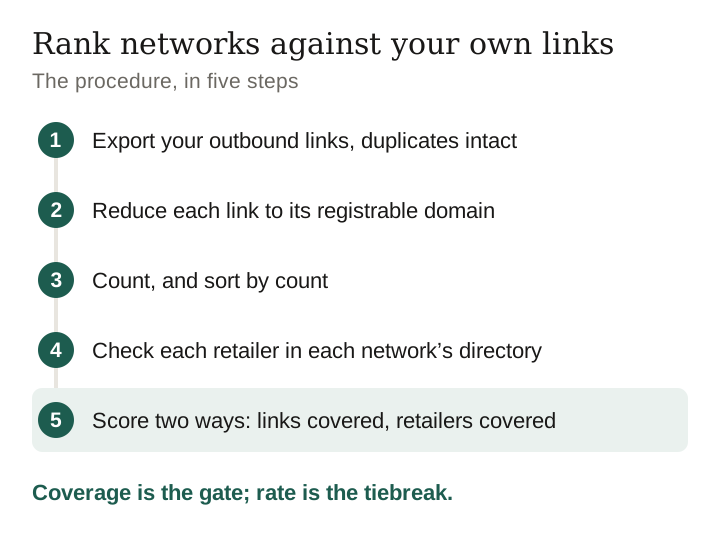
The procedure, in five steps
1. Export your outbound links
Every link you have published to a retailer, from wherever they live: your storefront, your link-in-bio page, your blog, your caption archive. You want the raw list with duplicates intact, because a retailer you linked forty times is worth forty times a retailer you linked once.
2. Reduce each link to its registrable domain
Strip protocol, strip www, and collapse subdomains. This step is not cosmetic: retailers that split departments across subdomains will otherwise appear as several different companies and quietly understate their own importance to you.
3. Count, and sort by count
You now have your demand curve. Look at it before you look at any network. Most creators are surprised by how few names carry the top half.
4. Check each retailer against each network’s directory
Search on the shortest distinctive token, read every result rather than the first, and confirm with a destination URL from the candidate’s own catalogue. Directory search fails in both directions and we have written up exactly how, because this step is where the exercise goes wrong.
5. Score two ways, not one
Compute share of links covered and share of retailers covered. They are different numbers and they answer different questions. The first tells you how much of your existing traffic a network could monetise today; the second tells you how often you will hit a retailer it does not carry when you write something new.
How to read your own table
Three readings, in the order they usually matter.
- A network that covers most of your links is a first application. It monetises most of what you have already published, which is the fastest thing you can do with old posts.
- A big gap between link share and retailer share means you will need a second network eventually, but not urgently. Your volume is concentrated; your variety is not.
- A network that covers many retailers but few of your links is the wrong first move, however impressive its directory. It is breadth you are not using.
One trap to avoid. If you built your link list from a network’s own product feed, do not use that list to grade that network: a retailer’s presence in your list is then not independent of its presence in the directory, and the score will read high. A list assembled from what you wanted to recommend, before any network was involved, is the independent evidence the procedure needs.
And one thing the table cannot decide for you: whether a retailer you link a lot would actually approve you. Coverage says the programme exists. It says nothing about whether you get in, and that is a separate question with a separate answer for every advertiser.
Frequently asked
How do I choose an affiliate network?
Rank networks against the retailers you already link, not against catalogue size or brand names. Export your outbound links, collapse them to registrable domains, count and sort, then check each retailer against each network’s directory and score both the share of links covered and the share of retailers covered.
Why compute two coverage scores instead of one?
Because they answer different questions and they can be far apart: one network can cover most of your links and a minority of your retailers at the same time. Link share tells you what you can monetise today; retailer share tells you how often you will hit a gap writing something new.
Does a bigger affiliate catalogue mean better coverage for me?
No. Catalogue size is a property of the network. Coverage is a property of the overlap between the network and your own link list, and two creators can get opposite answers from the same network.
How many links do I need before this is worth doing?
Enough that the top of your list is stable — in practice a few dozen. Below that you are measuring which posts you happened to write, not what you link.
Should I pick the network with the highest commission rate?
Rate is the tiebreak, not the gate. A rate on a retailer you never link is worth nothing, so settle coverage first and compare rates between the networks that pass.
What this procedure cannot tell you
Approval, as above: coverage counts programmes you could apply to, not ones that accept you. Name matching against a directory also errs in both directions, even after you treat regional and divisional names as the same company, so confirm each match with a destination URL before you count it. And we hold no network approvals ourselves, so this page describes a method, not an outcome we have seen.
Keep reading
How this page was made. Drafted with AI (Claude); not yet independently re-checked. How we work