LinkToLooks · Guides · Reference Desk
Reference Desk
Which American Girl doll is this? Start with the face mould
Hair, eyes and skin tone all vary inside one mould, so they identify nothing. The mould has a published release year, and that is a date floor.
Start with the face mould, because it narrows a shelf of lookalike dolls to a handful in one glance, and it is the one feature a reseller almost never lists. American Girl has released thirteen face moulds for its 18-inch dolls, twelve of them still in use as of 2026. Hair, eyes and skin tone all vary within a mould, so those three tell you very little on their own. The mould is the fixed point.
The moulds are named after the first character to use each one, and the release years are published. That gives you something better than a name — it gives you an earliest possible date for the doll in front of you.
What a face mould is
A face mould, sometimes called a head mould, is the cranial and facial shape a doll’s head was cast from. Two dolls sharing a mould can look entirely different once you change the eye colour, the hair and the skin tone, which is precisely why the mould is useful: the variable features are the ones that confuse you, and the mould is underneath all of them.
Two details from the American Girl Wiki’s reference page are worth carrying with you. Every mould is deliberately slightly asymmetrical, to mimic the natural asymmetry of a human face. And the company does not assign a racial designation to any mould — any mould could in principle appear with any combination of skin, hair and eyes, which the Create Your Own line demonstrates directly.
The same page notes that remoulding over the years produces slight variation within a single named mould. So treat the mould as a strong narrowing signal rather than a fingerprint.
The moulds and their release years
| Mould | Released | First used for | Status |
|---|---|---|---|
| Classic | 1986 | Kirsten, Samantha and Molly | in use |
| Addy | 1993 | Addy | in use |
| Asian | 1995 | Just Like You 4 | retired 2011 |
| Josefina | 1997 | Josefina | in use |
| Kaya | 2002 | Kaya | in use |
| Jess | 2006 | Jess | in use |
| Sonali | 2009 | Sonali | in use |
| Marie-Grace | 2011 | Marie-Grace | retired 2014, returned 2022 |
| Nanea | 2017 | Nanea | in use |
| Joss | 2020 | Joss | in use |
| Makena | 2021 | Makena | in use |
| Corinne | 2022 | Corinne | in use |
Source: American Girl Wiki, Face Mold, read 4 September 2026. Thirteen moulds have been released in total and twelve are in use as of 2026.
Using a release year as a date floor
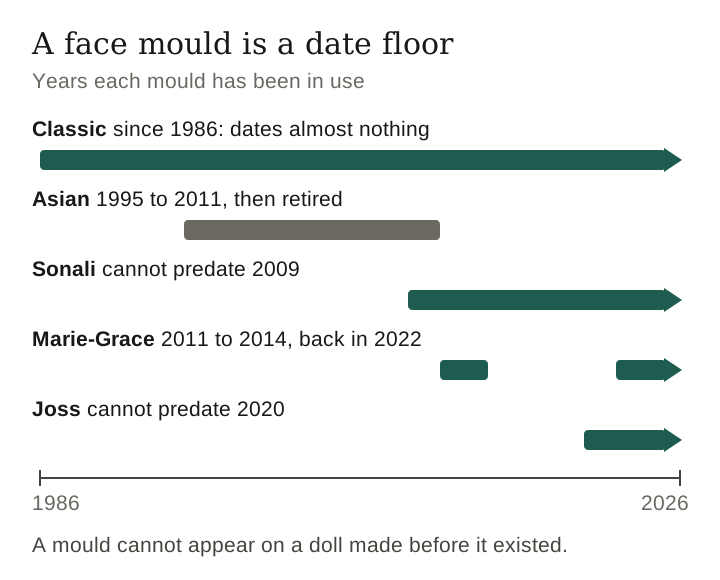
This is the part that turns a name into evidence. A mould cannot appear on a doll made before the mould existed, so identifying the mould gives you an earliest possible year for the doll.
- A doll on the Joss mould cannot predate 2020.
- A doll on the Sonali mould cannot predate 2009, whatever the seller believes about it being from “the nineties”.
- The Classic mould has been in use since 1986, so it gives you almost no upper bound — it narrows the field and dates nothing. Say so rather than pretending otherwise.
- The Asian mould is the useful closed case: released 1995, retired 2011, and used only for one doll. If you have positively identified it, you have a sixteen-year window and a single product.
A retired mould that later returned — Marie-Grace, retired in 2014 and back in 2022 — is the trap in this method. It gives you two possible eras and no way to choose between them from the face alone.
Three things that are not identification
- Hair colour and style. The most-quoted feature in resale listings and the least diagnostic. It varies within a mould by design, and it can be cut, restyled or replaced by an owner.
- The outfit. Clothing separates from dolls constantly on the resale market. An outfit tells you what somebody put on the doll, which is a different fact from what the doll is.
- The seller’s title. Titles on marketplace listings are written to be found, not to be accurate. Read the seller's photographs against the mould list instead.
Our editorial judgment, offered as an opinion rather than a fact: if you can only check one thing from a photograph, check the face at an angle rather than head-on. Moulds differ most in the cheek and chin profile, and a straight-on portrait flattens exactly the information you need.
What the resale market actually holds today
We pulled the affiliate catalogue for this term so the shopping half of the page is dated rather than assumed.
| Measured 4 September 2026 | Value |
|---|---|
| US listings returned for “american girl doll” | 390 |
| Distinct retailers | 10 |
| Median asking price | $25.00 |
| 10th to 90th percentile | $10.00 to $119.99 |
| Marked in stock | 381 |
| Largest single retailer | Poshmark, 359 listings |
Last verified 4 September 2026 against a live affiliate catalogue pull of 390 US listings for this term
The shape of that table is the useful part. One resale marketplace is 92 per cent of everything returned, and the brand’s own listings are a small minority of the rows. A search for this term is overwhelmingly a search of the secondhand market, which is worth knowing before you read a price as a market rate.
The percentile spread says the same thing differently: a range from $10.00 to $119.99 is not one product with a price. It is dolls, books, single accessories and outfits all answering to the same words.
Frequently asked
How many American Girl face moulds are there?
Thirteen have been released for the 18-inch dolls and twelve are in use as of 2026, according to the American Girl Wiki reference page.
Does the mould tell me the doll’s exact year?
No. It gives you an earliest possible year, because a mould cannot appear before it was released. Long-running moulds like Classic, in use since 1986, give you almost no upper bound.
Can two different characters share a mould?
Yes, routinely. The Classic mould was first used for Kirsten, Samantha and Molly together. Sharing a mould is normal and is why hair and eyes cannot identify a doll on their own.
Do the moulds correspond to ethnicities?
The company assigns no racial designation to any mould, and any mould can in principle be produced with any combination of skin, hair and eye colour.
Method and sources
The mould list, release years and first-use characters are from the American Girl Wiki Face Mold page, read on 4 September 2026; it is a community reference and we have quoted it rather than restating it from memory. Background on the line is from Wikipedia’s American Girl article. The market figures are a single affiliate catalogue pull taken, filtered to rows whose own country field reads US, deduplicated on retailer, title and destination URL. That pull is a keyword sample of one network and not a census of the resale market. We have not handled any doll in this article; every identification signal described here is one you apply to the object yourself.
How this page was made. Drafted with AI (Claude); not yet independently re-checked. How we work