LinkToLooks · Guides · Reference Desk
Reference Desk
Kilim or dhurrie? Identified
Two flatweave traditions that listings treat as one word. The fibre settles it, and half of listings do not state it.
Identified. Both are flatweave rugs with no pile, which is why listings use the words interchangeably and why the photographs look alike. They are not the same thing. A kilim is a flat tapestry-woven carpet from the lands of the former Persian Empire — Iran and Turkey, and also the Balkans and the Turkic countries — traditionally wool, and its slit-weave technique leaves visible gaps where two colours meet. A dhurrie is a handwoven flat carpet from the Indian subcontinent, characteristically cotton, and most often striped.
Last verified 8 September 2026 against 98 live US area rug listings and two public reference articles
Three tells, in order of reliability
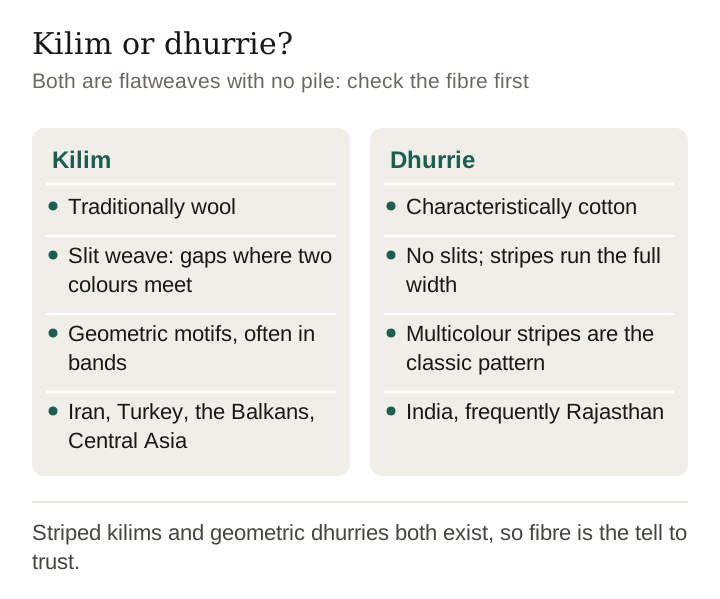
| Look at | Kilim | Dhurrie |
|---|---|---|
| Fibre | Traditionally wool | Characteristically cotton |
| Where the colours meet | Slit weave leaves visible vertical gaps at colour boundaries | No slit-weave signature; stripes run the full width |
| Pattern | Geometric motifs, often in bands; prayer-rug formats exist | Multicolour stripes are the classic pattern |
| Origin named in the listing | Iran, Turkey, the Balkans, Central Asia | India, frequently Rajasthan |
Fibre is the one to trust. If you can only establish one fact about a flatweave, make it wool or cotton: it separates the two traditions more reliably than pattern does, because striped kilims and geometric dhurries both exist.
The slit is the connoisseur’s tell and it is visible in a good photograph. In kilim weaving the weft threads of each colour are wound back from the colour boundary, which leaves a slit in the fabric where two blocks of colour meet. Hold a kilim to the light and those gaps show.
What a kilim is
A kilim is a flat tapestry-woven carpet or rug, traditionally produced in countries of the former Persian Empire including Iran and Turkey, and also in the Balkans and the Turkic countries. Kilims may be purely decorative or function as prayer rugs (Wikipedia: Kilim).
Two facts worth carrying into any purchase.
Age claims deserve scepticism. Kilims are much less durable than pile carpets, because a pile protects the warp and weft. Very old examples are rare; the explorer Aurel Stein’s fourth or fifth century find in Hotan survived by unusual preservation, and the reference literature notes that beyond such exceptions there are probably very few over a century old. A dealer’s casual “antique kilim” is a claim, not a fact.
The construction is the identity. Kilims are made by tightly interweaving warp and weft to produce a flat surface with no pile. That is what makes them a flatweave and what puts them in the same listing bucket as a dhurrie.
What a dhurrie is
A dhurrie — also written dhurri, durrie, durry or dari — is a handwoven rug or thin flat carpet from the Indian subcontinent. Its designs are associated with the state of origin, and multicolour stripes are among the most popular patterns. Dhurrie weaving was a significant rural industry in India (Wikipedia: Dhurrie).
Dhurries are traditionally used as floor coverings or bedding, and they are made across a much wider size range than Western rug listings suggest. The smallest, 12 by 12 inches, is a table cover for a stand or a vase; a 24 by 24 inch size, the aasan, is made for sitting on to meditate. A listing offering an oddly small “rug” is not necessarily an error.
Why the listing will not tell you
We looked. Across 98 live US area rug listings read on 8 September 2026, the catalogue was dominated by one company — 95.9% of rows from a single advertiser — and prices ran from $32.99 to $10,790.00 with a median of $228.99.
The relevant finding for identification is the one from the same morning’s wider field-completeness check: across 1,179 US listings, material was stated on only 47.2%. On the single most reliable tell for telling these two traditions apart, more than half of listings are silent.
So the practical advice is unglamorous. Ask the seller the fibre before you buy, treat “kilim-style” as a description of a pattern rather than an origin, and treat an unsupported age claim as marketing until someone shows you why it is not.
Frequently asked
What is the difference between a kilim and a dhurrie?
Both are flatweave rugs with no pile. A kilim is a tapestry-woven carpet from the lands of the former Persian Empire, traditionally wool, whose slit-weave technique leaves visible gaps where colours meet. A dhurrie is a handwoven flat carpet from the Indian subcontinent, characteristically cotton and often striped.
How can I tell a kilim from a dhurrie in a photo?
Check the fibre first — wool points to kilim, cotton to dhurrie — then look for slits at the colour boundaries, which are a kilim weaving signature.
Are old kilims common?
No. Kilims lack a protective pile and wear out, and the reference literature notes that very few survive beyond about a century. Treat an antique claim as something to be evidenced.
Do rug listings state the material?
Often not. Across 1,179 US listings we read on 8 September 2026, material was stated on 47.2% — so on the most useful identification tell, more than half of listings say nothing.
Why are dhurries sometimes tiny?
Because the tradition includes sizes Western rug listings do not: a 12 by 12 inch dhurrie is a table cover, and a 24 by 24 inch aasan is made to sit on.
Sources and method
Descriptions of origin, technique, material and use come from the reference articles linked above, read on 8 September 2026. Catalogue figures come from the keyword area rug queried against one affiliate network’s product endpoint the same day (98 US rows after deduplication) and from a field-completeness pass over 1,179 US rows across eight product families the same morning.
What this cannot show. We have not handled either kind of rug; this is construction and provenance from reference sources plus listing data, not an assessment of quality. Both traditions are broad, and exceptions to every tell above exist — striped kilims and geometric dhurries are both real. Modern production also crosses the boundary deliberately, so a contemporary rug may be woven in one tradition’s style in another’s fibre and be nobody’s forgery.
Keep reading
How this page was made. Drafted with AI (Claude); not yet independently re-checked. How we work