LinkToLooks · Guides · Creator Desk
Creator Desk
Describing a product you have never held
Most creators write about more products than they own. Here is what retailer data can honestly support, and the sentences to leave out.
Part of: For creators
The problem, stated plainly. Most creators write about far more products than they own, and pretending otherwise is the most common dishonesty in product content. The question worth answering is what you can legitimately say about a product from retailer data alone. We measured that today: across 1,179 live US listings from 29 retailers, every single row carried a description — and 13.0% of those descriptions were five words or fewer, with 7.4% identical to the product title. Only 6.3% stated a dimension.
Last verified 8 September 2026 against 1,179 live US listings from 29 retailers across eight product families, pulled during this batch
“Present” is not “useful”
Field-completeness numbers look reassuring until you read what is inside the fields. Here is the same set of rows measured both ways.
| Field | Present on | What that hides |
|---|---|---|
| Description | 100% | 13.0% are five words or fewer; 7.4% are the title again |
| Brand | 99.8% | Reliable. Use it. |
| Condition | 100% | Reliable, and the most under-used field in the set |
| Colour | 89.0% | Usually a marketing name, not a colour |
| Size | 85.2% | Present far more often than it is comparable |
| Material | 47.2% | Missing on more than half, and concentrated by retailer |
| Manufacturer part number | 65.8% | Good for finding a second seller |
| Barcode | 33.7% | Rarely there when you need it |
| Asking price distinct from list price | 34.4% | Two thirds of rows show only one price |
Read the first row twice. A completeness audit would score descriptions at 100% and be technically correct. A creator trying to write two useful sentences finds that one row in eight contains nothing they did not already have from the title.
The specification fields are worse. Of 1,179 descriptions, 6.3% stated any dimension, 2.1% stated a weight and 1.4% stated a capacity. Every listing has a price and a photograph. The number that would decide the purchase is optional.
Completeness is an advertiser habit, not a field
The averages above are almost useless on their own, because the variation is not random. It is per retailer, and it is enormous.
| Retailer | Rows read | Median description | Material stated |
|---|---|---|---|
| Wayfair North America | 566 | 76 words | 90.1% |
| Perigold | 28 | 46 words | 89.3% |
| Poshmark | 390 | 15 words | 0.0% |
| Woot! | 82 | 4 words | 0.0% |
Two of these retailers describe their products at length and fill in the material on nine listings in ten. Two publish a headline and stop. That is not a difference in product type — there are blankets, rugs and lamps on both sides of the table.
The practical consequence is a planning one. If your niche sits with retailers that publish four-word descriptions, no amount of technique recovers the missing information, and a format that requires you to state a material every time will quietly become a format that requires you to guess one. Find out which side of this table your retailers are on before you commit to a template.
What you can say from feed data
More than most creators use, and it is worth being specific about because these are claims you can stand behind.
What it is, and who made it
Brand is present on virtually every row. “This is a Lodge skillet” is a fact you have, and it does more work than an adjective because a reader can research a brand.
What it costs today, and whether that is a real cut
Where both a list and an asking price exist — a third of rows — you can say what is actually being charged and how it compares with the stated list. Where only one price exists, say the price and nothing about discounting.
Whether it is new or used
Condition is on 100% of rows and almost nobody mentions it. On a resale-heavy category this is the single most useful thing you can tell a reader, and it is sitting there unused.
Whether anyone else sells it
A manufacturer part number, present on two thirds of rows, will often find the same product under another retailer. That gives your reader a second option and gives you a price comparison you did not have.
Whether it is still there
Availability is a field, and it is the one that decides whether the post still works in three months. Check it before you feature something, not after a reader tells you.
Keep reading
What you cannot, and what to write instead
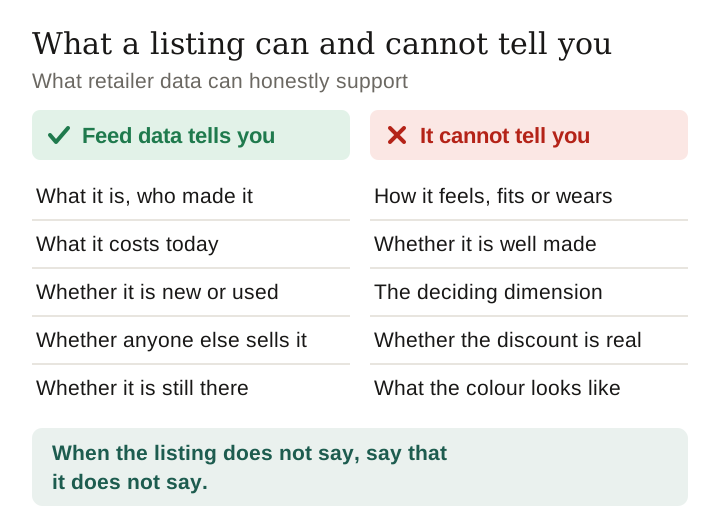
The list of things feed data cannot tell you is short and it is exactly the list of things creators most often assert.
| You cannot know | Because | Write this instead |
|---|---|---|
| How it feels, fits or wears | No amount of catalogue data contains it | Nothing. Leave the sentence out. |
| Whether it is well made | Material is missing on 52.8% of rows and absent entirely at some retailers | State the material where the retailer states it, and attribute it |
| The dimension that decides the purchase | 6.3% of descriptions state any dimension | “The listing does not give a size; check before you buy” |
| Whether the discount is real | Two thirds of rows publish only one price | Quote the asking price and say nothing about the saving |
| What the colour actually looks like | Colour is a marketing name on most rows | Use the retailer’s own colour name in quotation marks |
The temptation on every one of these rows is to fill the gap with a plausible sentence. It reads well, nobody checks it, and it is the exact behaviour that makes product content worthless in aggregate. Saying “the listing does not say” is more useful to a reader than a confident guess, because it tells them to go and look — which is the correct action.
We follow this rule for a self-interested reason as well as a principled one: we have never worn, handled or tested any of the products we write about, and everything on this site is written from listings and public sources. Our authority is that we counted something; it is not that we tried it. A creator who has genuinely used a product has the one thing we do not, and should lean on it hard — that experience is the part no catalogue can supply.
Four line patterns that stay honest
- Attribute the source inside the sentence. “The listing gives it as cast iron” rather than “it is cast iron”. One extra clause, and it is now checkable.
- Name the gap where it matters. “No weight is given, which matters for a pan” is more useful than silence and far more useful than a guess.
- Prefer the fact over the adjective. “Sold used, from a resale marketplace” beats “a great find”, and it is a fact you actually hold.
- Date the price in the sentence. Prices move and listings disappear; a dated price is still true next month, an undated one is quietly wrong.
Frequently asked
Can you write about a product you have not used?
Yes, if you confine yourself to what the listing and public sources actually state and attribute it. What you cannot do is describe fit, feel or durability, because no catalogue data contains them and a reader has no way to tell a guess from experience.
What do product feeds actually tell you?
Reliably: brand, condition, current price, image and availability. Less reliably: size (85.2% of rows), colour (89.0%) and material (47.2%). Rarely: dimensions, weight or capacity, which appeared in 6.3%, 2.1% and 1.4% of descriptions respectively.
Why are some product descriptions so short?
It is a per-retailer convention rather than a property of the category. In our sample the median description ran 76 words at one retailer and 4 words at another, with blankets, rugs and lamps on both sides.
Is a listing with a description always usable?
No. Every row we read carried a description, but 13.0% were five words or fewer and 7.4% repeated the title exactly. Presence and usefulness are different measurements.
What should I write when the listing does not say?
Say that it does not say. It is more useful to a reader than a confident guess, because it tells them to check — and it is the only version of the sentence that stays true.
Method, scope and limits
Eight product families — cast iron skillet, espresso machine, duffel bag, hiking boots, throw blanket, area rug, desk lamp, picture frame — queried against one affiliate network’s product endpoint on 8 September 2026, up to 300 rows per family, post-filtered to rows whose own country field reads US, then deduplicated on retailer, title and destination URL. That leaves 1,179 rows from 29 retailers. Field presence is a non-empty value; description length is a word count; dimension, weight and capacity were detected by matching a number followed by a unit.
What this cannot show. Eight families and 29 retailers is a sample, not a census, and the per-retailer table is dominated by two large catalogues — the four-retailer comparison is illustrative of the spread, not a ranking. The unit-matching test finds stated dimensions in prose and will miss any published in a structured attribute we did not request. And this measures what retailers publish to affiliates, which is not always what appears on their own product pages.
Keep reading
How this page was made. Drafted with AI (Claude); not yet independently re-checked. How we work