LinkToLooks · Guides · Reference Desk
Reference Desk
How do you date and read a LaserDisc sleeve?
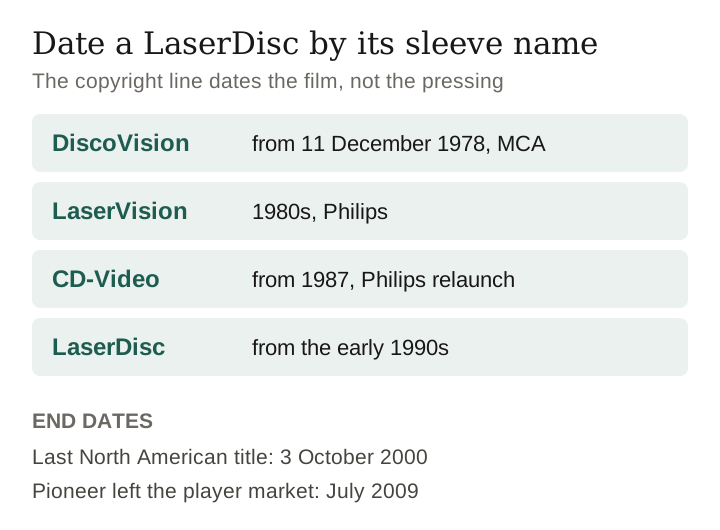
A LaserDisc tells you more about itself than a VHS tape does, and almost all of it is printed on the sleeve. This is a reading guide: how to date a disc, how to tell a CAV pressing from a CLV one and why it matters, what the format was called in which decade, and where the edition names came from. Everything factual here is sourced and cited at the foot of the page.
What the name on the sleeve dates
| Name printed | Period | Who used it |
|---|---|---|
| DiscoVision | from 11 December 1978 | MCA, at the US test market launch |
| LaserVision, or VLP in model numbers | 1980s | Philips, and the European launch of 1983 |
| CD-Video | from 1987 | Philips relaunch branding; appeared on 20 cm and 30 cm discs as well as the 12 cm hybrids |
| LaserDisc | from the early 1990s | The format's final official name, originally Pioneer's player brand |
So a sleeve that says DiscoVision is a first-wave American disc and a sleeve that says CD-Video is 1987 or later even if the film is older. The name is a better dating tool than the copyright line, which reflects the film rather than the pressing.
CAV against CLV, which is the thing collectors actually check
| CAV (Standard Play) | CLV (Extended Play) | |
|---|---|---|
| Rotation | Constant angular velocity, 1,800 rpm NTSC | Constant linear velocity |
| Per side | 30 minutes NTSC, 36 minutes PAL | 60 minutes NTSC, 64 minutes PAL |
| Frames per side | 54,000, each individually addressable | Not frame-addressable on standard players |
| Freeze frame and slow motion | Yes, on any player | Only with a player carrying a digital frame store |
| Typically used for | Special editions and supplements | Ordinary feature releases |
Here is the judgment worth having. A CAV pressing of a two-hour film needs four sides where a CLV pressing needs two, so the CAV box is physically bigger and the film is interrupted twice as often. Collectors pay more for CAV anyway, because frame-accurate stepping is the reason film scholars used the format at all, and because CAV was where the studios put the supplements.
Sizes
- 30 cm, 11.8 inches, about the size of a 12-inch LP. The standard, and the vast majority of all programming.
- 20 cm, 7.9 inches, roughly a 45 rpm single. Much rarer, especially in North America; 20 minutes per side on CLV.
- 12 cm hybrid CD-Video discs, from the 1987 relaunch. These are a different object from a LaserDisc proper.
Why the special edition exists at all
LaserDisc supported multiple audio tracks, which made it the first home format able to carry commentary and supplements on the disc itself. The Criterion Collection edition of Citizen Kane, released in 1984, is generally credited as the first special edition on home video, and King Kong as the first release with a commentary track. Every bonus feature on every disc since descends from those two.
The end dates, which are the ones people get wrong
| Event | Date |
|---|---|
| Last LaserDisc title released in North America | Bringing Out the Dead, 3 October 2000 |
| Last new film title in Japan | Tokyo Raiders, 21 September 2001 |
| Last LaserDisc release of any kind | Onta Station vol. 1018, a Japanese karaoke title, 21 March 2007 |
| Last player manufactured | Pioneer left the market, July 2009 |
The format also never won the market it was built for. Players were expensive and could not record, so North America and Europe largely ignored it while Japan, Singapore, Malaysia and especially Hong Kong adopted it - LaserDisc was the dominant rental format in Hong Kong through the 1990s.
Last verified 1 September 2026. Format history, technical specifications and end dates from the source below; the listing count is from a US affiliate product feed pulled the same day.
Frequently asked
What is the difference between CAV and CLV LaserDisc?
CAV discs spin at a constant angular velocity and hold 30 minutes per side NTSC with every frame individually addressable, so freeze frame and slow motion work on any player. CLV holds 60 minutes per side but is not frame-addressable.
How do I date a LaserDisc?
Read the format name on the sleeve. DiscoVision means 1978 to the early 1980s, LaserVision the 1980s, CD-Video 1987 or later, and LaserDisc from the early 1990s.
When did LaserDisc end?
The last North American title was Bringing Out the Dead on 3 October 2000; the last release of any kind was a Japanese karaoke disc on 21 March 2007; Pioneer stopped making players in July 2009.
What size is a LaserDisc?
Usually 30 cm, 11.8 inches, about the size of a 12-inch LP. A rarer 20 cm size exists, and the 1987 CD-Video relaunch added 12 cm hybrid discs.
Was LaserDisc better quality than VHS?
Yes. LaserDisc resolved 425 to 440 TV lines against VHS's, carried CD-quality digital audio and was the first home format to support surround sound.
Sources
- Wikipedia, LaserDisc — the DiscoVision, LaserVision, CD-Video and LaserDisc naming sequence; the 11 December 1978 US launch; CAV and CLV rotation, capacity and frame addressing; the 30 cm, 20 cm and 12 cm sizes; the 425 to 440 TV line resolution; the 1984 Criterion Citizen Kane special edition and King Kong commentary; adoption in Hong Kong; and the 2000, 2001, 2007 and July 2009 end dates
- CJ Affiliate product feeds, US advertisers, queried 1 September 2026 — every count and price on this page is a deduplicated row count from that pull, dated to it
Read next
Physical media players you can still buy new · What is the black diamond on a Disney VHS tape?
How this page was made. Drafted with AI (Claude); not yet independently re-checked. How we work