LinkToLooks · Guides · Reference Desk
Reference Desk
Parka or puffer? How to tell, and why a coat can be both
Length and hood identify one; the baffles identify the other. They are answers to different questions.
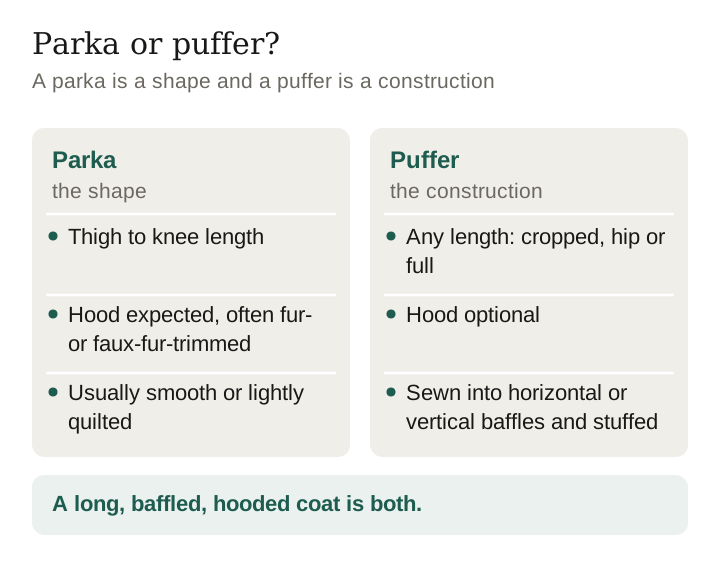
A parka is a shape and a puffer is a construction, which is why a coat can be both. Parka means a long, hooded cold-weather coat, usually thigh- or knee-length. Puffer means the body is sewn into baffles and stuffed, so the surface is visibly segmented. Look at the length and the hood for one, and at whether the surface is channelled for the other.
The two questions that settle it
People treat these as rival categories and then get stuck, because they are not rivals. Ask two separate questions and the confusion disappears.
- How long is it, and does it have a hood? Thigh-length or longer with a hood is parka territory. A reference definition puts it plainly: a parka is a hip-length or longer cold-weather coat, typically stuffed with down or a warm synthetic, with a fur-lined hood.
- Is the surface divided into channels? If the body is sewn into horizontal or vertical compartments, it is a puffer. Those seams are structural: they stop the filling migrating to the hem.
Answer yes to both and you have a long puffer parka, which is a real garment and a phrase 23 live listings in this pull use without embarrassment.
Side by side
| If you are looking at | Parka | Puffer |
|---|---|---|
| What the word describes | The shape: a long, hooded cold-weather coat, typically thigh- or knee-length | The construction: sewn into baffles and stuffed, so the surface is visibly segmented |
| Length | Thigh to knee | Anything — cropped, hip, or full length |
| Hood | Expected, and often fur- or faux-fur-trimmed | Optional |
| Surface | Usually smooth or lightly quilted | Horizontal or vertical channels, unmistakable in a photograph |
| Filling | Down or heavy synthetic, per reference definitions | Down or synthetic; the baffles exist to hold it in place |
| Can it be the other? | Yes — a long baffled hooded coat is both | Yes — and 23 listings in this pull say so in the title |
Reading it from a photograph
In order of how reliable they are:
- Baffles. The most reliable single signal there is. Channels running across or down the body mean stuffed construction. Nothing else in outerwear looks like it.
- Hem position against the hand. A parka reaches the top of the thigh at minimum. A cropped or waist-length coat is not a parka whatever else it is.
- Hood trim. A fur or faux-fur ruff around the hood opening is strongly associated with the parka and almost never appears on a plain puffer.
- Front opening. A full-length zip or a storm flap over one. A pull-over with no front opening is an anorak, which is a third thing.
What will not help: the colour, the brand, or the presence of a drawstring waist. All three appear on everything.
Where the anorak fits
The anorak is the word people reach for third and it has a stricter definition than either. Strictly, an anorak is a waterproof hooded jacket that pulls over the head, with no front opening, often with drawstrings at waist and cuffs; it is usually shorter than a parka, around hip length. The two words come from different languages — anorak from Greenlandic annoraaq, parka from Nenets — and both garments are staples of Inuit clothing, traditionally made from caribou or seal skin.
In practice the trade uses them interchangeably, and in this catalogue it barely uses anorak at all: 2 listings out of 5,872.
What the words are worth
Because the words are not synonyms, they do not carry the same price. Across 5,872 live US listings on 15 September 2026:
| Word in the listing title | Listings | Median asking price |
|---|---|---|
| parka | 1,074 | $79.99 |
| puffer | 1,680 | $35.00 |
| both words in one title | 23 | $99.99 |
| quilted | 42 | $99.99 |
| anorak | 2 | $30.00 |
A listing that says parka asks more than twice what a listing that says puffer asks — $79.99 against $35.00. The listings using both words sit higher still. We would not read that as the word adding value on its own; parkas are simply bigger, heavier garments and the ones here skew towards outdoor brands. But if you are writing your own listing, it is worth knowing that the two words set very different expectations. Prices checked 15 September 2026
Keep identifying
What a photograph cannot tell you
Three things, and they are the three that decide whether the coat is warm.
- What is inside it. Down and synthetic fill look identical through a shell. Only 31 of the 5,872 listings in this pull mention down anywhere in the title.
- How much is inside it. Two puffers with identical baffles can differ by a factor of three in insulation, and nothing visible distinguishes them.
- Whether the shell is waterproof. A membrane is invisible. So is its absence.
We identify garments from listing photographs and text. We have not worn, handled or weighed any coat, and we will not tell you which of two coats is warmer, because a photograph genuinely does not contain that information.
Sources
Definitions of parka and anorak, the length and hood distinctions, the pull-over construction of the anorak and the Greenlandic and Nenets etymologies are taken from the Parka reference article and the Anorak reference article, both read on 15 September 2026. The listing counts and prices are ours.
The seed list ships with the page. A method you cannot repeat is not a method, so here are the sixteen cold-weather keyword seeds behind every figure on this page: winter coat, puffer jacket, parka, snow boots, winter gloves, winter scarf, beanie hat, thermal underwear, wool socks, electric blanket, space heater, humidifier, snow shovel, ice scraper, hand warmers, fleece jacket. Scope: root shoppingProducts; arguments keywords and advertiserCountries: ["US"]; the sixteen cold-weather seeds read at limit: 1000 over offsets 0 and 1000, so up to 2,000 rows per seed, and the single-word seeds at offset 0 only; rows deduplicated on advertiser + title + destination URL; the US view is a post-filter on each row’s own targetCountry; the network’s own demo advertiser is removed everywhere. Asking price is salePrice where a row carries one and price otherwise, because price is the list price and not what a shopper pays. Rows priced at $0.00, peer-to-peer asks of $500 and over, and repeated-digit asks are dropped as placeholders. No totalCount is quoted anywhere: on a keyword pull the API OR-matches the words, so its count is not coherent. The pull script is in our repository as pull_night_0915.py and the analysis helpers as an_night_0915.py.
What we did not do. We identify from photographs and listing text only. We price and count listings; we do not test products, and nothing here is a performance review.
Last verified 15 September 2026 against two published reference articles plus 5,872 live US coat listings
How this page was made. Drafted with AI (Claude); not yet independently re-checked. How we work