LinkToLooks · Guides · Reference Desk
Reference Desk
What fill power actually measures
A volume test, not a warmth rating - and only half of what decides whether a down coat is warm.
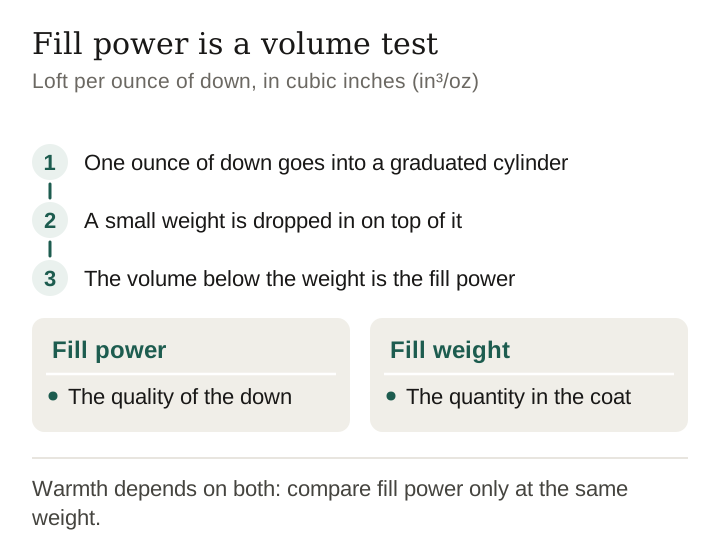
Fill power is a volume measurement, not a warmth rating. One ounce of down is dropped into a graduated cylinder with a small weight on top, and the volume it holds up — in cubic inches per ounce — is the number. 800-fill down insulates better than 600-fill of the same weight, because it traps more air per ounce. It says nothing about how much down is in the coat.
How the number is actually produced
The test is refreshingly physical. An ounce of down goes into a graduated cylinder, a small weight is dropped in on top of it, and the volume below the weight is read off. That volume, in cubic inches, is the fill power — hence the unit, in³/oz.
So the number is measuring loft per unit of weight: how much air a fixed mass of down can hold open against a small load. Air is the insulator. The down is only the scaffolding that holds it still.
That is also why the comparison is always “of the same weight”. Higher fill-power down insulates better than lower fill-power down of the same weight. Change the weight and the comparison stops being valid, which is precisely what a coat manufacturer is free to do.
What the numbers mean
| Fill power (in³/oz) | What it is used for | Note |
|---|---|---|
| 400–550 | The bottom of the outdoor range | Still provides reasonably good insulation at 550 |
| 500–650 | Most conditions | Described as warm enough and light enough for most use |
| 650–800 | Colder or lighter-weight gear | Within the 400–900 band most outdoor equipment occupies |
| 800–900 | Very lightweight or very cold-weather gear | The top of the mainstream range |
| 1200 | Eiderdown | The highest fill power there is |
Two things are worth pulling out of that table. Insulation in most outdoor equipment runs from roughly 400 to 900 in³/oz, so the usable range is narrower than the marketing suggests. And 550-fill down — the number that gets described as entry-level — still provides reasonably good insulation. The difference between 550 and 850 is real, but it is mostly a difference in weight and packability for a given warmth, not a difference between warm and cold.
The half of the answer fill power leaves out
Fill power tells you the quality of the down. It does not tell you the quantity, and warmth depends on both. A jacket with 850-fill down and 60 grams of it will be colder than one with 600-fill and 200 grams. The first number is on the marketing; the second, the fill weight, very often is not.
If you are comparing two down garments and only one number is published, you cannot rank them. That is not a gap in your knowledge; it is a gap in the information you were given. The question worth asking a retailer is “how many grams of fill?”, and the answer is usually harder to obtain than the fill power.
What the label words are allowed to mean
| Label on the product | What US regulation requires |
|---|---|
| 100% Down | Only down feathers, nothing else |
| Down | May contain a mixture of fibre and feathers |
| Goose Down | At least 90% goose down and 10% goose feathers |
The distinction that catches people is the second row. A product labelled simply Down may legitimately contain a mixture of fibre and feathers; only 100% Down means down alone. Feathers are heavier, less lofty and have quills. A coat can be honestly labelled and still be mostly feather.
The failure mode nobody prints on the tag
Down has one decisive weakness and it is worth more than any fill number: when it is wet, its thermal properties are virtually eliminated. It clumps in damp, will mildew if left damp, and absorbs and retains odours. Cared for, it holds its loft up to three times longer than most synthetics — but the wet-weather behaviour is the reason synthetic fill still exists in a market where down is warmer per ounce.
That is the honest way to choose between them, and it has nothing to do with fill power. Dry cold favours down. Wet cold favours synthetic. Everything else is a detail.
Keep identifying
How often a listing tells you any of this
We checked, because it seemed worth knowing before sending anyone looking for a number. Across 5,872 live US coat, puffer, parka and fleece listings pulled on 15 September 2026:
- 0 listings state a fill power. Not a small share — none.
- 31 mention the word down at all, 0.5% of the total.
- 16 carry anything in the material field, which is where a feed could put “goose down” if it wanted to.
This is not a complaint about one catalogue. It is the reason a reference page like this one has to exist: the specification that decides whether you are warm is not in the listing, so you will be reading it off a product page, a hang tag, or nothing at all. Prices checked 15 September 2026
Sources and what we could not check
The cylinder-and-weight test method, the in³/oz unit, the 400–900 outdoor range, the 550 and 800–900 guidance, the 1200 eiderdown figure, the wet-performance and loft-retention behaviour, and the US labelling rules for 100% Down, Down and Goose Down all come from the Down feather reference article, read on 15 September 2026.
What we did not verify. We have not read the Federal Trade Commission rule text itself, so the labelling rows above are reported as that reference states them rather than quoted from the regulation. We have not tested a sample of down, we do not know which laboratory standard any given brand uses, and standards differ — the same down can test differently under different methods. If a number matters to you commercially, go to the standard, not to us.
What we did not do. We have not owned, weighed or tested any down garment, and nothing here ranks one coat against another. We price and count listings; we do not test products, and nothing here is a performance review.
Last verified 15 September 2026 against one published reference source for the measurement and labelling rules, plus 5,872 live US listings checked for whether they state a fill power
How this page was made. Drafted with AI (Claude); not yet independently re-checked. How we work