LinkToLooks · Guides · Reference Desk
Reference Desk
Upright or canister vacuum? How to tell from the photograph
Count the units. Four tells, plus where sticks and handhelds sit and why the upright price looks wrong.
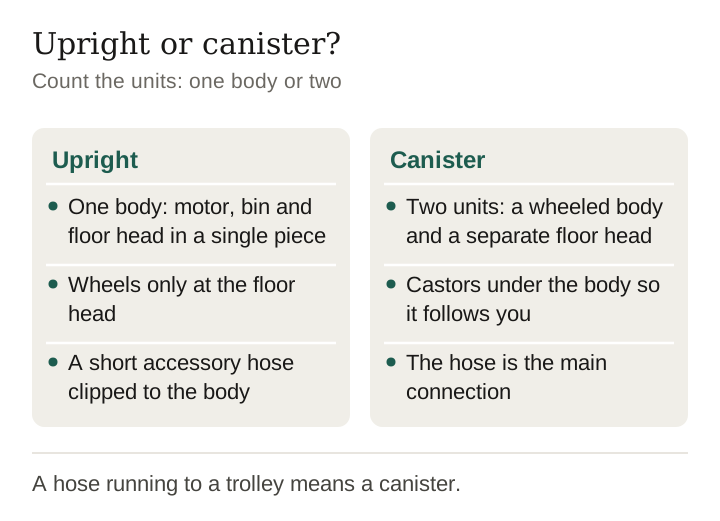
Count the units. An upright is one body: motor, bin and floor head in a single piece you push. A canister is two: a wheeled body you drag behind you, joined by a hose to a separate floor head. If the photograph shows a hose running to a trolley, it is a canister. In US listings checked on 12 September 2026, upright-titled vacuums ask a median of $254.00 and canister-titled ones $69.99.
The tells
- One body or two. Decisive, and visible in every product photograph.
- Where the wheels are. A canister has castors under the body so it follows you; an upright has wheels only at the floor head.
- The hose. On an upright it is a short accessory hose clipped to the body for above-floor work. On a canister it is the main connection and carries the airflow.
- The handle. An upright’s handle is part of the machine and reclines. A canister’s is a wand you hold, with a carry handle on the body itself.
What each type asks
| Cut of the data | Listings | Median asking price | Middle half of the range |
|---|---|---|---|
| Titles saying “upright” | 67 | $254.00 | $129.99 – $593.99 |
| Titles saying “canister” | 73 | $69.99 | $67.89 – $109.99 |
| Titles saying “stick” | 138 | $79.99 | $54.99 – $159.99 |
| Titles saying “handheld” | 305 | $41.16 | $25.99 – $67.99 |
Prices checked 12 September 2026 The upright figure is the one to read carefully. It sits far above the others because the word also appears on commercial and janitorial machines in this catalogue, which are the same shape and a different market. The domestic uprights are clustered much lower, inside the range the canister row shows.
Sticks and handhelds, which are neither
A stick vacuum looks like a thin upright and is not one: the motor and bin sit at the top of the wand rather than at the floor, which is what lets it detach into a handheld. A handheld is that top section on its own. Both are usually cordless, and the cheapest rows in the whole vacuum search are handhelds, at a median of $41.16.
The practical confusion is between a stick and an upright in a product photograph taken head-on, because the silhouettes are close. The tell is the bin: on an upright it is at ankle height, on a stick it is up by the handle.
Which one a listing is really selling you
Listings in this catalogue use the type words loosely, and a fair number use two of them in one title — “upright stick vacuum” is a real phrase here. When the words conflict, the photograph is the authority and the price is the tiebreaker. We have not used any of these machines and take no view on which type cleans better; what we can tell you is which one you are looking at.
How the prices were produced
Where the numbers come from. One live pull of the vacuum cleaner search against a US-filtered affiliate catalogue, taken at 02:05 local on 12 September 2026, read to 2,000 rows and deduplicated on advertiser, title and destination URL. Asking price where a row publishes one, list price otherwise. The full query scope, the seed list and the pull script are set out on our study of what a product search returns.
Type splits are whole-word matches on the listing title within the vacuum cleaner search. Machines that do not name their own type are not counted in any row, and a title naming two types is counted in both, which is why the rows do not sum to the category.
What we did not do. We identify these machines from photographs and listings; we have not run any of them. We price and count listings; we do not test products, and nothing here is a performance review.
Last verified 12 September 2026 against live US vacuum listings split by the type named in the title
More identification work
How this page was made. Drafted with AI (Claude); not yet independently re-checked. How we work