LinkToLooks · Guides · Reference Desk
Reference Desk
Is it Westmoreland? The mark changed three times
Three marks, one pattern that is most of the shelf, and a colour rule that tells you when you are not looking at the 1950s.
A W inside a keystone means 1910 to the mid-1940s. An intertwined W and G means 1946 onward. The word Westmoreland in a circle means 1981 to 1984, under the company’s last owner. Westmoreland worked at Grapeville, Pennsylvania from 1889 until 1984, and milk glass was about 90% of its output from the 1920s to the 1950s. Of 280 live US listings priced on 16 September 2026, 32% are the Paneled Grape pattern, at a $29.99 median.
Last verified 16 September 2026 against 280 live US Westmoreland listings pulled from retailer product feeds the same morning
Three marks, three eras
Westmoreland is one of the few American glasshouses where the mark itself dates the piece, because the company changed it twice and both changes are documented.
| What is on the base | When it was used |
|---|---|
| A W inside a keystone | 1910 to the mid-1940s |
| An intertwined W and G | 1946 onward, on most of the glassware |
| The word Westmoreland in a circle around three lines | 1981 to 1984, after David Grossman bought the factory |
| No mark | Common. A great deal of the output carried a paper label instead, and labels come off |
The company was founded in 1889 and worked at Grapeville, Pennsylvania, until it closed in 1984. Its identity is milk glass: from the 1920s to the 1950s an estimated 90 per cent of production was milk glass, which is why almost everything you will meet under this name is opaque white rather than clear or coloured.
One pattern is a third of the shelf
Of 280 live US listings this morning, 89 — 32% — are Paneled Grape. If you have inherited a box of white glass with raised grapes and vine leaves in vertical panels, the odds are strongly that this is what it is.
| Pattern | Live listings | Median ask | Range |
|---|---|---|---|
| Paneled Grape | 89 | $29.99 | $3.99 – $349.95 |
| Old Quilt | 30 | $39.99 | $4.99 – $249.95 |
| American Hobnail | 22 | $17.99 | $7.99 – $139.95 |
| Doric | 21 | $59.99 | $17.99 – $119.95 |
| Bramble | 11 | $39.99 | $5.99 – $79.95 |
| Della Robbia | 10 | $12.99 | $4.99 – $39.99 |
| Thousand Eye | 10 | $12.99 | $5.99 – $29.99 |
| Waterford | 9 | $29.99 | $6.99 – $69.95 |
Two judgements worth signing. First, the price is in the form, not the pattern: a Paneled Grape saucer is $3.99 and a Paneled Grape canister with its lid is $349.95, the same pattern at eighty-eight times the money, because lids and hollowware did not survive in the numbers plates did. Second, milk glass carries the name: 238 of 280 listings say milk glass in the title, at a $29.99 median against $11.99 for the rest of the shelf.
What happened to the moulds — carefully
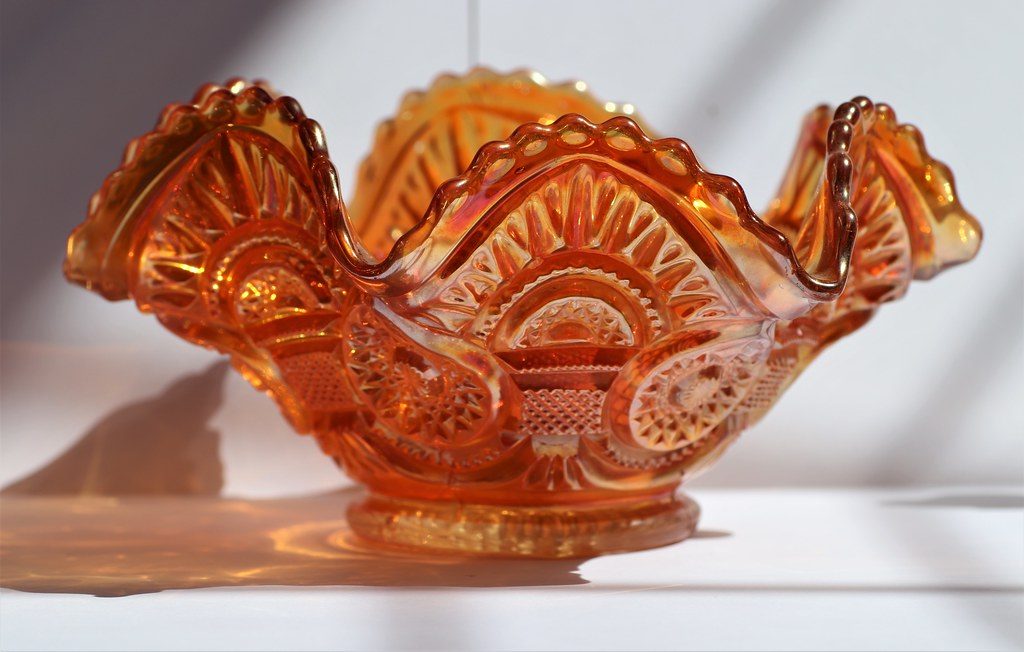
This is where identification gets harder, and where we will mark the limit of what we can stand behind. Westmoreland ceased operations in 1984 and the plant was sold. Collector references report that the moulds were auctioned and bought by several other glasshouses, and that the company had already been pressing its own patterns in new finishes for a distributor, Levay, from the 1970s — including Paneled Grape in carnival and opalescent colours that the original 1950s production never had.
We could not confirm the mould sales from a primary source, so treat that paragraph as collector consensus rather than as established fact. What follows from it is sound either way and is the useful part: a Paneled Grape piece in a colour, an iridescent finish or an opalescent edge is not 1950s Westmoreland milk glass, whoever pressed it. Milk glass is the safe ground; anything else needs the mark.
What it costs today
| All Westmoreland | Paneled Grape only | |
|---|---|---|
| Live US listings | 280 | 89 |
| Median ask | $29.99 | $29.99 |
| Middle half | $15.99 – $59.99 | $15.99 – $59.99 |
| Cheapest / dearest | $3.99 / $349.95 | $3.99 / $349.95 |
| Marked in stock | 106 of 280 | — |
As with every replacement-dealer shelf, read those numbers as one large dealer’s asking prices rather than as a market: 279 of 280 listings come from Replacements Ltd. Only 106 of 280 report as in stock, which is normal for a dealer that lists its whole catalogue and fills from what comes in.
Method, and what this cannot show
One keyword search, westmoreland glass, against the CJ shopping-product API on 16 September 2026: US advertisers, three pages of 100 rows, deduplicated on retailer, title and destination URL and filtered again on each row’s own country field. 280 US rows, all priced. Pattern counts are title matches, so a listing that names no pattern is not counted — 71 of the 280 name none of the patterns above.
What this cannot show. It cannot date your piece: a title is a dealer’s description and the mark is on the object, not in the feed. It cannot price the coloured and carnival reissues, which barely appear in this catalogue. And it is asking prices at one dealer, not sold prices anywhere.
Sources checked for this page
- Westmoreland Glass Company — Wikipedia
- Westmoreland Carnival Glass Revival — Carnival Glass Worldwide
Keep identifying
Frequently asked
How do I know if my milk glass is Westmoreland?
Look at the base. A W inside a keystone dates it 1910 to the mid-1940s; an intertwined W and G means 1946 or later; the word Westmoreland in a circle means 1981 to 1984. Many pieces carried only a paper label and are unmarked.
What is the Paneled Grape pattern worth?
Across 89 live US listings on 16 September 2026 the median ask was $29.99, with a range from $3.99 for a saucer to $349.95 for a large canister with its lid. Complete lidded pieces and hollowware carry the value.
Is Westmoreland glass still made?
No. The company closed in 1984. Collector references report its moulds were sold to other glasshouses, so later pressings of Westmoreland patterns exist, typically in colours and finishes the original milk-glass production did not use.
Why is nearly everything I find Paneled Grape?
Because it was made in vast quantity across a long run. In our pull it was 32% of all live Westmoreland listings, far ahead of Old Quilt and American Hobnail.
How this page was made. Drafted with AI (Claude); not yet independently re-checked. How we work