LinkToLooks · Guides · Reference Desk
Reference Desk
What is a cameo brooch worth?
961 live listings priced, and the finding underneath the spread: 92 per cent never say what the cameo is carved from.
Across 961 live US cameo brooch listings pulled on 4 September 2026, the median asking price was $25.00. Half of everything listed sat between $16.00 and $39.00, the cheapest was $2.09 and the dearest $1,250.00. These are asking prices from live listings, not realised sale prices — we hold no sold data, and neither does any page quoting a cameo “value” without saying where it came from.
The reason the range is so wide is that a cameo can be carved shell, coral, lava, hardstone, porcelain, glass or moulded resin, and those are not the same object at all. Only 75 of the 961 titles — 7.8 per cent — name the carved material. The market is priced on a property the listings mostly do not state.
What cameo brooches are actually listed at
| Measure | Asking price |
|---|---|
| Listings measured | 961 |
| Median | $25.00 |
| 25th percentile | $16.00 |
| 75th percentile | $39.00 |
| Cheapest | $2.09 |
| Most expensive | $1,250.00 |
| Marked in stock | 961 of 961 |
Prices checked 4 September 2026
Last verified 4 September 2026 against 961 live US cameo brooch listings pulled from one affiliate network’s catalogue
One resale marketplace held 960 of the 961 listings. That is the highest single-seller concentration we have measured in any category, and it means these figures describe one marketplace's asking prices rather than a market consensus. An auction house or a specialist dealer would show different numbers, and we did not measure those.
The gap between the $2.09 floor and the $1,250 ceiling is a factor of 598. Quoting a single “what a cameo is worth” figure across that spread is close to meaningless, which is why the quartiles are the number to take away: three quarters of what is listed is under $39.
The material problem, measured
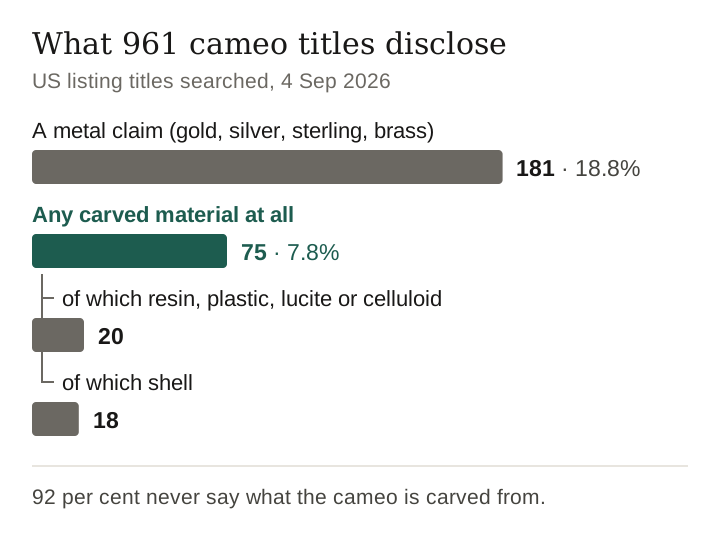
We searched all 961 titles for the words that would tell a buyer what the cameo is carved from. Here is everything the titles disclose:
| What the title says | Listings | Share of 961 |
|---|---|---|
| Shell | 18 | 1.9% |
| Resin, plastic, lucite or celluloid | 20 | 2.1% |
| Glass | 17 | 1.8% |
| Porcelain or ceramic | 11 | 1.1% |
| Coral | 4 | 0.4% |
| Hardstone, agate, onyx or carnelian | 4 | 0.4% |
| Lava | 1 | 0.1% |
| Any carved material at all | 75 | 7.8% |
| A metal claim instead (gold, silver, sterling, brass) | 181 | 18.8% |
Read the last two rows together. A listing is nearly two and a half times more likely to tell you about the mounting than about the cameo. That is not sellers being evasive — the metal is usually stamped and the shell is not — but it is the reason price filters cannot sort this category by quality.
The practical effect: at the median of $25 you cannot tell from the listing text whether you are buying a hand-carved shell cameo or a moulded resin one, and those have different lifespans, different weights and different resale prospects.
Keep identifying
The word ‘vintage’ is worth more than the material
601 of the 961 titles — 63 per cent — carry the words vintage, antique or an abbreviation of them. We split the pull on that word and priced each side:
| Group | Listings | Median asking | 25th–75th percentile |
|---|---|---|---|
| Title says vintage or antique | 597 | $25.00 | $18.00–$40.00 |
| Title does not | 360 | $20.00 | $15.00–$37.75 |
A $5 gap at the median, which is a 25 per cent premium for a word that carries no verification and no date. Compare that with the material, which genuinely determines what the object is and appears in fewer than one title in twelve.
We are stating the association and not a cause: sellers who write “vintage” may also list better pieces, photograph them better, or simply price more confidently. What we can say is that on this catalogue the unverifiable adjective tracks a higher asking price than the verifiable material does, because the material is usually absent.
How to tell shell from resin
Since the listing usually will not say, these are the checks that work from a photograph or in the hand. We have not handled any of these listings; this is the method, not a verdict.
- Look at the back. A shell cameo is carved from a curved shell, so the reverse is usually concave and slightly translucent at the edges. A moulded cameo is typically flat-backed and opaque.
- Look for undercutting. Carving leaves the figure standing free of the background in places, with tiny shadow gaps. Moulding cannot easily produce an undercut, so moulded cameos look softer where the figure meets the ground.
- Check for mould seams. A faint line running around the edge of the oval is a casting seam and settles the question.
- Hold it to light. Shell glows warm and unevenly at the thin points; resin either blocks the light or glows uniformly.
- Weigh it against the mounting. Hardstone and lava feel heavy for the size; resin feels lighter than the metal frame it sits in.
If a listing photographs only the front, none of these are available to you. Asking for a photograph of the reverse is the single most useful question in this category.
Frequently asked
What is a cameo brooch worth in 2026?
Across 961 live US listings pulled on 4 September 2026, the median asking price was $25.00, with half of all listings between $16.00 and $39.00. The full range ran from $2.09 to $1,250.00.
Are old cameo brooches valuable?
Age alone did little in this data: listings whose titles said vintage or antique carried a $25.00 median against $20.00 for the rest. The material and the quality of carving matter more, and neither is usually stated.
How do I know if a cameo is shell or plastic?
Look at the reverse for a concave, slightly translucent surface, look for undercutting where the figure meets the background, and check the rim for a moulding seam. Only 1.9 per cent of listings state that it is shell.
Why are the prices so inconsistent?
Because a cameo can be carved shell, coral, lava, hardstone, porcelain or moulded resin, and 92 per cent of listings do not say which. Buyers cannot price what is not disclosed.
Where are cameo brooches sold?
In the catalogue we measured, one resale marketplace held 960 of 961 listings. That is a fact about affiliate-visible supply rather than about the whole market, which also includes auction houses and dealers we did not measure.
Method and scope
One 1,000-row pull for the keyword “cameo brooch” from a single affiliate network's shopping catalogue on 4 September 2026, filtered to 961 rows whose target country was US. Prices are the sale-price field where present and the list price otherwise, so they are asking prices from live listings and not realised sale prices; we hold no sold data. Material and vintage counts come from searching the listing titles for the terms named, so they undercount anything disclosed only in a description or a photograph. One affiliate catalogue is not the whole market. We have not handled any of these brooches.
Keep identifying
How this page was made. Drafted with AI (Claude); not yet independently re-checked. How we work