LinkToLooks · Guides · Reference Desk
Reference Desk
What are the scallops on a santoku blade?
They are flutes, sold as a Granton edge — and our source calls them a feature of santoku copies, not of the original.
They are flutes — shallow recesses hollowed out of each side of the blade, the feature a European-style santoku is described as having when it carries a “Granton edge”. They are not decoration and they are not a sharpening guide. The hollows are intended to trap small air pockets between the steel and the food so a slice separates from the blade instead of clinging to it, and the same idea appears on meat-carving knives.
Worth knowing before you pay extra for them: Wikipedia’s santoku article describes the fluting as a trend in santoku copies made from a single alloy, rather than as a traditional feature of the Japanese original.
What the scallops are for
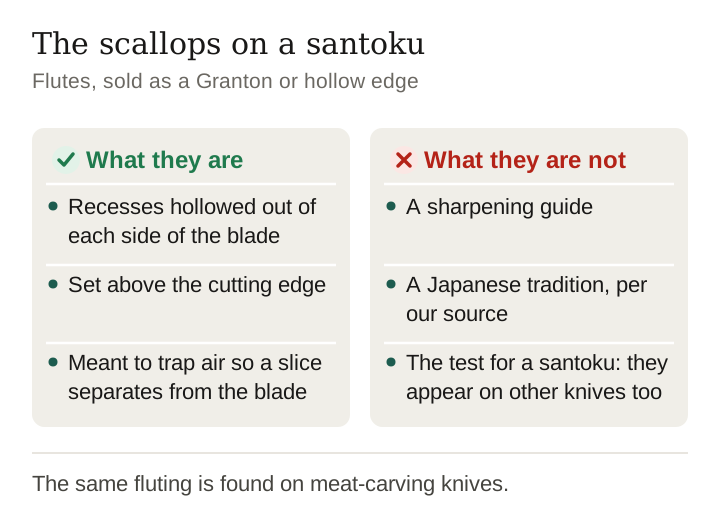
The recesses are hollowed out of the side of the blade above the cutting edge. The stated purpose is friction: the hollows create small air pockets between the blade and whatever is being sliced, which is meant to reduce the suction that makes a potato slice stick to steel. The same fluting is found on meat-carving knives, where the problem is identical.
Two things this feature is not, both of which get repeated confidently online:
- Not a sharpening guide. The flutes sit above the edge and have nothing to do with the bevel angle.
- Not a Japanese tradition. Our source describes it as a trend in single-alloy santoku copies, not as a feature of the original.
What to call them
In English retail listings the usual term is a Granton edge, or simply a fluted or hollow-edge blade. Wikipedia captions a European-style santoku as having “a Granton edge (fluted blade)”. If you are searching a retailer’s site, “hollow edge” and “granton” will both find them; “dimpled” usually will not.
What makes a santoku a santoku
The flutes are optional. These are the features that actually define the shape, all from the santoku article:
| Feature | What the source says |
|---|---|
| Name | Santoku bōchō, given as “three virtues” or “three uses” knife |
| Origin | A general-purpose kitchen knife originating in Japan |
| Blade length | Typically 13–20 cm (5–8 in); standard length given as 15–18 cm (6–7 in) |
| Edge | Flat, rather than the curved belly of a European knife |
| Tip | A sheep’s-foot tip curving down at an angle approaching 60 degrees |
| Related shape | The bunka bōchō instead has a k-tip, also called a reverse tanto |
Last verified 4 September 2026 against the cited Wikipedia articles, fetched 4 September 2026
Telling a santoku from a chef’s knife
The quickest checks, in order of reliability:
- Look at the spine near the tip. A santoku’s spine drops sharply to meet the edge — the sheep’s-foot shape. A European chef’s knife comes to a point.
- Look at the edge from the side. A santoku edge is flat; a chef’s knife has a curved belly for rocking.
- Check the length. Standard santoku is given as 15–18 cm against a typical 20 cm European cook’s knife.
- Do not use the flutes as the test. They appear on both, and on carving knives.
One more figure worth carrying, from the same source: most classic kitchen knives are described as maintaining a blade angle between 40 and 45 degrees in total, that is roughly 20 to 22.5 degrees per side.
What they cost right now
From our own pull of 542 US kitchen-knife listings on 4 September 2026: a $44.84 median, with most listings between $16.00 and $107.99, across 27 retailers.
Feed listings rarely state whether a blade is fluted, so the product photograph is the only reliable check. Two listings from that pull, priced as their feeds carried them:
Ergo Chef 6" Boning Knife
- Listed by Wayfair North America at $20.99
- Availability as the retailer states it: in stock
- View the listing at Wayfair North America
Ergo Chef 6'' Chef's Knife
- Listed by Wayfair North America at $49.99
- Availability as the retailer states it: in stock
- View the listing at Wayfair North America
Frequently asked
What are the oval indents on a santoku knife?
Flutes, usually sold as a Granton or hollow edge. They are recesses hollowed into the side of the blade, intended to create air pockets that stop food sticking to the steel.
Do the scallops on a knife actually work?
The stated mechanism is reducing friction and suction between blade and food. We have not tested any knife and make no claim about how well it works in a kitchen; treat any confident number you read on that as unsourced.
Is a fluted blade traditional on a santoku?
Our source describes fluting as a trend in santoku copies made from a single alloy, rather than a feature of the traditional Japanese knife.
What does santoku mean?
It is given as “three virtues” or “three uses” knife, a general-purpose kitchen knife originating in Japan.
Sources and limits
Object facts: Santoku, Chef’s knife and Kitchen knife, all fetched 4 September 2026 and each returning HTTP 200. Prices: CJ shoppingProducts, our companyId, keywords: “chef knife”, twelve pages of 100 rows, US view post-filtered on each row’s own targetCountry.
What we cannot tell you. We have not handled, used or sharpened any knife on this page, so nothing here is a performance claim. The encyclopaedia article is a tertiary source and parts of it carry citation-needed markers; where it hedges, we have hedged with it.
How this page was made. Drafted with AI (Claude); not yet independently re-checked. How we work