LinkToLooks · Guides · Creator Desk
Creator Desk
The affiliate gap is apparel, not audiences
We re-tested the six niches that looked empty. Every clothing shelf came back a resale marketplace; every object shelf came back a market.
Part of: For creators
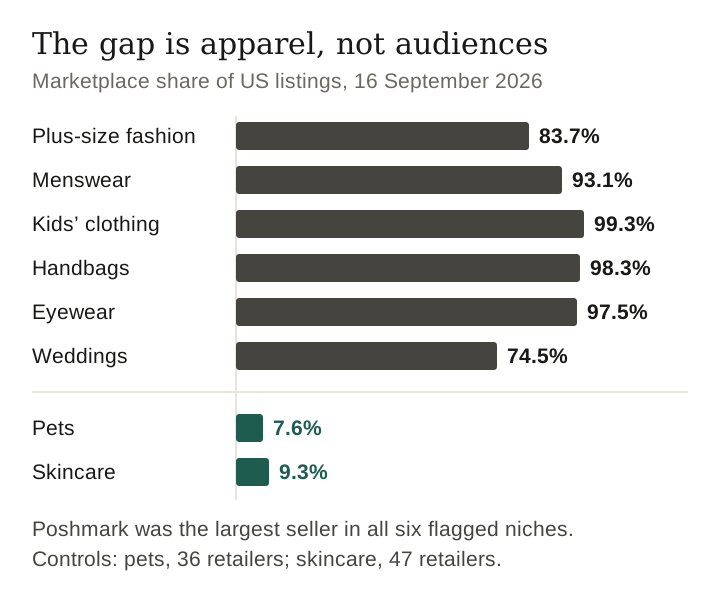
Across 5,442 live US listings pulled on 16 September 2026, the six creator niches flagged as having no affiliate catalogue came back 74.5% to 99.3% peer-to-peer marketplace listings, with Poshmark the largest seller in every one. Two control niches, pets and skincare, came back at 7.6% and 9.3% across 36 and 47 retailers. The dividing line is not the audience. It is whether the thing is clothing.
Last verified 16 September 2026 against 5,442 live US listings across 24 category searches in eight creator niches
The question, and why it needed asking twice
On 3 September we sized twenty-four creator niches on one seed term each and found six that came back almost entirely peer-to-peer resale: plus-size fashion, menswear, kids’ clothing, handbags, eyewear and weddings. Menswear returned one retailer. The note we wrote against that table said, in as many words, that a one-retailer result is more likely a failure of the search term than a fact about the market, and that nobody should publish it until it had been tested three ways.
This is that test. Three seed terms per niche, three pages of 100 rows each, plus two niches carried as controls because a study that only examines the cases it expects to fail is not a study. 5,442 US rows in total, pulled on 16 September 2026.
What came back
| Niche | US rows | Retailers | Largest single seller | Marketplace share | Median ask |
|---|---|---|---|---|---|
| Plus-size fashion | 596 | 5 | Poshmark 80.5% | 83.7% | $26.00 |
| Menswear | 715 | 11 | Poshmark 93.1% | 93.1% | $25.00 |
| Kids' clothing | 753 | 4 | Poshmark 99.3% | 99.3% | $14.00 |
| Handbags | 775 | 7 | Poshmark 98.3% | 98.3% | $25.00 |
| Eyewear | 720 | 8 | Poshmark 97.5% | 97.5% | $25.00 |
| Weddings | 711 | 7 | Poshmark 73.8% | 74.5% | $50.00 |
| Pets | 622 | 36 | Wayfair North America 24.9% | 7.6% | $16.74 |
| Skincare | 550 | 47 | eCosmetics.com 27.1% | 9.3% | $32.89 |
The gap is real and it is not subtle. Every one of the six flagged niches came back between 74.5% and 99.3% peer-to-peer marketplace listings, with Poshmark the largest seller in all six. The two controls came back at 7.6% and 9.3%, across 36 and 47 retailers. That is not a difference of degree.
What the old table got wrong
Two of its numbers do not survive, and both were retailer counts.
| Niche | Retailers, 3 Sept (one seed) | Retailers, 16 Sept (three seeds) | Marketplace share now |
|---|---|---|---|
| Plus-size fashion | 2 | 5 | 83.7% |
| Menswear | 1 | 11 | 93.1% |
| Kids' clothing | 2 | 4 | 99.3% |
| Handbags | 1 | 7 | 98.3% |
| Eyewear | 3 | 8 | 97.5% |
| Weddings | 5 | 7 | 74.5% |
Menswear is the correction that matters: one retailer became 11. Read on its own that looks like the absence evaporating. It is not. Those 10 retailers supply 6.9% of the rows between them, because Poshmark alone supplies 93.1%. The count moved; the concentration did not. A retailer count is the wrong statistic for this question, and we were using it — as we have written elsewhere, it is a property of the search at least as much as of the market.
Keep reading
The seed term decides the answer, and here is the proof
Weddings is the niche that shows it cleanly, because its three seeds disagree with each other more than the niches disagree with each other:
| Seed term | US rows | Retailers | Marketplace share | Median ask |
|---|---|---|---|---|
| wedding dress | 248 | 3 | 97.6% | $200.00 |
| bridesmaid dress | 267 | 1 | 100.0% | $50.00 |
| wedding decor | 196 | 7 | 10.7% | $23.99 |
Bridesmaid dress returns one retailer and 100.0% marketplace. Wedding decor returns 7 retailers and 10.7%. Same niche, same morning, opposite answers — and the honest conclusion is not that weddings have no catalogue. It is that wedding clothing has no catalogue and wedding decor has a perfectly ordinary one.
Apply that lens to the whole table and the pattern reorganises itself. Plus-size fashion, menswear, kids’ clothing, bridesmaid dresses: apparel. Handbags and eyewear: worn accessories. Pets, skincare, wedding decor: objects. The affiliate catalogue gap is not a gap in audiences. It is a gap in clothing. We will argue that position because the data we hold supports it, and we will say plainly what would refute it: a clothing seed that comes back with twenty retailers and low marketplace share. We did not find one in nine apparel seeds today.
Why clothing behaves this way is not in our data. A plausible reading is that clothing retailers run their own affiliate programmes through networks we are not in, or do not publish product-level feeds at all, while resale marketplaces publish every individual item. That is an inference, not a measurement, and we have not asked a single retailer. Anyone quoting this should quote the share, not the explanation.
What a creator should do with this on Monday
Three consequences, in the order they will bite.
- Your links are one-of-one, so they rot. A resale listing is a single garment. When it sells, the link is dead and your post still points at it. In a retail catalogue the same link survives a sale. This is measurable and we have measured it: in-stock share by niche is a link-durability number, and resale carries a link-rot tax.
- The marketplace will not tell you when it happens. Peer-to-peer feeds in every lane we have measured never mark a row out of stock — they delist it. So an availability check on that half of the catalogue returns nothing useful, and the field is silent exactly where you need it.
- Link the category, not only the item. Where the inventory is one-of-one, a link to a search or a brand page survives a sale where a product link does not. It converts worse. It also still exists next month, which a dead link does not.
And the strategic one, which we would rather say than imply: if you make clothing content and you want linkable inventory, the adjacent objects in your own frame — the bag, the lamp, the mug, the pet bed — sit in catalogues with 36 and 47 retailers rather than one. That is not advice to abandon your niche. It is where the shelf is.
Method, and what this cannot show
Eight niches, three seed terms each, twenty-four searches against the CJ shopping-product API on 16 September 2026, US advertisers, three pages of 100 rows per seed, deduplicated within a niche on retailer, title and destination URL and filtered again on each row’s own country field. Seeds, verbatim: Plus-size fashion: plus size dress, plus size clothing, curve jeans; Menswear: mens shirt, menswear, mens trousers; Kids' clothing: kids clothing, toddler outfit, girls dress; Handbags: handbag, shoulder bag, tote bag; Eyewear: sunglasses, eyeglass frames, reading glasses; Weddings: wedding dress, bridesmaid dress, wedding decor; Pets: dog bed, cat toy, dog collar; Skincare: face serum, moisturiser, sunscreen. Asking price is the sale price where published and the list price otherwise; peer-to-peer asks at or above $500 are excluded as seller placeholders. Marketplace share counts rows from peer-to-peer platforms — Poshmark, eBay, Etsy, Mercari, Depop, ThredUp and their peers.
What it cannot show. It reads one affiliate network, so “no catalogue” means no catalogue we can link, not no retailer in America; a brand running its own programme elsewhere is invisible here and its absence is our blind spot, not its business failure. Three seeds is better than one and is still three. And a marketplace share is a share of listings, not of sales, which nobody in this market publishes.
Frequently asked
Which creator niches have no affiliate catalogue?
On 16 September 2026, plus-size fashion, menswear, kids' clothing, handbags, eyewear and wedding clothing all returned 74% to 99% peer-to-peer marketplace listings in a US affiliate catalogue, led by Poshmark in every case.
Does that mean nobody sells those things?
No. It means the product-level catalogue a publisher can link is almost entirely resale. Retailers may run programmes on networks we do not read, or publish no product feed at all. The absence is an absence in linkable inventory, not in retail.
Why does the seed term matter so much?
Because it decides the population. In the weddings niche, 'bridesmaid dress' returned one retailer and 100% marketplace listings while 'wedding decor' returned seven retailers and 10.7%. The niche is not empty; the clothing inside it is.
What does a high marketplace share cost a creator?
Durability. A resale listing is a single item, so the link dies when it sells, and peer-to-peer feeds delist rather than mark a row out of stock, so nothing warns you. Retail links survive the sale.
Which niches came back healthy?
The two controls. Pets returned 36 retailers at 7.6% marketplace listings and skincare 47 retailers at 9.3%, both with ordinary retail price spreads.
How this page was made. Drafted with AI (Claude); not yet independently re-checked. How we work