LinkToLooks · Guides · Creator Desk
Creator Desk
What do creators actually have to disclose?
Part of: For creators
The rule creators actually need is short: if you get anything of value in return for a recommendation, and your audience would not assume that, say so where they will see it. Everything else is detail. Here is the detail, with the regulation’s key words quoted rather than paraphrased from folklore.
What the regulation says, with its key words quoted
| What the rule says | Where it says it |
|---|---|
| An endorsement is any ad, marketing or promotional message about a product that people are likely to take as one that "reflects the opinions, beliefs, findings, or experiences of a party other than the sponsoring advertiser". | 16 CFR § 255.0(b) |
| A connection has to be disclosed when it "might materially affect the weight or credibility of the endorsement" and the audience would not reasonably expect it. | 16 CFR § 255.5 |
| Such a connection "must be disclosed clearly and conspicuously", judged from the point of view of the audience. | 16 CFR § 255.5 |
Two things follow from that language and they are the two most commonly missed.
First, the trigger is the connection, not the money. A connection you have to disclose is anything that might change how your audience weighs the recommendation and that they would not reasonably expect — a commission, a gifted product, a discount code that pays you, an affiliate relationship, a job at the company, a family tie. Whether a sale ever happens is irrelevant. You are not disclosing income; you are disclosing a reason a reader might discount your opinion.
Second, "clear and conspicuous" is measured on the audience, not on you. A disclosure that technically exists but that nobody reads has not met the standard. That single sentence disposes of most of the placements creators actually use.

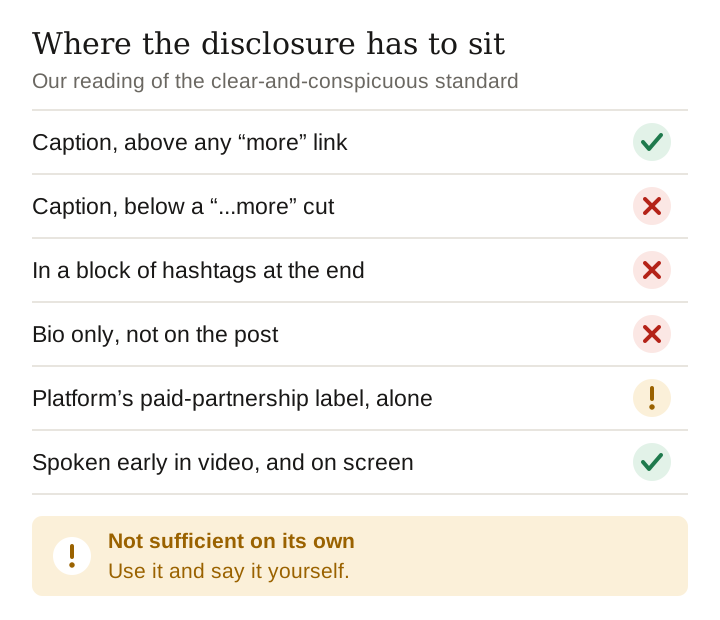
Where the disclosure has to sit
| Placement | The problem with it | Verdict |
|---|---|---|
| In the caption, above the fold, before any "more" link | None. The reader sees it before they read the recommendation. | Works |
| In the caption, below a "...more" truncation | A reader who does not expand the caption never sees it. A disclosure they do not see is not conspicuous. | Fails |
| In a block of hashtags at the end | Buried among unrelated tags, and read as decoration rather than as information. | Fails |
| Bio only, not on the post | The disclosure has to travel with the endorsement. Posts are seen individually and reshared without the profile. | Fails |
| Platform's own paid-partnership label, alone | It is placed and worded by the platform, not by you, and it may not cover an affiliate-commission relationship at all. | Not sufficient on its own |
| Spoken aloud in video, and on screen in text | None, provided it is early enough that a viewer who leaves at fifteen seconds has heard it. | Works |
Every product link in a post carries the same obligation. One disclosure covering the post is fine; no disclosure is not.
Wording that works, and wording that does not
- Works: plain, ordinary words. "I earn a commission if you buy through my links." "Paid partnership with [brand]." "[Brand] sent me this."
- Fails: jargon and abbreviations your audience has to decode. "aff", "sp", "collab", "#ad" buried in a hashtag wall, "thanks [brand]" with no statement of the relationship, and anything in a language the audience does not read.
- Fails quietly: a disclosure in grey 10-point text on a white background, or one that flashes on screen for a second. Conspicuousness is about whether it is actually noticed.
The parts creators get wrong most often
- Assuming the platform's label is enough. A built-in paid-partnership tag is placed and worded by the platform. It may not describe an affiliate-commission arrangement, and it is not within your control. Use it and say it yourself.
- Disclosing once, at the top of a series. Individual posts get seen individually. Each one needs its own.
- Thinking a free product does not count. A gifted item is a material connection even if no money changed hands and even if you were free to say you hated it.
- Putting it only in a linked page. A disclosure a reader has to click through to is not one they saw before reading the recommendation.
Our own disclosure, as a worked example
Every page on this site ends with a line saying that LinkToLooks holds no affiliate approvals and that no link on the page pays us, with the date that was checked. It reports that there is no connection, which is why it can sit at the end: no link here pays us, so there is nothing a reader needs to weigh before a recommendation. The day a link here does pay us, the rules above apply to us exactly as they apply to you, and a line at the end of the page will no longer do. If nothing pays you either, you are welcome to copy the shape of it.
Last verified 10 October 2026 against the text of 16 CFR Part 255, sections 255.0 and 255.5. Quoted phrases are from that text. Placement and wording guidance is our reading of the clear-and-conspicuous standard applied to how the platforms actually render posts, and is labelled as our reading rather than as regulation.
Frequently asked
Do I have to disclose affiliate links?
Yes, where the relationship is one your audience would not reasonably expect. Under 16 CFR 255.5 a connection that "might materially affect the weight or credibility of the endorsement", and that your audience would not reasonably expect, "must be disclosed clearly and conspicuously". An affiliate commission is such a connection.
Is #ad in my hashtags enough?
Not reliably. The standard is that the disclosure is clear and conspicuous to the audience, and a tag buried in a block of unrelated hashtags at the end of a caption is read as decoration rather than as information.
Do I need to disclose a gifted product if I was not paid?
Yes. A free product is a material connection whether or not money changed hands, and whether or not you were free to give a negative review.
Is the platform's paid partnership label sufficient?
Use it, but do not rely on it alone. The label is worded and positioned by the platform, is outside your control, and may not describe an affiliate-commission relationship at all.
Where exactly should the disclosure go?
Before the recommendation and where it cannot be truncated away: in the visible part of a caption above any "more" link, spoken aloud early in a video as well as shown on screen, and on each individual post rather than once in a bio.
Sources
- 16 CFR Part 255, Guides Concerning Use of Endorsements and Testimonials in Advertising — the definition of an endorsement at 255.0(b), and the material-connection definition and disclosure requirement at 255.5.
Read next
How creators actually get paid · Affiliate cookie windows, explained · LTK vs ShopMy vs Mavely
How this page was made. Researched and drafted with AI (Claude); checked by a separate automated pass on 12 October 2026. How we work