LinkToLooks · Guides · Creator Desk
Creator Desk
What can a LinkedIn creator actually link to?
Six professional categories, 1,800 live listings, 19 retailers. The platform permits more than the catalogue can supply.
Part of: For creators
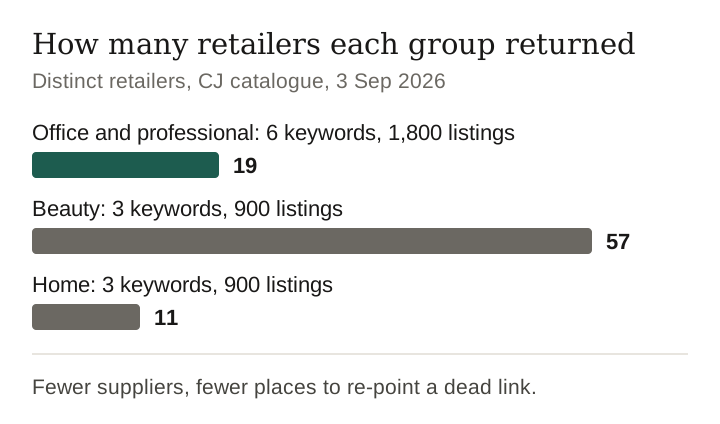
LinkedIn is not the constraint on a professional creator's affiliate links. The catalogue is. On 3 September 2026 we pulled 1,800 live listings across six office and professional keywords and found 19 distinct retailers. Three beauty keywords pulled 900 listings and returned 57. Per keyword, that is 3.2 retailers against 19.
And what does come back is not office supply. The office pull is dominated by home-office furniture from home-goods retailers: Wayfair North America was the largest supplier for office chairs, desk organisers and conference tables. Of 300 ‘printer paper’ listings, only 38 were priced in US dollars.
What the professional catalogue actually holds
Six keywords, 300 listings read for each, in-stock only, on 3 September 2026:
| Keyword | Listings read | Distinct retailers | Largest supplier | Rows priced in USD | Median USD price |
|---|---|---|---|---|---|
| Office chair | 300 | 4 | Wayfair North America (214) | 214 | $359.99 |
| Standing desk | 300 | 7 | Wayfair UK (105) | 192 | $531.50 |
| Desk organiser | 300 | 10 | Wayfair North America (160) | 181 | $35.99 |
| Printer paper | 300 | 10 | OnBuy EU (167) | 38 | $17.93 |
| Conference table | 300 | 8 | Wayfair North America (197) | 295 | $1,229.99 |
| Business card holder | 300 | 7 | OnBuy EU (104) | 81 | $30.00 |
Prices checked 3 September 2026 against live listings pulled from the CJ product catalogue. Medians are computed on the USD rows only. The catalogue API takes no country argument at all — it is absent from the schema rather than withheld from us — so each pull is global, and the USD column is how much of it a US audience could actually buy.
Two things jump out of that table. The furniture is well supplied and expensive — conference tables at a $1,229.99 median, standing desks at $531.50, chairs at $359.99. The consumables barely exist in dollars: printer paper returned 300 rows and 38 of them were USD, with a UK marketplace as the largest supplier.
For a creator whose audience is American professionals, that is a catalogue of high-ticket home-office furniture, not an office-supply shelf. It is a real business — a $359.99 chair is worth more per sale than a $17.93 ream of paper by any commission structure — but it is a narrower one than ‘B2B affiliate’ suggests, and it repeats itself quickly.

Against beauty and home
| Group | Keywords | Listings | Distinct retailers | Retailers per keyword | Share priced in USD | Median USD price |
|---|---|---|---|---|---|---|
| Office / professional | 6 | 1,800 | 19 | 3.2 | 55.6% | $329.99 |
| Beauty | 3 | 900 | 57 | 19.0 | 29.4% | $48.00 |
| Home | 3 | 900 | 11 | 3.7 | 57.3% | $65.00 |
Beauty is the outlier in supplier diversity: three keywords, 57 distinct retailers, 19 per keyword. Office managed 3.2 and home 3.7. The consequence for a creator is link durability. When one retailer supplies most of a category, that retailer's stock decisions are your dead links, and there is nowhere obvious to re-point them.
Beauty pays for that diversity in a different currency: only 29.4% of its rows were priced in dollars, the lowest of the three groups. There is no group in this pull that is simultaneously deep, diverse and reliably US-priced.
A correction to our own expectation
We went into this pull expecting the professional category to be the thinnest thing we had measured. It is not. Home came back just as concentrated — 3.7 retailers per keyword against office's 3.2, a gap well inside the noise of a six-keyword sample, and home is a category nobody calls underserved.
So the finding is narrower and more useful than ‘B2B is empty’. It is that beauty is unusually well supplied and most other categories look like office does: two or three retailers doing most of the work, one of them frequently overseas. Publishing the version that flattered our expectation would have been easy and wrong, and we would rather correct ourselves in public than carry a claim the data does not support.
What LinkedIn's own crawl rules say
We also read linkedin.com/robots.txt on 3 September 2026 with a Googlebot user agent, since a professional creator's second question is usually whether the post will be found later:
- 120,190 bytes, the largest robots file of the five platforms we checked, with 77 user-agent blocks and 4,398 Disallow rules in total.
- 109 rules address Googlebot by name, one of which disallows
/feed/update/— the URL form a post carries when it is reached through the feed. - No sitemap is listed in the file at all. Pinterest advertises 50 there; LinkedIn advertises none.
We are not going to extrapolate from that to a claim about whether any given LinkedIn post ranks. A missing sitemap line is not a block, and one disallowed URL form is not all URL forms. But if your plan was for a LinkedIn post to keep earning through search a year from now, the platform is not visibly asking for that.
What actually works on LinkedIn
- Sell the expensive thing. The catalogue's strength is high-ticket home-office furniture. One chair at a $359.99 median is worth many reams of paper, and it is what the inventory can actually support.
- Check the currency before you write the price. Over 40% of the professional rows we pulled were not in dollars. A price quoted from a feed without checking its currency is a mistake waiting to be screenshotted.
- Do not build the post around one retailer. With three or four suppliers per keyword, a stock-out has nowhere to go. Pick products that appear at more than one retailer where you can.
- Put the durable version somewhere it will be crawled. If the piece should still earn next year, the LinkedIn post is the distribution and something you control is the asset.
- Disclose the same way you would anywhere else. A professional audience is not a lighter disclosure standard, and the regulation does not care which platform you are on.
What we could not check
- LinkedIn's own posting rules for affiliate links. We did not find a policy page we could read and quote on this date, so this page makes no claim about what LinkedIn permits. Read its current terms yourself rather than taking any article's word for it.
- Commission rates, for any of these categories. The catalogue API carries no commission field and no public rate table survived our earlier sourcing attempts. Nothing here says what an office chair pays.
- Whether these retailers accept new publishers. Catalogue access and programme approval are different things — we hold the first and none of the second.
- Click or conversion behaviour on LinkedIn. We have none, for any platform.
- Six keywords is six keywords. A different seed list would return a different retailer count, and a category that looks thin on one term sometimes is not. Treat this as one dated reading.
Frequently asked
Are there affiliate programs for B2B and office products?
There is inventory, but it is narrow. Six office and professional keywords returned 19 distinct retailers across 1,800 live listings on 3 September 2026, concentrated in home-office furniture rather than office supply.
What sells best for a professional audience?
By what the catalogue actually holds: chairs, standing desks, desk organisers and conference furniture, at USD medians of $359.99, $531.50, $35.99 and $1,229.99 respectively. We have no sales data, only supply data.
Why is office inventory so concentrated?
We measured the concentration rather than its cause. Wayfair North America was the largest supplier for three of six keywords; the consumable keywords were led by a UK marketplace with few US-priced rows.
Do LinkedIn posts rank in Google?
LinkedIn's robots.txt lists no sitemap and disallows the /feed/update/ URL form for Googlebot. That is not a statement about ranking, but it is not an invitation either.
What commission do these categories pay?
Unknown, and we will not estimate it. The product API has no commission field, and every public category rate table we examined was unsourced and contradicted the others.
Method
- Source: CJ
shoppingProducts, publisher company ID 8058658, in-stock filter, 3 September 2026. - Read depth: offsets 0, 100 and 300, 100 rows each, for every keyword.
- Keywords: office chair, standing desk, desk organizer, printer paper, conference table, business card holder; against serum, lipstick, moisturizer and throw pillow, area rug, table lamp.
- Retailer counts are distinct advertiser names in the returned rows, unmerged — sibling banners of one company count separately, which if anything overstates diversity.
- Medians use USD rows only. There is no country filter in the catalogue API's schema, so every pull is global.
Keep reading
Last verified 3 September 2026 against 1,800 live office and professional listings and 1,800 beauty and home listings pulled, plus linkedin.com/robots.txt
How this page was made. Drafted with AI (Claude); not yet independently re-checked. How we work