LinkToLooks · Guides · Creator Desk
Creator Desk
Should creators link marketplaces or brand sites?
The answer is not 'whichever pays more'. It is a trade between a catalogue that has everything and a link that is still alive next month.
Part of: For creators
Link the retailer when the product is current, and the marketplace only when it is not. On 2 September 2026 we measured 1,604 US sneaker listings: the resale marketplace asked more than retail in five of the six models we measured, and every resale link points at a single item that dies when it sells.
The marketplace's advantage is not price and it is not permanence. It is that the marketplace has the thing that no longer exists anywhere else.
One marketplace holds nearly the whole catalogue
We paged 2,000 consecutive results for air jordan 1 through the CJ product API on 2 September 2026, filtered to US advertisers. 1,998 of those 2,000 rows came from a single marketplace. To see any retailer at all we had to explicitly exclude that one advertiser from the query.
This is the first thing a creator should understand about marketplace links: a marketplace is not one more shop in your list, it is a different order of magnitude. It will supply an answer to nearly any product query you have, which is exactly why it is tempting and exactly where the trap is.

Resale is not the cheap option
| Sneaker model | Resale listings | Resale median | Retail listings | Retail median |
|---|---|---|---|---|
| Air Jordan 1 | 198 | $140.00 | 206 | $89.99 |
| Nike Dunk | 185 | $120.00 | 64 | $115.00 |
| Nike Air Force 1 | 144 | $98.50 | 18 | $84.99 |
| Adidas Samba | 176 | $100.00 | 86 | $77.99 |
| New Balance 550 | 138 | $102.50 | 73 | $139.99 |
| Converse Chuck Taylor | 228 | $55.00 | 88 | $50.00 |
1,604 US listings pulled 2 September 2026. 'Resale' is the Poshmark feed; 'retail' is every other US advertiser for the same query. Resale prices are asking prices, not sale prices.
Five of six models asked more on resale than at retail. The Air Jordan 1 gap is the widest: $140.00 against $89.99, a 56% premium on the same search term. Only the New Balance 550 came in cheaper on resale, at $102.50 against $139.99.
We want to be careful about what this does and does not prove, because the obvious reading is wrong. It does not prove resale sellers overcharge. Resale inventory skews to sold-out colourways that retail no longer carries, and a marketplace asking price is an ask, not a sale. What it does prove is narrower and more useful: if you send a reader to a marketplace for a shoe that is still on a retailer's shelf, you are probably sending them to a higher price.
The trade, on objective criteria
| Criterion | Marketplace listing | Brand or retailer listing |
|---|---|---|
| Catalogue depth | Very deep — 1,998 of 2,000 consecutive sneaker rows came from one marketplace | Shallower per advertiser; Nike returned 38 rows to Poshmark's thousands |
| Listing lifespan | One item, one seller; the link dies when it sells | Survives the sale; restocks under the same URL |
| Size availability | Usually a single size | Full size run on one link |
| Price | Higher than retail in 5 of the 6 models we measured | Lower, and more often discounted |
| Discontinued items | The only place they exist | Gone once the season ends |
| Photography | Seller photos, inconsistent, sometimes worn | Consistent packshots supplied in the feed |
| Returns | Marketplace policy, often stricter | Retailer policy, usually generous |
| What breaks | The specific item sells | The colourway is discontinued |
Criteria are objective and observable; the counts come from our 2 September 2026 pull.
The row that decides most cases is listing lifespan. A retailer's product URL survives the sale and often survives a restock. A marketplace listing is one physical item; the moment it sells, your link becomes a dead end, and every post that carried it becomes a dead end with it.
That is not a small maintenance problem. It is the reason a post from six months ago earns nothing even though people are still watching it.
A rule you can apply this week
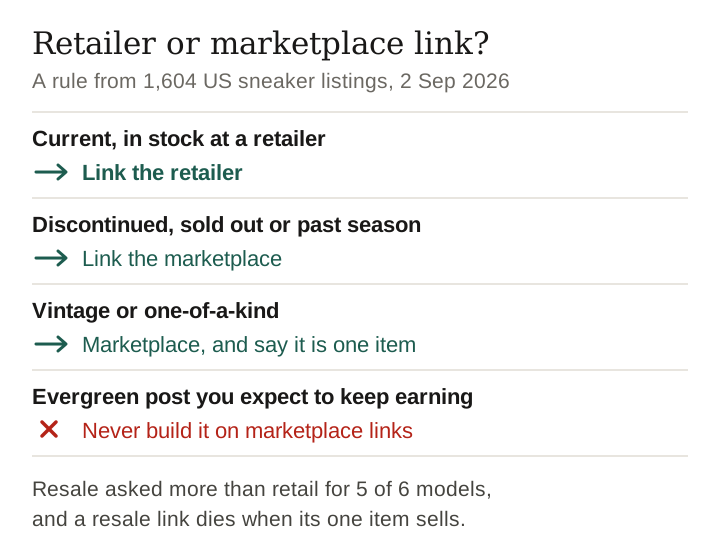
- Current product, in stock at a retailer? Link the retailer. Full size run, one durable URL, usually the lower price.
- Discontinued, sold out, or a past-season colourway? Link the marketplace. It is genuinely the only place it exists, and this is where marketplaces earn their keep.
- Vintage or one-of-a-kind by nature? Marketplace, and say in the caption that it is one item and may already be gone. Readers forgive a sold-out link they were warned about.
- Evergreen post you expect to keep earning? Never build it on marketplace links. Every one of them is a timer.
Where the marketplace is genuinely better and we will say so: depth, discontinued stock, and price in categories where retail rarely discounts. Our New Balance 550 row is a real counterexample to our own argument and we have left it in the table rather than dropping an inconvenient line.
What we could not measure
- Condition is not controlled. Resale rows mix new-with-tags and worn; retail rows are new. A used pair asking more than a new one is a fact about the sample, not proof of anything about sellers.
- Colourway is not controlled. Hyped colourways sit on resale and not at retail. This alone could explain much of the premium.
- Asking prices are not sale prices. We can see what marketplace sellers ask. We cannot see what anything sold for.
- No commission rates. We hold no network approvals, so we cannot compare what either side pays — only what they cost the reader.
- One query family, one day. Six sneaker models on 2 September 2026.
Frequently asked
Is resale cheaper than retail for sneakers?
Not in our sample. Across 1,604 US listings pulled on 2 September 2026, the resale median was above the retail median for five of six models, including $140.00 against $89.99 for the Air Jordan 1.
When should a creator link a marketplace?
When the product is discontinued, sold out at retail, or one-of-a-kind. Marketplaces hold inventory that no longer exists anywhere else, and that is their real advantage.
Why do marketplace links break so often?
Because each listing is a single physical item. When it sells, the URL dies. A retailer's product page survives the sale and often survives a restock.
Do marketplaces have more products than brands?
Vastly more. Paging 2,000 consecutive US results for one sneaker query returned 1,998 rows from a single marketplace and 2 from everyone else.
Method and scope
- Source: CJ product feeds, queried live on 2 September 2026, advertiser country set to the United States.
- Six model queries. For each, one pull restricted to the Poshmark advertiser ('resale') and one excluding it ('retail'). Titles were filtered to require the model name; rows without a usable price were dropped.
- 1,604 listings in total: 1,069 resale, 535 retail. Medians are of listed asking price.
- Condition, size and colourway are not controlled for. This is the main limitation and it is stated in the body as well as here.
- We hold no affiliate approvals, so no commission comparison is made or implied.
Last verified 2 September 2026 against 1,604 live US sneaker listings pulled from CJ product feeds
How this page was made. Drafted with AI (Claude); not yet independently re-checked. How we work