LinkToLooks · Guides · Creator Desk
Creator Desk
Does the banner you link change what your reader pays?
Yes, twice over: once because sibling storefronts of one retailer sit inside one affiliate catalogue, and once because four US retailers price the identical product 25% apart.
Part of: For creators
We pulled 4,600 live listings from US retailer catalogues on 2 September 2026, with the country filter set to the United States. 113 rows (2.5%) came back priced in a currency other than US dollars — 64 Canadian, 32 Australian, six euro, six sterling, three New Zealand and two rand — and 52 rows came from storefronts whose names say Canada or APAC.
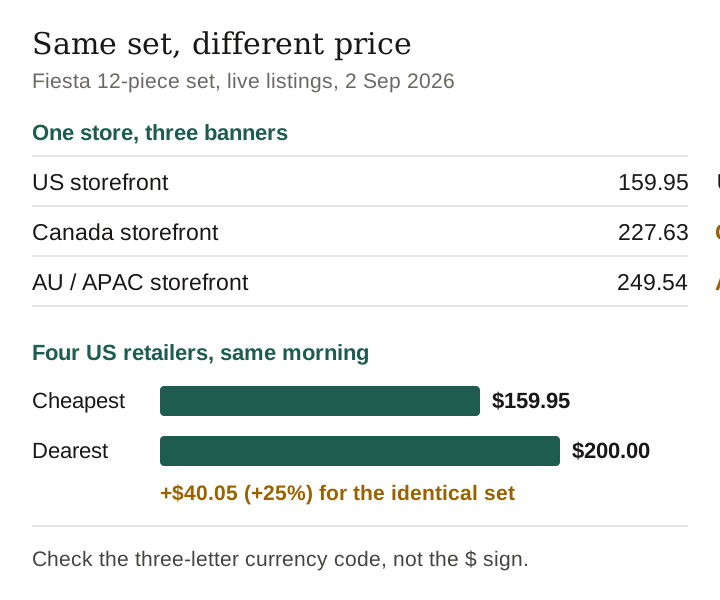
The clearest case: the same Fiesta 12-piece dinnerware set, in the same eight colours, appeared at $159.95 from one banner, 227.63 Canadian dollars from a second and 249.54 Australian dollars from a third — all three inside a query filtered to US advertisers.
The case, in one table
| Storefront | Listed price | Currency | Colours seen |
|---|---|---|---|
| Department store, US | 159.95 | USD | 8 |
| Same store, Canada | 227.63 | CAD | 8 |
| Same store, AU / APAC | 249.54 | AUD | 8 |
48 rows for one product, from a query filtered to US advertisers, 2 September 2026. Prices re-checked 28 September 2026
The product name is byte-identical across all three. So is the description — the same 48 rows share one description string. Nothing in the row except the storefront name and the currency code tells you these are different markets.
If you link the wrong one, a US reader lands on a page quoting 227.63 for a set that costs $159.95 at home. Some will convert mentally and think you sent them somewhere expensive. Some will buy at a shipping and duty premium. Either way the creator who picked the link gets the blame.

It also happens inside the US
The currency problem is the loud version. The quiet one is that four US retailers carried the identical product at materially different prices on the same morning.
| US retailer | Same 12-piece set | Difference vs cheapest |
|---|---|---|
| Department store A | $159.95 | — |
| Home retailer | $159.95 | — |
| Department store B | $161.99 as of 2 September 2026 | +$2.04 |
| Department store C | $200.00 | +$40.05 (+25%) |
Live US listings for the same current-production set, 2 September 2026. Prices re-checked 28 September 2026
A creator sending a reader to the $200.00 listing has cost that reader $40 for nothing. If the commission rate is the same at both — and a creator usually cannot check that — the creator earned about $2 more and the reader paid $40 more. That trade is not one most people would make knowingly.
A four-point check before you paste a link
- Read the storefront name in full. Not the brand — the whole advertiser name. “Retailer” and “Retailer Canada” are different programmes with different links, and the second is a real trap for a US audience.
- Check the currency code, not the symbol. A dollar sign is used by at least five countries in this dataset. The three-letter code is the only reliable signal, and 2.5% of a single catalogue pull carried one that was not USD.
- Open the link once, from your own browser. The landing page shows the currency and the shipping destination immediately. This takes ten seconds and catches everything above.
- Compare the same product across two programmes. A 25% spread on an identical set is not exotic; it was the first product family we looked at today.
The position: pick the reader’s price
An argued claim. When two programmes carry the same product, link the cheaper one for the reader even when you cannot see which pays you more.
The reasoning is asymmetric risk rather than virtue. The commission difference between two programmes on one product is typically a percentage point or two of the same order value — on this set, roughly two dollars. The price difference we measured was forty. A reader who notices they overpaid by $40 through your link does not come back, and one lost reader costs more than every commission that link would ever have paid.
What would change our mind: a case where the cheaper retailer has materially worse returns or delivery, which is a real trade and one we cannot measure from feed data. If you know that from your own experience with a retailer, that knowledge beats this rule.
Frequently asked
Can an affiliate product feed return non-US prices?
Yes. In our pull of 4,600 catalogue rows on 2 September 2026, 113 rows (2.5%) were priced in Canadian dollars, Australian dollars, euro, sterling, New Zealand dollars or rand.
How big can the price gap be between two retailers?
We measured 25% on an identical dinnerware set across four US retailers on the same morning — $159.95 against $200.00.
How do I tell a foreign banner from the US one?
Read the full advertiser name and the three-letter currency code, then open the link once yourself. The dollar symbol alone is used by several countries in this data.
Should I link the cheaper retailer or the higher-paying one?
The cheaper one, on our reading. The commission gap between two programmes on one product is usually a couple of dollars; the price gap we measured was forty.
Method and scope
- 4,600 live listing rows pulled from US retailer catalogues via the CJ product API on 2 September 2026, with advertiserCountries set to US.
- Currency counts are taken from the currency code on each listing’s price object. Foreign banners were identified by advertiser name.
- The four-retailer comparison uses listings for the same current-production 12-piece set, matched on product name.
- We hold no commission-rate data. Nothing on this page asserts what any programme pays.
Last verified 28 September 2026: the Fiesta listings in both tables re-checked against live US retailer listings — six unchanged, one not re-found and shown as of 2 September 2026. The 4,600-row currency count is as of 2 September 2026.
Keep reading
How this page was made. Drafted with AI (Claude); not yet independently re-checked. How we work