LinkToLooks · Guides · Creator Desk
Creator Desk
Amazon Associates or a creator storefront?
We read Amazon’s Associates terms line by line so you do not have to — including the clause that ends your attribution window early, and the four places Amazon simply wins.
Part of: For creators
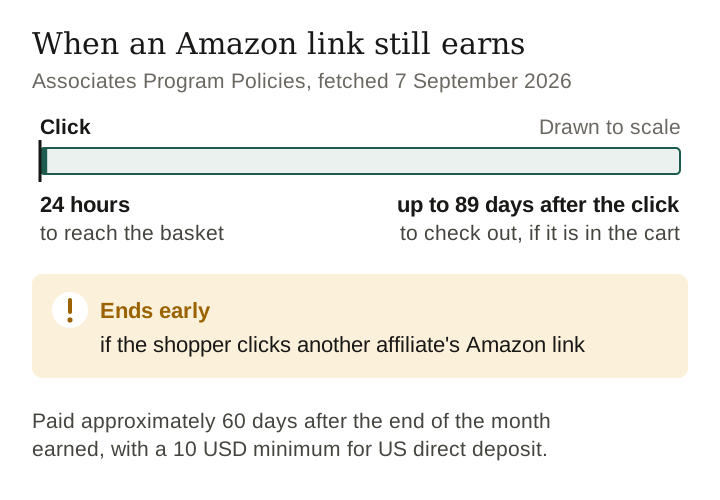
The 24-hour window, and the 89-day clause under it
Almost every creator knows Amazon’s cookie is 24 hours. Fewer have read what the 24 hours are actually attached to. From the Associates Program Policies, fetched 7 September 2026, a qualifying session begins when a customer clicks your link and ends on the first of three events: (x) 24 hours pass after that click, (y) the customer orders a product other than a digital one, or (z) the customer clicks through “a Special Link to an Amazon Site that is not your Special Link”.
Read (z) again, because it is the clause that costs money and almost nobody mentions it. Your window does not only expire on a clock. It ends the moment the shopper clicks somebody else’s Amazon affiliate link. On a platform where a shopper may open three creators’ link-in-bios in an evening, that is a real mechanism, not a technicality.
The clause that runs the other way is more generous than the reputation suggests. If the shopper adds the item to their cart inside the session, Amazon pays when they complete the order “no later than 89 days after their initial click-through”. So the honest summary is not “24 hours”. It is: 24 hours to get something into the basket, then up to 89 days to check out — unless another affiliate link intervenes first.
Last verified 10 October 2026 against the Amazon Associates Program Policies and Operating Agreement, both fetched live and quoted verbatim
Sources fetched 7 September 2026 with a browser user-agent, and linked here so you can read them yourself. Amazon’s Associates Program Operating Agreement and its Program Policies returned 200; so did LTK’s terms of service and Linktree’s terms. Beacons’, Meta’s and ShopMy’s terms could not be read in full, so none of them is characterised here. We quote what we could read and name what we could not. These are editorial citations, not affiliate links: we earn nothing if you follow them.

When the money actually arrives
Two numbers, both quoted rather than characterised. Payment timing: Amazon pays “approximately 60 days following the end of each calendar month in which they were earned”. So a commission earned on 1 September is paid around the end of November — roughly 90 days from the sale, not 60.
Payment minimum, from the Payment Minimum Chart in the same document: 10 USD for direct deposit in the US, and the terms reserve “the right to hold commission income until the total amount due reaches the minimum”. That is in line with the minimums other networks publish: impact.com and eBay Partner Network also set 10 USD, and Awin 20 USD.
| Term | What Amazon's own documents say | Where |
|---|---|---|
| Attribution window | 24 hours from the click, ending early if the shopper clicks another affiliate's Amazon link | Program Policies |
| Cart completion | Order may complete up to 89 days after the initial click if the item entered the cart in-session | Program Policies |
| Payment timing | Approximately 60 days after the end of the month earned | Program Policies |
| Payment minimum | 10 USD, direct deposit, US | Payment Minimum Chart |
| Image use | A link to a catalogue image may be stored for up to 24 hours, then must be refreshed | Program Policies |
| Termination | Commission income may be permanently withheld on violation, and re-joining needs advance authorisation | Operating Agreement / Policies |
Keep reading
The rule that catches storefront builders
This one is buried in the API and content section and it governs any page showing product images obtained through Amazon’s Creators API, PA API or a data feed: you may not store or cache the images themselves, and you may keep “a link to Product Advertising Content consisting of an image for up to 24 hours”, after which it must be refreshed from the API or a new data feed.
A page that hot-links Amazon product images and sits unchanged for six months is not complying with that, however ordinary it looks. It is worth knowing before you build a permanent shelf of Amazon imagery, and it is one of the few places where the choice of programme genuinely constrains the design of your page rather than just its economics.
What happens if they close your account
Its key words, quoted because paraphrase softens them: Amazon reserves the right to “permanently… cease payment of” all the commission income you would otherwise be paid under the agreement, which you agree you are not eligible to receive, “whether or not directly related to such violation”. And on returning: if Amazon closes your account for a violation or abuse, judged “in our sole discretion”, you “cannot attempt to re-join the Associates Program without our advance authorization”.
Every platform has a version of this clause, ours included in spirit. What is unusual here is the breadth — unrelated earnings, sole discretion, and a re-entry gate. That is the actual argument for not having every link you own point at one programme, and it is a stronger argument than any commission-rate comparison.
Where Amazon is simply the better answer
We are one of the alternatives being compared here, so this section is the important one, and none of it is grudging.
- Catalogue breadth. Nothing in the affiliate world comes close.
- Shopper trust and checkout. A reader who already has an account, a saved card and Prime shipping converts at a rate no comparison table captures. That is a genuine advantage and it is not ours.
- One account, one payout, one tax form. The operational overhead of a multi-network storefront is real, and for a creator posting a few links a week it may not be worth carrying.
- The whole-basket rule. Within the session, commission is not limited to the item you linked. For a creator whose audience shops broadly, that is worth more than a headline rate.
Where we sit, on the same criteria
Held to the identical standard, and stated plainly because a comparison that flatters the author is worthless:
- We hold no network approvals. Amazon has a functioning programme; we have a product and a waiting list.
- There is no self-serve signup. We start only when a creator asks: we read that creator’s posts, identify the products, match retailers, and the creator approves product by product before anything goes live. The request form on the LinkToLooks creators page is a request, not an account.
- We publish no terms of service. Amazon’s are long and one-sided, but they are published, dated and quotable — which is more than we can currently say, and it is a gap we should close.
- Our data-deletion page says what deletion covers and when. A request to privacy@linktolooks.com is completed within 7 days: what we hold from a creator’s posts is deleted and anything built from it comes down. There is no undo; if you want it back it is rebuilt from scratch.
How to choose between them
The question is not which programme pays more, because you cannot find that out reliably and neither can anyone quoting a rate table at you. The question is what your content actually does.
- If your posts send people to buy a broad basket of ordinary things, the session-wide rule and the catalogue depth make Amazon hard to beat.
- If your posts feature specific items from specific retailers — a brand of serum, a particular chair — a storefront spanning several programmes carries products Amazon does not, and the concentration risk in the termination clause above is the reason not to put everything in one place.
- If you cannot answer either way yet, the cheap move is to keep your own list of what you linked and where, independent of any platform. That is portable no matter which of us you end up using.
Keep reading
Frequently asked
Is the Amazon affiliate cookie really only 24 hours?
The session is 24 hours, but if the shopper adds the item to their cart within it, the order can complete up to 89 days later and still qualify. The session also ends early if they click a different affiliate’s Amazon link.
When does Amazon pay affiliate commission?
Approximately 60 days after the end of the calendar month in which it was earned, with a 10 USD minimum for US direct deposit.
Can you use Amazon product images on your own storefront?
The Program Policies permit storing a link to a catalogue image for up to 24 hours, after which it must be refreshed. Storing the catalogue image itself is not permitted.
Should a creator use only one affiliate programme?
That is a judgement, not a measurement. The clause worth weighing is the one allowing all commission income to be withheld on termination, whether or not related to the violation.
How this page was made. Researched and drafted with AI (Claude); checked by a separate automated pass on 12 October 2026. How we work