LinkToLooks · Guides · Creator Desk
Creator Desk
Should your creator storefront be indexed by Google?
The upside is slower than the pitch suggests and the downside is permanent — here is the decision, argued from what the search engines themselves document.
Part of: For creators
Index it if the storefront is meant to be found by strangers; keep it out of the index if it is a list you send to people who already follow you. That sounds obvious until you notice that most creators never make the choice deliberately, and that the two options fail in completely different directions.
One fact should set your expectations before you decide. Google says it does not guarantee that it will crawl, index or serve a page, even one that follows its guidelines. Indexing a page makes it eligible to be found. It does not make it found, and nothing in Google’s documentation promises that it will happen quickly.
What the choice actually decides
A storefront page that search engines can index becomes three things at once, and people usually consider only the first.
- A door. Someone searching for a product can arrive at your page without knowing you exist.
- A record. Your picks, your prices and your affiliate relationships become public, quotable and archivable by anyone — including the brands you work with and the creators you compete with.
- A competitor for your own posts. If your storefront and your Instagram post target the same phrase, they are both in the same result set.
A page kept out of the index is none of those things. It still works perfectly for everyone you send the link to. It simply has no independent existence.

The case for indexing
It outlives the post
A Reel caption stops being seen within days. A page that ranks keeps answering the same question for as long as the question is asked. This is the strongest argument and it is a real one — the whole reason search is worth anything to a creator is that it is not tied to a posting schedule.
It reaches people who have never heard of you
Every other channel a creator has is downstream of an audience they already built. Search is the only one where the first contact can be a stranger with a purchase in mind.
It is measurable in a way social reach is not
An indexed page gets a Search Console entry: queries, impressions, position. Even when the answer is discouraging, it is a real measurement rather than a platform's summary of itself.
The case against indexing
The traffic is slower and smaller than the pitch suggests
Indexing is not traffic. Google’s guide to how Search works says indexing isn’t guaranteed, and an indexed page still has to earn its way past everything already ranking. A new page often does not, and a storefront is competing against retailers with two decades of authority. You do not have to guess where yours stands: Search Console’s URL Inspection tool shows whether a given page is indexed, and its Performance report shows the impressions and clicks it actually gets.
It publishes your commercial choices
An indexed storefront tells anyone who looks which retailers you send people to, at what prices, and by implication which programmes you are in. Some creators are fine with that. Creators negotiating with brands, or working under an exclusivity arrangement, often are not, and this is the consideration most likely to be overlooked until it matters.
Thin pages can drag on the rest of your site
If your storefront is a grid of product tiles with no writing on it, it is close to what Google’s spam policies call thin affiliation: affiliate pages that copy the merchant’s product descriptions without any original content or added value. Indexing many near-identical ones is a bigger risk than indexing one good one.
Unpublishing is slow
Adding a page to the index is a request. Removing it is also a request, and it is honoured on the search engine's schedule: Google drops a noindex page when it next crawls it, and a Removals tool request hides a URL for only about six months. Anything you would want gone within the hour should never have been indexed.
Keep reading on getting found
Who should pick which
| If this is you | Index it? | Why |
|---|---|---|
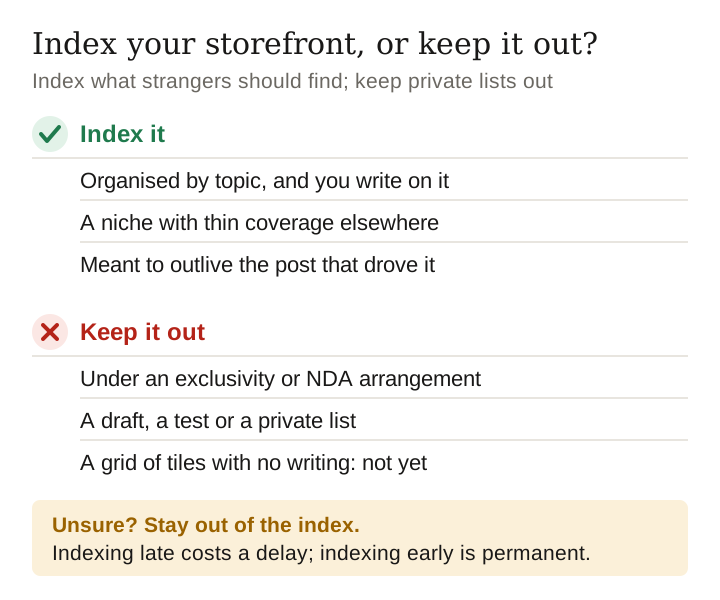
| Your storefront is organised by topic and you write on it | Yes | It can answer a query on its own terms rather than duplicating a post |
| You cover a niche with thin coverage elsewhere | Yes | Low competition is the one condition under which a new page can rank |
| You want the page to outlive the post that drove it | Yes | Search is the only channel that does this |
| The storefront repeats what your own posts already say | Probably not | You are entering the same contest twice with your weaker entry |
| You are under an exclusivity or NDA arrangement | No | It publishes commercial relationships you agreed to keep quiet |
| It is a draft, a test, or a private list for followers | No | Nothing to gain, and removal is slow |
| It is a grid of tiles with no writing | Not yet | Add the writing first; a thin page indexed is not a win |
How reversible is it?
Both directions are reversible in principle and asymmetric in practice. Turning indexing on costs you a wait — days to weeks before anything appears, and nothing guarantees the wait ends in traffic. Turning it off removes the page from future results, but cached copies, third-party archives and anyone who already saved the URL are outside the switch entirely.
The practical rule that falls out of that asymmetry: the cost of indexing late is a delay, and the cost of indexing early is permanent. When you are unsure, stay out of the index and revisit when the page is finished and you know what it is for.
On our own platform this is a single toggle on the storefront, so the decision is not technically difficult. It is difficult because it is a judgement about exposure rather than a setting.
What we cannot tell you
- Whether an indexed storefront cannibalises your own posts. We hold no creator’s search data to observe it in. Anyone quoting a cannibalisation rate for creator storefronts is not measuring one either.
- How much traffic your storefront would get. That depends on your niche, your domain's age and its links, and only your own Search Console can show it.
- Whether search engines treat storefront pages as a category. No search engine documents this and we have no way to test it.
Frequently asked
Will indexing my storefront get me traffic?
Eventually, maybe, and not soon. Google does not guarantee that it will crawl, index or serve a page. Indexing makes a page eligible; it does not make it competitive.
Does a noindexed storefront still work?
Yes. Every link still resolves for everyone you send it to. The page is private from search engines, not from people.
Can I index some pages and not others?
Yes, and that is usually the right answer: index the pages you wrote for strangers and keep the private lists out.
How long does removal take?
It is a request on the search engine's schedule, not an instant delete. Treat anything you might need gone immediately as something that should never have been public.
Sources and scope
The recommendations in the table are reasoning from the search-engine documentation below; they are not derived from any creator’s results, because we hold none.
- Google Search Central, In-depth guide to how Google Search works — crawling, indexing and serving not guaranteed; not every page Google processes is indexed.
- Google Search Central, Block Search indexing with noindex — a noindexed page is dropped when Googlebot next crawls it.
- Search Console Help, Removals tool — a temporary removal lasts about six months.
- Google Search Central, Spam policies — thin affiliation.
- Search Console Help, URL Inspection tool — whether a given page is indexed.
Google documentation cited on this page read 29 September 2026.
Keep reading
How this page was made. Drafted with AI (Claude); not yet independently re-checked. How we work