LinkToLooks · Guides · Creator Desk
Creator Desk
How long until an affiliate commission is final?
Three timelines computed from Amazon’s published terms — and what other networks do and do not publish.
Part of: For creators
On Amazon’s published terms, a commission is not final at the sale, not at delivery, and not at the end of the month. Amazon pays “approximately 60 days following the end of each calendar month in which they were earned” — and “earned” can itself be up to 180 days after the purchase. Do the arithmetic and the gap between a click and settled money runs from about two months to about eight.
Other networks publish less. CJ and Awin describe their clearing cycles on public pages, and eBay Partner Network publishes its payment timing; for the rest we found no figure, and we say so rather than borrowing somebody else's number.
The four stages a commission passes through
Networks use different words for these, and the words are not standardised, so we describe the mechanics rather than pretending there is a shared vocabulary.
- The click is attributed. A cookie or equivalent records that the visit came from you. Nothing is owed yet, and if the attribution fails here nothing downstream can recover it.
- The order is placed. Now there is a number in a dashboard. It is provisional: nothing has shipped, nothing is settled, and the customer can still cancel.
- The commission is earned. This is the stage creators skip when they estimate income. On Amazon's terms the product must be shipped, streamed or downloaded and paid for — and that has to happen within 180 days of the purchase for it to count at all.
- The payment issues. Only after the month in which it was earned closes, and then after the network's own delay.
The gap that surprises people sits between stages two and three. A dashboard number is a claim about an order, not a claim about money.
The arithmetic, worked from published terms
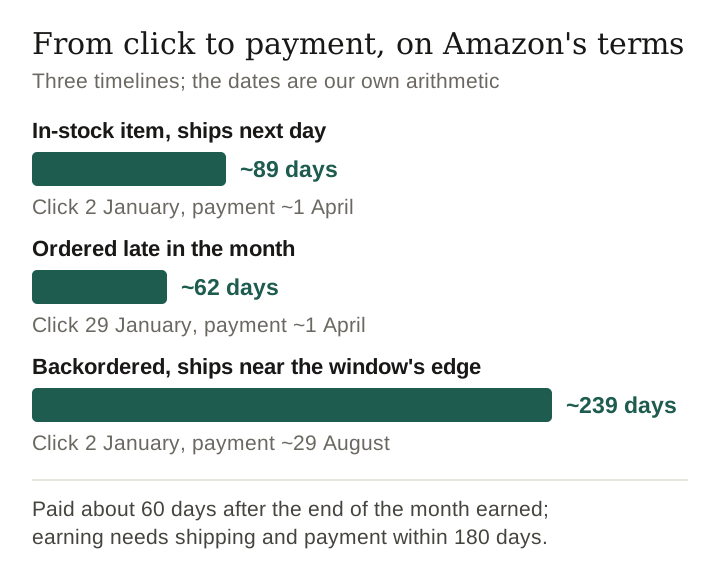
Three timelines, all computed from the same two published clauses: the 180-day qualifying window and payment approximately 60 days after the end of the month of earning. The dates are our arithmetic, not Amazon's examples.
| Scenario | Click | Earned | Month closes | Payment issues | Total wait |
|---|---|---|---|---|---|
| In-stock item, ships next day | 2 January | 3 January | 31 January | ~1 April | ~89 days |
| Ordered late in the month | 29 January | 30 January | 31 January | ~1 April | ~62 days |
| Backordered, ships near the window's edge | 2 January | late June | 30 June | ~29 August | ~239 days |
Last verified 10 October 2026 against Amazon’s published Associates Program Policies at affiliate-program.amazon.com, with the date arithmetic our own
Read the middle row against the first. A sale on 29 January settles faster than a sale on 2 January, by nearly a month, because the clock that matters starts when the month closes rather than when the sale happens. Nothing you can do about it — but it explains why income from a campaign feels lumpy and arrives in a pattern that has nothing to do with when you published.
The word “approximately” in the source clause is doing real work too. Treat the ~1 April figures as a centre, not a date to plan a payment around.
Keep reading on getting paid
What sends a commission backwards
A number in a dashboard can go down as well as up. The causes are ordinary and none of them are anybody behaving badly:
- The customer returns the item. The commission was earned on a completed purchase; an undone purchase undoes it.
- The order is cancelled before shipping. On terms requiring the product to ship, nothing was ever earned.
- The window expires. If the item never ships within the qualifying period — 180 days on Amazon's terms — the order stops counting even though it exists.
- The order data is corrected. A brand or network can correct a transaction after it first appears, for example when a product turns out not to be eligible, and the commission changes with it.
Practical consequence: a dashboard figure for the current month is the most optimistic number you will ever see for that month. If you are deciding anything on it, decide on the figure from two months ago instead, because that one has stopped moving.
What we could not verify
We looked for clearing and locking periods on other networks’ public pages. Three publish something: CJ’s own blog describes its standard locking cycle (commissions lock on the 10th of the month after the sale, or 7 to 60 days after it on a custom cycle); Awin’s publisher training gives an average approval time of 30 to 45 days; and eBay Partner Network pays monthly, around the 10th business day, for the previous month’s transactions. We found no figure for the others.
| Network | Clearing period published on a public page? |
|---|---|
| CJ Affiliate | Yes — a standard locking cycle, on the 10th of the month after the sale |
| Awin | An average only — approval in 30 to 45 days |
| Impact.com | Not found |
| Rakuten Advertising | Not found |
| eBay Partner Network | A payment schedule — monthly, around the 10th business day, for the previous month |
| ShareASale | Closed in October 2025; its accounts moved to Awin |
| Amazon Associates | Yes — quoted above |
To be exact about what that means: these networks certainly have clearing periods, and a signed-in publisher can probably read them. We hold no affiliate approvals, so we cannot log in. What we are reporting is that, for the networks marked not found, the information is not on a public page for someone deciding whether to join — which is precisely when it matters.
If you see a table online giving a locking period for these networks, ask where the number came from. For CJ and Awin the network’s own pages give one; for the others we could not find a primary source.
How to plan around it
- Treat the current month as unearned. Not conservative accounting — accurate accounting. Nothing in it has cleared.
- Expect roughly a quarter between work and money. On Amazon’s terms, an ordinary in-stock sale takes about two to three months from click to payment, depending on where in the month it falls.
- Watch the reversal rate, not just the total. Two months of history tells you what fraction of your provisional numbers survive. That fraction is the only honest multiplier for the current month.
- Get the clearing period in writing before you join. Ask publisher support directly. Their answer is authoritative for your account in a way that no article, including this one, can be.
- Remember the threshold sits on top of all this. A cleared commission still waits for the minimum balance before it is paid.
Frequently asked
How long until an affiliate commission is final?
On Amazon's published terms, payment issues approximately 60 days after the end of the calendar month in which the commission was earned, and earning requires the item to ship and be paid for within 180 days of the purchase. In ordinary cases that is about two to three months from click to money.
Why did my pending commission disappear?
Most often a return or a cancellation, sometimes a correction to the order data, sometimes an order that never shipped inside the qualifying window. A provisional number is a claim about an order, not about money.
Do all networks work this way?
The four-stage shape is general. The specific windows are not: Amazon publishes its terms in full, CJ and Awin describe their cycles on public pages, and for the others we found no figure.
Can I be paid faster?
Not on Amazon’s schedule — it is set by the programme, and the one lever in Amazon’s terms is the payment method, which changes the minimum balance and the fee rather than the timing. Some networks publish a faster option: impact.com’s Anytime PayPal lets a partner withdraw an available balance without waiting for the scheduled date.
Method and scope
The quoted terms come from Amazon's Associates Program Policies, fetched unauthenticated on 4 September 2026. The three timelines are our own arithmetic applied to those published clauses, not examples Amazon supplies, and the word “approximately” in the source means they are estimates. The “not found” rows record that we found no clearing-period figure on that network's public pages; they are not a claim that no such period exists. We hold no affiliate approvals, so nothing here is drawn from our own payment history. This is not tax, legal or financial advice.
Keep reading
How this page was made. Researched and drafted with AI (Claude); checked by a separate automated pass on 10 October 2026. How we work