LinkToLooks · Guides · Reference Desk
Reference Desk
Is that early Barbie actually a Bild Lilli?
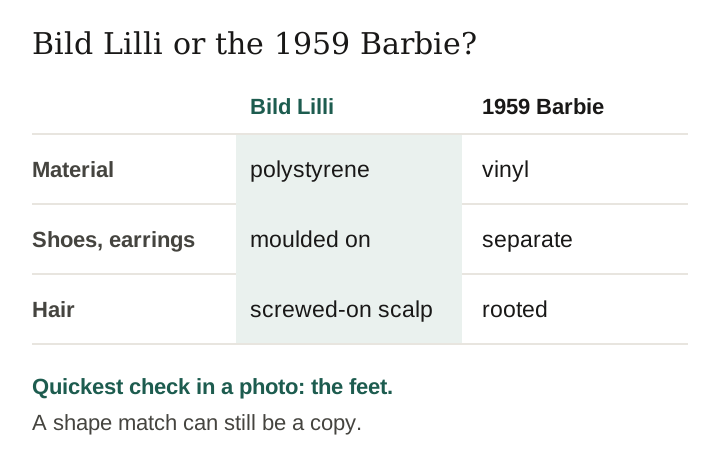
Check the material and the feet: moulded-on shoes and a screwed-on scalp separate a 1955 German gag gift from the doll it was copied into.
Check the material and the feet. A Bild Lilli is hard polystyrene with shoes and earrings moulded onto the body; the first Barbie of March 1959 is vinyl, with separate shoes and separate earrings. Lilli’s hair is a cut-out scalp fixed by a hidden metal screw rather than rooted hair, and her limbs are strung inside on coated rubber bands.
The confusion is not the buyer’s fault. Mattel’s doll was based on Lilli dolls that Ruth Handler brought back from Europe, and apart from those differences the earliest Barbies were in many ways quite similar to Lilli in overall shape and appearance.
The separating features, one by one
| Feature | Bild Lilli (1955–1964) | First Mattel Barbie (March 1959) |
|---|---|---|
| Material | polystyrene, a hard plastic | vinyl |
| Shoes | moulded onto the foot | separate |
| Earrings | moulded on | separate |
| Hair | a cut-out scalp attached by a hidden metal screw | rooted, with curly bangs |
| Eyelashes | moulded | — |
| Eyes | painted, side-glancing, high narrow eyebrows | — |
| Fingernails | painted red | — |
| Neck seam | mid-neck, behind the chin, not at the shoulders | — |
| Limbs | attached inside by coated rubber bands | — |
| Sitting | legs do not sprawl open | — |
Source: Wikipedia, Bild Lilli doll and Wikipedia, Barbie, both read 4 September 2026. Dashes mark features the sources describe for Lilli and do not describe for the 1959 Barbie; they are not claims of absence.
Three of those rows are patents Lilli held, and they are the ones worth learning because they are structural rather than cosmetic: the mid-neck seam behind the chin instead of a seam at the shoulders, the screwed-on cut-out scalp instead of rooted hair, and legs that do not sprawl open when the doll is seated.
The quickest single check in a photograph is the feet. Moulded-on shoes are visible in almost any picture and separate shoes are obvious once you look for the join.
Dates, sizes and how many exist
- Launched 12 August 1955 by Greiner & Hausser GmbH in West Germany, designed by Max Weissbrodt, and produced until 1964.
- Two sizes only: 30 cm and 19 cm (11.8 and 7.5 inches). A doll in a third size is not a Lilli.
- 130,000 were made in total. That is the number that should govern how you read any claim about one.
- Mattel acquired the rights in 1964 and German production stopped in favour of the vinyl doll.
- Based on a comic-strip character drawn by Reinhard Beuthien for the newspaper Bild, and originally sold to adults as a gag gift through tobacconists, kiosks and newsagents rather than toy shops.
The original prices are the detail that makes the marketing obvious in hindsight: DM 12 for the tall doll and DM 7.50 for the small one, at a time when average monthly take-home pay was DM 200 to DM 400.
Keep identifying
The third possibility nobody mentions: a copy
Most guides frame this as a two-way question. It is a three-way question, and the third answer is the most likely one for anything found loose.
- Several toy companies, mainly in Hong Kong, produced dolls resembling Bild Lilli, some from purchased original moulds. A doll cast from the original mould will pass a shape test.
- In Spain, Muñecas FEJ copied the moulds and produced a very similar doll with darker skin, white earrings and an articulated waist. The articulated waist is the giveaway.
- Louis Marx and Company acquired rights from Hausser and sold Miss Seventeen and the smaller Miss Marlene.
This is why we would not call a photograph alone conclusive, and it is the honest position: a shape match is consistent with a genuine Lilli, with a Hong Kong doll from an original mould, or with a Marx doll from acquired rights. Distinguishing those needs the object, and in real dispute it needs a specialist. We do not authenticate dolls.
What original packaging looks like
Where a doll comes with its original presentation, the packaging is more diagnostic than the doll:
- A clear plastic tube, with the doll’s feet fitted into a stand that formed the base of the tube.
- The stand labelled “Bild-Lilli”.
- A miniature copy of the newspaper Bild included with each doll.
- On the clothes, patent fasteners marked “PRYM” — a detail worth knowing because outfits survive separately from dolls and can be identified on their own.
Outside Germany the doll was usually sold simply as “Lilli”, and some have been seen in 1950s packaging for an English-speaking market labelled “Lili Marleen”. We flag that last point as one the source itself marks as needing a citation.
What the live market holds under this search
| Measured 4 September 2026 | Value |
|---|---|
| US listings returned for “barbie doll” | 195 |
| Distinct retailers | 12 |
| Median asking price | $29.17 |
| 10th to 90th percentile | $10.92 to $85.00 |
| Marked in stock | 99 |
Last verified 4 September 2026 against a live affiliate catalogue pull of 195 US listings for this term
Nothing in that pull is a Bild Lilli, and we would be surprised if anything ever were: 130,000 made, sixty years ago, in one country. What the retail catalogue holds is current production and ordinary resale. If you are looking for the real thing, the market for it is specialist auction, and the price discovery there has nothing to do with the median above.
Frequently asked
Was Barbie copied from Bild Lilli?
Wikipedia states the Lilli doll was copied, and altered to some degree, for Mattel on Ruth Handler’s direction, and that Mattel acquired the rights to Bild Lilli in 1964.
What is the fastest way to tell them apart in a photo?
The feet. Lilli’s shoes are moulded onto the body; the 1959 Barbie’s shoes are separate. The earrings work the same way.
How rare is a Bild Lilli?
A total of 130,000 were made between 1955 and 1964. Copies exist in unknown numbers, including some cast from purchased original moulds.
Can you value or authenticate my doll?
No. We identify from published references and we price live listings; we do not handle objects and we are not authenticators. For anything valuable, a specialist auction house is the right call.
Method and sources
Construction details, dates, sizes, production total and packaging are from Wikipedia’s Bild Lilli doll article, read 4 September 2026; the launch date and material of the first Mattel doll are from Wikipedia’s Barbie article, read the same day. Where the source itself marks a claim as needing a citation, we have said so rather than passing it on as settled. Market figures are one affiliate catalogue pull taken, filtered to rows whose own country field reads US — a keyword sample of one network, not a census. We have not handled, tested or authenticated any doll described here.
Keep identifying
How this page was made. Drafted with AI (Claude); not yet independently re-checked. How we work