LinkToLooks · Guides · Reference Desk
Reference Desk
American cast iron: the brands and their eras, dated
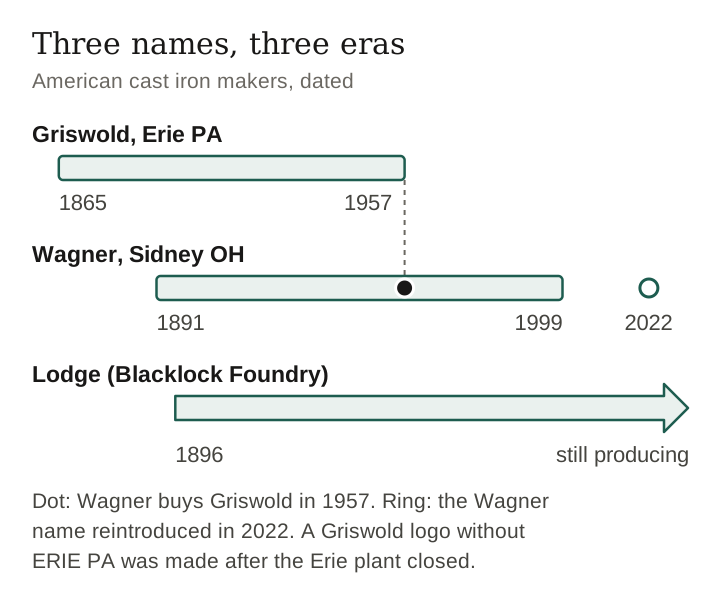
Three names carry this field. Griswold ran in Erie, Pennsylvania from 1865 until the plant closed in December 1957. Wagner ran in Sidney, Ohio from 1891 until 1999, having bought Griswold in 1957. Lodge began as the Blacklock Foundry in 1896 and still produces. Nearly every other American iron cookware firm closed in the 1920s or was absorbed.
Why this taxonomy is worth having
Cast iron cookware is one of the few collecting fields where the objects are still usable, still cheap at the bottom, and still being reproduced. That combination makes dating worth doing properly. This page is the company-by-company timeline, drawn from published histories, with the dates that actually narrow a piece.
Sources for every date below: the Wikipedia entries for Cast-iron cookware, Griswold Manufacturing and Wagner Manufacturing Company, all read 2 September 2026.
The timeline, in one table
| Year | Event |
|---|---|
| 1865 | Seldon-Griswold Manufacturing founded in Erie, Pennsylvania, making hinges and light hardware |
| 1870s | Griswold moves into cookware: skillets, pots, grinding mills, waffle irons |
| 1891 | Wagner Manufacturing founded in Sidney, Ohio by Milton and Bernard Wagner |
| 1892 | Wagner adds nickel-plated ware |
| c. 1893 | Griswold's first aluminium product, a tea kettle |
| 1894 | Wagner among the first to make aluminium cookware |
| 1896 | Blacklock Foundry founded — the origin of Lodge |
| 1897–1903 | Wagner buys and then sells back Sidney Hollow Ware |
| 1913 | Wagner distributing globally |
| 1920s | Griswold begins producing enamelled items; most other US iron cookware firms close |
| early 1930s | Wagner introduces the cast-aluminium Magnalite line |
| 1933–34 | John Gordon Rideout designs the Magnalite teakettle and casserole |
| 1946 | Wagner heirs begin divesting |
| 1952 | The Randall Company acquires Wagner |
| March 1957 | McGraw-Edison acquires Griswold |
| late 1957 | Griswold brand and housewares division sold to Wagner |
| December 1957 | The Erie, Pennsylvania plant closes |
| 1969 | Textron sells both lines to General Housewares |
| 1999 | The Sidney, Ohio plant closes |
| June 2023 | The Sidney foundry demolished |
Griswold logo eras
The Griswold cross logo changed enough times to be a dating tool, and these are the published windows.
| Logo | Window |
|---|---|
| Slanted ‘Griswold’ at the cross centre | 1910s – early 1920s |
| Block lettering (the most common version) | 1920s – 1930s |
| The ‘small logo’ | early 1940s – 1957 |
| Griswold logo without the ERIE PA mark | 1957 – mid-1960s |
| Dual Griswold / Wagner logos | early – mid 1960s |
The last two rows are the ones that catch people out. A pan carrying a Griswold logo but no ERIE PA mark was made after the Erie plant closed, and a dual-logo pan is a post-merger object. Neither is fake; both are later than the logo suggests.
Wagner and its many names
Wagner did not sell everything as Wagner. Brand names in use included Wagner Ware, National, Long Life, Wardway and Ward's Cast Iron. At its peak the company held about a 60% share of the cookware market and was distributing globally by 1913.
- A pan marked National or Long Life is a Wagner product, not a different foundry.
- Wardway and Ward's were retail-channel names — the pans were made in Sidney.
- Magnalite is cast aluminium, not iron. It is a Wagner line and it is collected separately.
- The Wagner name was reintroduced in 2022 with family involvement, so a Wagner-marked pan can be three years old.
Physical dating tells, ranked by reliability
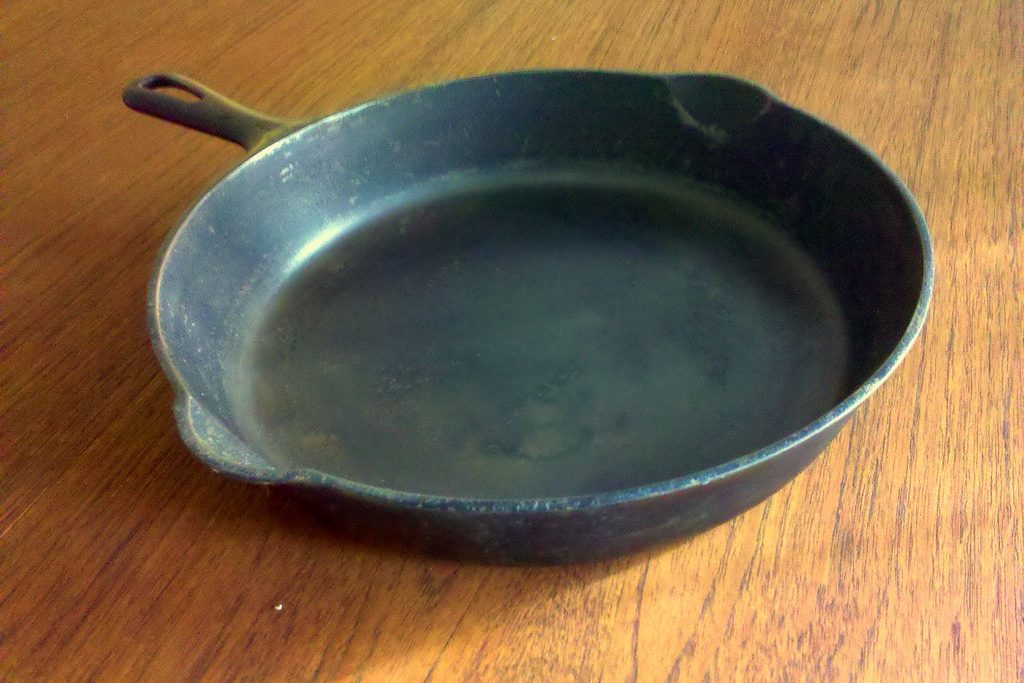
Current-production pans in the 2 September 2026 pull share three features a pre-war pan would not have: a flat base with no heat ring, a rough sand-cast cooking surface, and a moulded handle. Those three features together date a pan to the modern era before you have read a single letter of the mark.
- Gate mark. A raised scar across the underside from the pour. Older casting method; points at nineteenth-century production. Hard to fake and hard to misread.
- Heat ring. A raised ring at the outer edge of the base, common on pre-war pans and largely dropped after. Reliable as a broad era signal, useless as a year.
- Surface finish. Machined-smooth cooking surfaces belong to the Griswold and Wagner era; modern production is rough-cast. This is the single most useful old-versus-new tell.
- Logo style. Useful when it is crisp, misleading when it is not — see the reproduction note below.
- Weight. Older pans are noticeably lighter for the same diameter. A useful confirmation, not a standalone test.
Reproductions, and the one thing that gives them away
Two corollaries we would add from handling the objects rather than from the literature. First, a reproduction usually feels wrong before it looks wrong — too heavy, too rough inside. Second, a pan with a perfect logo and a terrible cooking surface is a worse sign than a worn logo on a smooth pan, because wear happens to the outside of a used pan and smoothness happens to the inside of a used pan.
What was never made, and other things to distrust
- There is no Griswold cast iron made after December 1957 from Erie. The plant closed. Later Griswold-marked product came from elsewhere.
- A ‘Griswold’ item is not necessarily cookware. The company made hinges, hardware, aluminium and enamelled goods. Our live retail pull for the name returned an electrical parts line and a musician's back catalogue before it returned anything cast.
- Foundry size numbers are not inches. A number on the base is a size code for matching lids.
- Seasoning is not age. A black, glassy surface can be six months of hard use. Colour tells you about the cook, not the decade.
Last verified 2 September 2026 against the published company histories cited above and a live CJ product-feed pull of 33 in-stock US cast iron listings, all current production
Keep identifying
Frequently asked
Which American cast iron makers matter to collectors?
Griswold of Erie, Pennsylvania (1865–1957), Wagner of Sidney, Ohio (1891–1999) and Lodge, which began as the Blacklock Foundry in 1896 and is still producing. Most other foundries closed in the 1920s or were absorbed.
When did Griswold stop making cookware?
McGraw-Edison acquired Griswold in March 1957, the brand and housewares division were sold to Wagner later the same year, and the Erie plant closed in December 1957.
What happened to Wagner?
The Randall Company bought it in 1952; it acquired Griswold in 1957; Textron sold both lines to General Housewares in 1969; the Sidney plant closed in 1999 and the foundry was demolished in June 2023. The name was reintroduced in 2022.
What is a gate mark?
A raised scar on the underside left where molten iron entered the mould. It reflects an older casting method and points at nineteenth-century production rather than at any particular maker.
Did Griswold only make cast iron?
No, and this is where reference guides go wrong. It made hinges and hardware first, aluminium from about 1893, and enamelled items from the 1920s. A Griswold-marked object is not automatically a cast iron pan.
Keep reading
How this page was made. Drafted with AI (Claude); not yet independently re-checked. How we work