LinkToLooks · Guides · Reference Desk
Reference Desk
Whose cast iron skillet is this?
Turn it over. The underside carries the maker's mark, a foundry size number, and two dating tells: a gate mark (a raised scar from the pour, pointing to nineteenth-century casting) and a heat ring (common before the war, largely dropped after). Griswold was made in Erie, Pennsylvania from 1865 until the plant closed in December 1957; Wagner in Sidney, Ohio from 1891 until 1999; Lodge from 1896 and still in production.
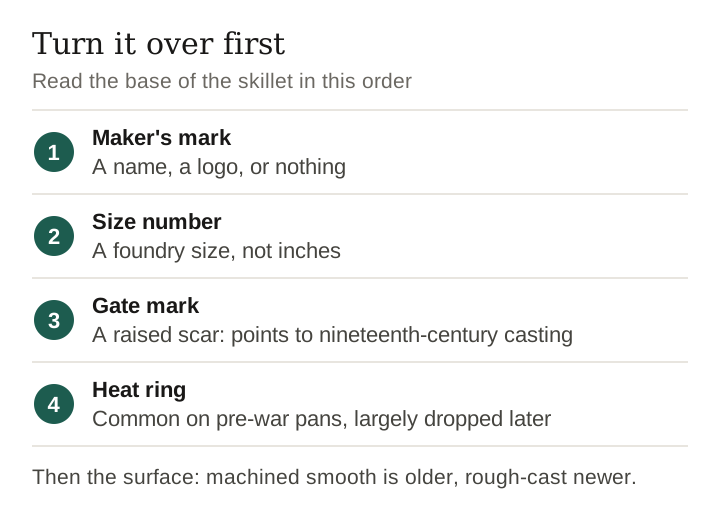
Turn it over first
Almost everything that identifies a cast iron skillet is on the underside. Before you look at the pattern of the handle or the colour of the seasoning, look at the base and read it in this order: maker's mark, size number, gate mark or its absence, heat ring or its absence.
- Maker's mark. A name, a logo, or nothing. Griswold and Wagner both marked heavily; many foundries did not mark at all.
- Size number. A number like 8 or 10 is a foundry size, not inches. It is useful for matching lids, and useless for dating.
- Gate mark. A raised line or scar across the underside, left by the pouring gate. It indicates an older casting method and points at nineteenth-century production.
- Heat ring. A raised ring around the outer edge of the base. Common on pre-war pans, largely dropped later.
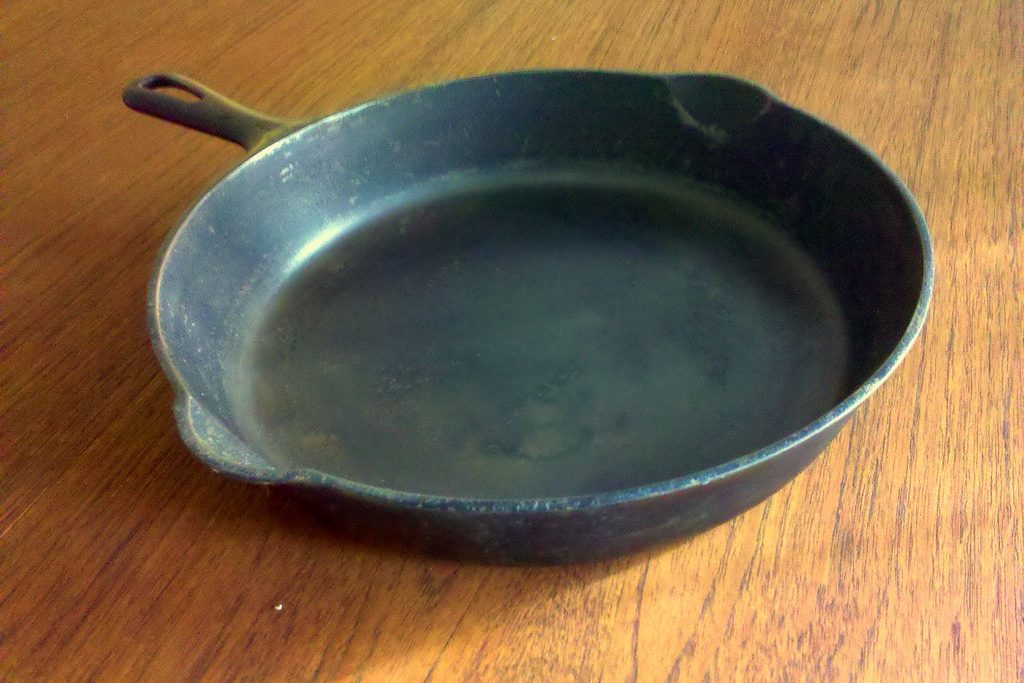
The three names you will actually meet
Griswold, Erie, Pennsylvania
- Founded in 1865 as the Seldon-Griswold Manufacturing Company by Matthew Griswold with cousins J.C. and Samuel Selden, initially making hinges and light hardware.
- Moved into cookware in the 1870s: “skillets, pots, grinding mills and waffle irons”, later kettles, Dutch ovens and roasters. Enamelled items followed in the 1920s.
- Bought by McGraw-Edison in March 1957; the brand and housewares division went to Wagner the same year; the Erie plant closed in December 1957.
- Logo eras, useful for dating: slanted name in the cross centre in the 1910s to early 1920s; block lettering in the 1920s and 1930s; the small logo from the early 1940s to 1957; the logo without ERIE PA from 1957.
Wagner, Sidney, Ohio
- Founded in 1891 by brothers Milton M. and Bernard P. Wagner. Added nickel-plated ware in 1892 and was among the first to make aluminium cookware in 1894.
- Sold under several names — Wagner Ware, National, Long Life, Wardway, Ward's Cast Iron — which is why a pan with none of those four letters on it can still be a Wagner.
- Introduced the cast-aluminium Magnalite line in the early 1930s. Acquired Griswold in 1957; both lines went to General Housewares in 1969; the Sidney plant closed in 1999 and the foundry was demolished in June 2023.
Lodge, South Pittsburg, Tennessee
- Began as the Blacklock Foundry in 1896 and is the one American maker in this list still producing at scale.
- A Lodge pan is the most likely answer when a modern skillet is marked, because Lodge is what is in the shops. Our live retail pull found Lodge-branded skillets at $20.99 and $24.90 from two different US retailers; both prices were re-checked on 28 September 2026. Both are current production: rough-cast cooking surface, moulded handle, no heat ring.
Company histories and dates: the Wikipedia entries for Cast-iron cookware, Griswold Manufacturing and Wagner Manufacturing Company, all read 2 September 2026.
Old pan or new pan?
The single most useful physical distinction, and it has nothing to do with the logo.
| Feature | Points older | Points newer |
|---|---|---|
| Cooking surface | Machined smooth, almost polished | Rough sand-cast texture |
| Weight for size | Noticeably lighter for the same diameter | Heavier |
| Base | Gate mark or heat ring often present | Flat, no ring, induction-friendly |
| Lettering | Crisp, deep, evenly formed | Crisp on genuine modern pans; grainy and blurred on reproductions |
That last row is the anti-counterfeit line, and it comes from the Griswold literature rather than from us: reproductions are identified by a grainy finish and uneven, blurred lettering. The forger can copy the logo shape. Copying a 1930s casting is harder.
Why searching the brand names does not work
We tried to price vintage cast iron from live retail listings. It did not work, and the reason is worth publishing because it will happen to you too.
| Search term | Rows matched | What actually came back |
|---|---|---|
| griswold | 200 | Erik Griswold albums, Griswold Electric parts, a Griswold tee, textbooks |
| wagner | 200 | Wagner opera recordings and automotive parts from a truck-parts retailer |
| skillet | 209 | Concert tickets and albums by the band Skillet, plus cookbooks, alongside real pans |
| cast iron (in skillet results) | 33 | Genuine new cast iron cookware from nine retailers, median $35.99 |
Method: CJ product API, US advertisers, in-stock only, up to 400 rows pulled per term and filtered on the listing title, 2 September 2026.
Two things follow. First, the affiliate catalogues we can see carry new cast iron, not old — every one of the 33 clean rows was current retail. Second, if you are hunting a maker by name in any retail search box, expect the band, the composer and the electrical supplier to arrive first.
Last verified 28 September 2026: the two Lodge prices quoted above re-checked against the CJ product feed (US advertisers) — 1 unchanged, 1 repriced from its list price to the $24.90 a shopper pays. The search-term table is as of 2 September 2026 (33 in-stock US cast iron listings across nine retailers).
Keep identifying
Frequently asked
How do I tell who made an unmarked cast iron skillet?
You often cannot, and honest sellers say so. Work from the physical tells instead: a gate mark on the underside points to nineteenth-century production, a raised heat ring points to pre-war, and machined-smooth cooking surfaces point to the Griswold and Wagner era rather than to modern rough-cast pans.
When was Griswold made?
The Seldon-Griswold Manufacturing Company was founded in Erie, Pennsylvania in 1865 and moved into cookware in the 1870s. McGraw-Edison bought it in March 1957, the brand went to Wagner later that year, and the Erie plant closed in December 1957.
When was Wagner made?
Wagner Manufacturing was founded in Sidney, Ohio in 1891 by brothers Milton and Bernard Wagner. It acquired Griswold in 1957, passed to General Housewares in 1969, and the original Sidney plant closed in 1999.
What does a Griswold logo tell me about the date?
Roughly: slanted lettering in the cross for the 1910s to early 1920s, block lettering for the 1920s and 1930s, the small logo from the early 1940s to 1957, and a Griswold logo without the ERIE PA mark after 1957.
Are there fake Griswold pans?
Reproductions exist. Wikipedia's entry on Griswold notes that collectors should watch for reproductions with a grainy finish and uneven, blurred lettering — the casting quality is the tell, not the logo shape.
Keep reading
How this page was made. Drafted with AI (Claude); not yet independently re-checked. How we work