LinkToLooks · Guides · Reference Desk
Reference Desk
Is this Corelle or CorningWare?
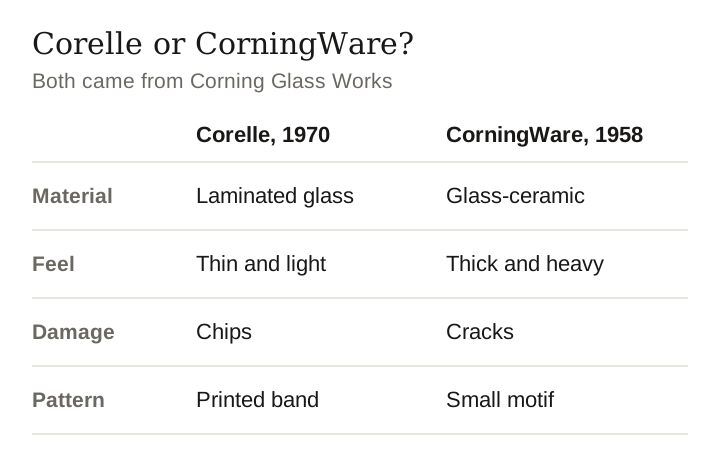
Corelle is Vitrelle, a three-layer laminated glass introduced in 1970 for plates, bowls and mugs. CorningWare is Pyroceram, a white glass-ceramic introduced in 1958 for casseroles and bakers. In the hand the difference is obvious: Corelle is thin and light with a rolled rim, CorningWare is thick, heavy and square-shouldered. Both came from Corning Glass Works, which is the entire reason they get mixed up.
Three Corning brands, three materials
Corelle, CorningWare and Pyrex all came out of Corning Glass Works, all lived in the same American kitchens, and all end up in the same resale photographs. They are not variants of one another. They are three different materials with three different jobs.
| Brand | Material | Introduced | What it is for |
|---|---|---|---|
| Corelle | Vitrelle laminated glass | 1970 | Plates, bowls, mugs — tableware |
| CorningWare | Pyroceram glass-ceramic | 1958 | Casseroles, bakers, saucepans |
| Pyrex | Heat-resistant glass | 1915 | Measuring, mixing, baking dishes |
Dates and materials: Wikipedia entries for Corelle and CorningWare, read 2 September 2026. Corelle is described there as “made of Vitrelle, a tempered glass product” in which two kinds of glass are laminated in three layers, introduced by Corning Glass Works in 1970; CorningWare as Pyroceram cookware “introduced in 1958 by Corning Glass Works”.
The two-second test, in your hand
Forget the pattern for a moment. Pick the piece up.
- Corelle is startlingly light. A dinner plate feels like it should not survive being dropped, which is exactly the trick the laminate is doing. The rim is rolled and thin, and the wall thickness barely changes from centre to edge.
- CorningWare is heavy and squared off. Straight sides, sharp shoulders, often two moulded tabs for handles, and a wall thick enough that you can feel the thermal mass.
- Corelle chips; CorningWare cracks. A damaged Corelle rim shows a shallow flake where the outer glass layer has left the white core, and you can often see the three layers in the flake. A damaged CorningWare piece shows a clean bright fracture through a single body.
- Light through the edge. Hold a Corelle plate rim up to a window and the edge glows faintly; the core is opaque but the outer layers are not. CorningWare is opaque throughout.
What the backstamp actually tells you
Both brands mark the underside, and the marks are more useful for confirming a brand than for dating a piece precisely.
- Corelle pieces are commonly marked with the brand name and, on older stock, Corning as well — which is why the replacement-china listings we pulled are titled “Corning Corelle” followed by the pattern name.
- CorningWare carries the brand and, on the classic pieces, the Pyroceram association. The pattern name is not usually on the base; you identify Blue Cornflower by looking at it.
- A piece with no mark at all is not automatically a fake. Mugs, creamers and small hollowware were marked inconsistently across decades and factories.
The one thing a backstamp will not do is tell you the pattern name. For that you are matching artwork, and the matching is easier than it looks because the catalogue is finite: our pull surfaced named Corelle patterns including Carousel, Pewter, Quilt, Almond, Friendship, Zenith, Maritime, Rola, Abundance, Wildflower, Cinnamon, Fiesta, Hometown, Cocoa and Burgundy.
Naming the pattern, with the catalogue in front of you
A useful shortcut for photographs: Corelle patterns live on the rim or the outer wall as a printed band; CorningWare decoration sits as a small motif on a large white field. Blue Cornflower is a sprig on a white box. Corelle Butterfly Gold is a band around a white plate. That difference survives a bad photograph better than any backstamp does.
What is actually for sale, measured 2 September 2026
We pulled live US affiliate listings for both brands, in-stock only, and the shape of the two markets is not the same.
| Search | Live in-stock US listings | Rows we matched | Distinct retailers | Median |
|---|---|---|---|---|
| Corelle | — | 408 | 1 | $15.99 |
| CorningWare | 240 | 47 | 10 | $59.99 |
Method: CJ product API, US advertisers, in-stock only, keyword pull filtered to titles containing the brand name and de-duplicated by title and retailer, 2 September 2026.
Re-checked 28 September 2026: Corelle again came entirely from one replacement-china specialist, at the same $15.99 median across the 1,043 in-stock rows we read, and a Friendship-pattern Corelle mug was still $9.99. CorningWare’s brand-titled rows now include shirts, mugs and artwork; with those set aside, too few cookware rows remained for a settled median, so its $59.99 stands as of 2 September. The feed’s own total for Corelle is an estimate we cannot reproduce, so it is not published.
The single-retailer result for Corelle is the finding worth carrying away. Every one of the 408 Corelle rows we matched came from one replacement-china specialist, because what is still being sold is mostly discontinued patterns rather than current production. CorningWare is the opposite: fewer listings overall, but spread across ten retailers including department stores, because the current French White line is ordinary in-store stock.
Last verified 2 September 2026 against a live CJ product-feed pull of Corelle and CorningWare listings taken
Where identification goes wrong
- Calling a CorningWare casserole ‘vintage Pyrex’. Different material, different brand, different decade. Pyrex is transparent or opaque glass; CorningWare is a white glass-ceramic.
- Calling a Corelle plate ceramic. It is glass. Sellers write “ceramic” because it looks like china.
- Reading a modern piece as old. Both brands are still produced under Corelle Brands, so a clean piece in a current pattern is very likely new.
- Trusting a pattern name in a listing title. On the peer-to-peer marketplaces, pattern names are guesses more often than not. On replacement-china listings they are catalogue data, and much more reliable.
Keep identifying
Frequently asked
Is Corelle the same as CorningWare?
No. Corelle is Vitrelle, a three-layer laminated glass introduced in 1970 for plates, bowls and mugs. CorningWare is Pyroceram, a white glass-ceramic introduced in 1958 for casseroles and bakers. Both came from Corning Glass Works, which is why they are confused.
How do I tell them apart by hand?
Weight and wall thickness. A Corelle plate is thin, light and springy with a rolled rim; a CorningWare dish is thick, heavy, square-shouldered and usually has straight sides and handles or tabs.
Is Corelle a ceramic?
No. It is glass. Three layers of it: two clear outer layers laminated around an opaque white core, with the pattern printed on the outside as a glassy ink.
Which one can go on a stovetop?
Original Pyroceram CorningWare was designed to move between freezer, stovetop, oven and table. Corelle is tableware and bakeware-adjacent, not a stovetop material. Check the piece you actually own, because both brands have had many production changes.
Why is nearly all the Corelle for sale from one shop?
Because the pieces still being sold are mostly discontinued patterns, and replacement-china specialists are who stocks those. In our live pull on 2 September 2026 all 408 matched Corelle listings came from a single retailer.
Keep reading
How this page was made. Drafted with AI (Claude); not yet independently re-checked. How we work