LinkToLooks · Guides · Reference Desk
Reference Desk
Is this Fire-King Jade-ite, or something else?
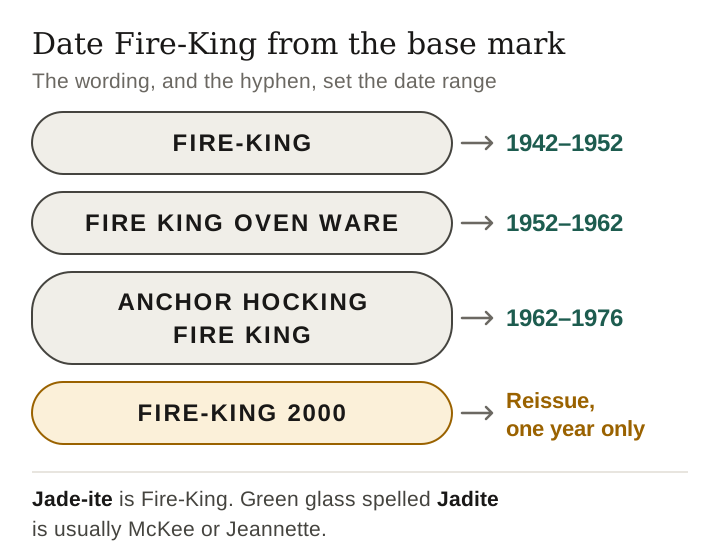
Fire-King is Anchor Hocking's heat-resistant glass line, made in Lancaster, Ohio from 1942 to 1976. Jade-ite is its opaque jade-green milk glass, coloured with recycled green bottle cullet. Date a piece from the base: FIRE-KING with a hyphen is 1942–1952, FIRE KING OVEN WARE without one is 1952–1962, and ANCHOR HOCKING above the name is 1962–1976. Green kitchen glass by McKee or Jeannette is usually spelled Jadite, without the hyphen.
What Fire-King is, precisely
Fire-King is a brand of heat-resistant ovenware and dinnerware made by Anchor Hocking of Lancaster, Ohio. It was introduced in 1942 and the original line ran for more than three decades, to 1976. It was built to move from refrigerator to oven to table without shattering, which is the whole reason it survives in usable condition eighty years later.
Jade-ite is the colour that made it famous: an opaque jade-green milk glass produced by adding green glass cullet — recycled bottle scrap — to a milk-glass base. That is why no two pieces are quite the same green, and why an exact colour match between a cup and its saucer is worth noticing rather than expecting.
Brand, dates, colours and marks in this section: the Wikipedia entry for Fire-King, read 2 September 2026.
Dating a piece by its mark
The base mark is the most reliable dating tool on the piece, and it changed twice in thirty-four years.
| Mark on the base | Date range |
|---|---|
| FIRE-KING (with hyphen) | 1942–1952 |
| FIRE KING OVEN WARE (no hyphen) | 1952–1962 |
| ANCHOR HOCKING above FIRE KING | 1962–1976 |
| FIRE-KING 2000 | 2000 commemorative reissue, one year only |
Note the last row. The 2000 commemorative series is genuine Anchor Hocking, genuinely Jade-ite, and genuinely not old. It is marked as such, so a seller describing a Fire-King 2000 piece as mid-century is either not looking at the base or hoping you will not.
The other colours, and why they matter
Jade-ite gets the attention, but Fire-King ran a spread of colours, each with its own window. Knowing the windows lets you date a piece before you have turned it over.
| Colour | Approximate run |
|---|---|
| Sapphire Blue | 1942–1945 |
| Peach Lustre | 1952–1963 |
| Turquoise Blue | c. 1956–1962 |
| Azur-ite, Rose-ite, Burgundy | within the original run |
| White glass with decal patterns | within the original run |
Sapphire Blue is the tell that most often surprises people: a three-year window at the very start of the line, which makes a Sapphire Blue piece a much narrower dating clue than a Jade-ite one.
McKee and Jeannette: the other green glass
Anchor Hocking did not have green opaque kitchen glass to itself. McKee and Jeannette both made it, and both usually spelled it Jadite, without the hyphen. This matters for identification because the shapes differ even when the colour does not.
A McKee Sunkist reamer is a shape Fire-King never made, so it is an immediate identification. When we pulled, a McKee Sunkist reamer and a Jeannette mixing bowl were both live listings at a replacement-china specialist, at $139.95 each.
The practical rule: ribbed kitchen shapes — reamers, spice shakers, canisters, drawer pulls — skew McKee and Jeannette. Restaurant-weight tableware — cups, saucers, dinner plates, mugs — skews Fire-King.
The spelling trap, measured
Here is a finding we did not expect and would not have believed without pulling it. The spelling you type decides which product category you get.
| Search term | Rows matched | What they actually are | Median |
|---|---|---|---|
| jadeite | 315 | Jade jewellery: bangles, pendants, earrings, beads (289 of 315 from one resale marketplace) | $80.00 |
| jadite | 200 | Mostly the same jewellery, but 45 rows of genuine McKee and Jeannette green kitchen glass | $129.95 for the glass rows |
Method: CJ product API, US advertisers, in-stock only, two keyword pulls of up to 200–500 rows each, matched on the spelling in the listing title, 2 September 2026.
The reason is that jadeite is a real mineral — a pyroxene, formula NaAlSi2O6, one of the two minerals recognised as the gemstone jade — and the jewellery trade is much larger than the glass trade. Collectors settled on jadite for the glass, and that spelling is what the replacement-china catalogues use.
Mineral definition: the Wikipedia entry for Jadeite, read 2 September 2026, which addresses only the mineral and gemstone senses of the word.
Keep identifying
What we could not find
Last verified 2 September 2026 against live CJ product-feed pulls for fireking, jadeite, jadite and Anchor Hocking, plus the Wikipedia entries for Fire-King and Jadeite
Frequently asked
What is Fire-King Jade-ite?
Fire-King is Anchor Hocking's heat-resistant ovenware and dinnerware brand, introduced in 1942. Jade-ite is its opaque jade-green milk glass, coloured by adding green glass cullet to a milk-glass base, which is why the hue varies from piece to piece.
How do I date a Fire-King piece from the mark?
By the wording. FIRE-KING with a hyphen runs 1942 to 1952; FIRE KING OVEN WARE without the hyphen runs 1952 to 1962; ANCHOR HOCKING added above the name runs 1962 to 1976.
Is Jade-ite the same as jadeite the gemstone?
No, and this trips up every product search. Jadeite is a pyroxene mineral used for jade jewellery. Jade-ite is green glass. Searching retail catalogues for 'jadeite' returns jewellery almost exclusively.
Who else made jadite glass?
McKee and Jeannette both made green opaque kitchen glass, usually spelled 'Jadite' without the hyphen. In our live pull the only genuine green kitchen glass on offer was McKee Laurel and Jeannette, not Fire-King.
Was Fire-King Jade-ite ever reissued?
Yes. Anchor Hocking relaunched Jade-ite in a commemorative series in 2000, marked 'Fire-King 2000' and produced for one year only.
Keep reading
How this page was made. Drafted with AI (Claude); not yet independently re-checked. How we work