LinkToLooks · Guides · Creator Desk
Creator Desk
Should you link the cheapest retailer?
We counted how often an affiliate catalogue even offers a choice of retailer for the same product. It was 4% of titles, and the median gap was six per cent.
Part of: For creators
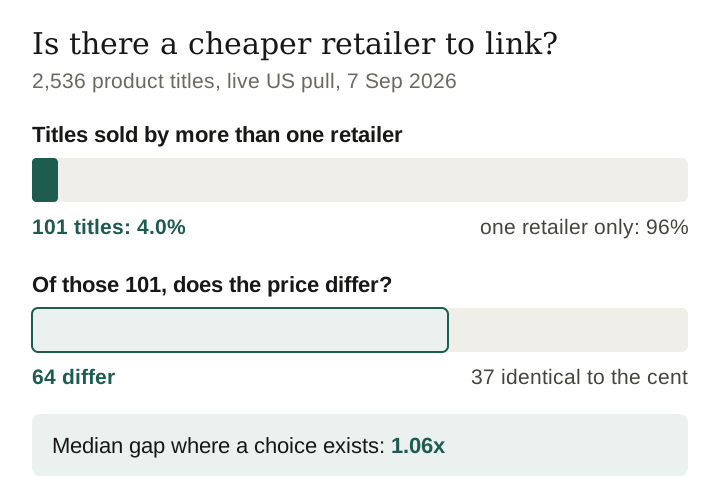
Usually you cannot, because the choice is not there. Across 2,536 distinct product titles in a live US pull on 7 September 2026, only 101 — 4.0% — appeared at more than one retailer at all. For the other 96%, there is exactly one place in the catalogue to send someone.
Where there is a choice, the gap is usually small: the median dearest-to-cheapest ratio across those 101 titles is 1.06x. The enormous gaps that make the top of the table are mostly not the same object at two prices — they are two different objects sharing a generic title.
The advice, and why it is hard to act on
“Compare a few retailers and link the cheapest” is standard affiliate advice. It assumes a shelf: the same product, several shops, pick one. We wanted to know how often that shelf exists inside an affiliate catalogue, so we counted.
The answer is that it mostly does not, and the reason is structural. A network catalogue is not a market. It is the union of the feeds of the retailers who happen to be in it, and in our pull three retailers held 71% of all rows. Where two of them stock the same item, you have a comparison. Where they do not, the “choice” is between linking the one listing that exists and linking nothing.

How often two retailers sell the same thing
| Measure | Result |
|---|---|
| Priced US rows read | 5,111 rows, 101 advertisers |
| Distinct product titles after normalising | 2,536 |
| Titles appearing at more than one retailer | 101 — 4.0% |
| Of those, price differs between retailers | 64 of 101 — 63.4% |
| Of those, price is identical | 37 of 101 — 36.6% |
| Median dearest-to-cheapest ratio | 1.06x |
| 90th percentile ratio | 3.75x |
Titles were lowercased and stripped of punctuation before comparison. That is a loose match, so 4.0% is a ceiling on real product overlap, not a floor.
Note the third row from the bottom. When two retailers do carry the same title, better than a third of the time they are asking the same money to the cent — which is what you would expect where a brand sets the price and both are following it.
When they do, how far apart are they?
A median of 1.06x means the typical answer to “which retailer is cheaper” is about six per cent. On a $40 item that is $2.40, and at a commission rate in the 3–5% band it is a difference of about ten cents to you. It is not nothing to the shopper, and it is close to nothing as a reason to restructure how you pick links.
At the 90th percentile the ratio is 3.75x, which sounds like the real money is in the tail. Read the tail carefully before you believe that.
The trap in the widest rows
| Normalised title | Cheapest | Dearest | Ratio |
|---|---|---|---|
| chess board game | $20.00 (Poshmark) | $3,875.00 (Perigold) | 193.8x |
| denim jacket | $5.00 (Poshmark) | $188.00 (J.Crew Canada) | 37.6x |
| running shoes | $5.00 (Poshmark) | $134.50 (Desigual) | 26.9x |
| table lamp | $31.99 (Wayfair) | $389.00 (Joss & Main) | 12.2x |
| board game | $18.00 (Poshmark) | $89.99 (Wayfair) | 5.0x |
| bluetooth oval speaker assorted colors | $6.03 (UnbeatableSale) | $26.39 (Zoro) | 4.4x |
| throw pillow | $27.99 (Wayfair) | $105.00 (Joss & Main) | 3.8x |
The seven widest gaps among the 101 shared titles.
Six of those seven rows are not price differences. They are title collisions. “Chess board game” at $20 on a resale marketplace is somebody’s used set; the same words at $3,875 at a luxury furniture retailer are a piece of furniture. “Denim jacket” is the entire title of a secondhand listing and also the entire title of a new designer one.
The one row that behaves like a real comparison is the speaker: a specific enough title, two mid-market retailers, a genuine 4.4x gap. That is what a usable price comparison looks like, and there were very few of them.
This is the same mechanism from the other direction as our identifier study: without a barcode or part number, “same product” is a judgement about words. Generic titles are exactly the ones that collide, and generic titles are what secondhand marketplaces produce.
Keep reading
What to compare instead of price
If the price comparison mostly is not available, the retailer choice still matters. It just turns on things you can actually read in the listing.
- Will the link survive? A one-of-one secondhand listing disappears when it sells; a catalogued item from a conventional retailer can be restocked. In this pull 41.3% of rows were peer-to-peer, and that share ran from 0% to 100% depending purely on the search term.
- Can the shopper buy the right variant? 44.6% of rows carried a variant group id, and that is a retailer switch: 26 of 27 advertisers in an earlier study sat at exactly 0% or exactly 100%.
- Is the item still in stock? 9.5% of rows in this pull were already marked out of stock by the feed itself. That is readable before you post.
- What does the programme pay, and for how long? A 6% price difference is dwarfed by a difference in commission rate or cookie window between two programmes.
- Does the retailer publish anything you can verify? Listings with an identifier can be checked against another source. Listings without one cannot, by anyone, including you.
What this cannot tell you
- It is a title match, so it over-counts overlap. Two listings sharing a normalised title are frequently not the same object, as the table above shows. Real product overlap is lower than 4.0%.
- It is one network. A retailer absent from this account sells the same products elsewhere, and a shopper comparing prices on the open web will find gaps this catalogue cannot see.
- It is one evening. Prices move; we did not re-run.
- We did not check the products. We have not handled or compared any item here. Everything above is read out of feed data.
Method
Scope, so this can be repeated rather than believed: root shoppingProducts on the CJ product API, filtered on keywords and advertiserCountries: ["US"], four pages of 100 rows per seed, deduplicated on advertiser plus title plus destination link, then post-filtered on each row’s own targetCountry. Asking price is salePrice where a row carries one and price otherwise; peer-to-peer asks of $500 or more and repdigit asks are dropped as seller placeholders. 5,111 US rows, 101 advertisers, 7 September 2026.
The eighteen seeds, published so the pull can be re-run: wool scarf, running shoes, denim jacket, table lamp, throw pillow, cast iron skillet, stand mixer, french press, bluetooth speaker, wireless earbuds, board game, lego set, face serum, dog bed, yoga mat, hiking boots, hardcover book, gold necklace. Titles were lowercased, stripped to letters, digits and single spaces, and compared exactly. For each shared title we took each retailer’s lowest asking price, then the ratio of the highest of those to the lowest.
Frequently asked
How often do two retailers sell the same product?
In a 7 September 2026 pull of 5,111 US listings, 101 of 2,536 distinct normalised titles appeared at more than one advertiser: 4.0%. Because title matching is loose, that is a ceiling.
How big is the price difference between retailers?
Among the titles carried by more than one retailer, the median ratio of dearest to cheapest was 1.06x. About a third were identical to the cent.
Why do some products show a 100x price difference?
Almost always a title collision rather than a price difference. "Chess board game" is a $20 used set at a resale marketplace and a $3,875 furniture piece at a luxury retailer.
If I cannot compare price, what should I compare?
Whether the listing can be restocked or is one-of-one, whether the retailer publishes variants, whether the feed already says out of stock, and what the programme pays.
Does this mean price comparison is useless?
No. In categories held by conventional retailers it works: cast iron skillets returned 26 retailers in this pull. The finding is that the band where it works is narrow.
Last verified 7 September 2026 against 5,111 live US listings from 101 advertisers, comparing asking prices for normalised titles carried by more than one retailer.
How this page was made. Drafted with AI (Claude); not yet independently re-checked. How we work