LinkToLooks · Guides · Creator Desk
Creator Desk
Does a creator need their own website?
Most answers to this come from people selling hosting. This one is a procedure: what a site is for, what it will not do early, and how to measure your own from the first week.
Part of: For creators
A site is worth owning, and it will not do much in search for months. Those are both true and most advice on this question drops one of them.
Google says as much itself. Its documentation puts crawling at anywhere from a few days to a few weeks, says it does not guarantee that any page will be crawled, indexed or served, and names a new site with few external links as one that can benefit from a sitemap, because Google may not otherwise find its pages. So the first months are about getting pages known to Google, and that part you can measure for free.
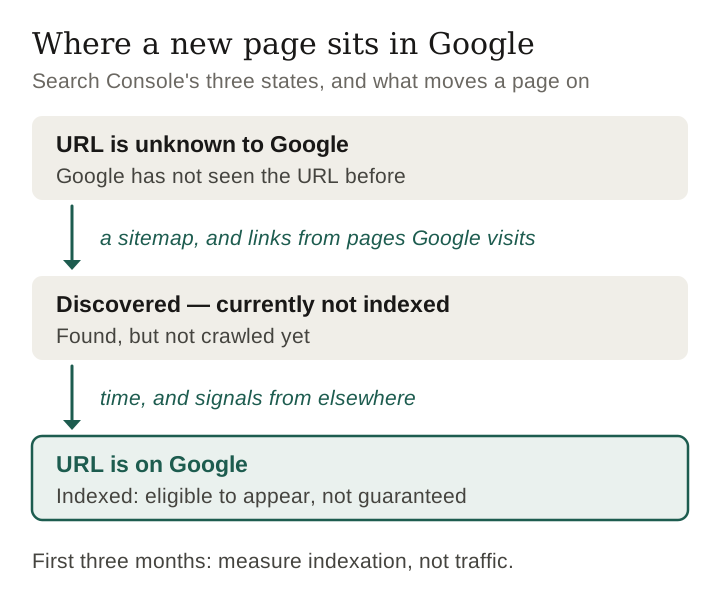
The three states a new page can be in
Search Console’s URL Inspection tool gives every URL on a verified site a verdict. Three of them matter in a new site’s first months, and they mean different things.
| Index state | What Google’s documentation says it means | What moves it |
|---|---|---|
| URL is on Google | Crawled and indexed: eligible to appear in results, which Google says is not a guarantee that it will | The page itself, once it is in |
| Discovered — currently not indexed | Found but not crawled yet; Google typically reschedules the crawl so as not to overload the site | Time, and signals from elsewhere |
| URL is unknown to Google | Google has not seen the URL before | Discovery: a sitemap, and links from pages Google already visits |
Definitions from Google’s Search Console Help pages on the URL Inspection tool and the Page indexing report, read 29 September 2026.
Expect a young site to have pages in all three at once. Google’s page-indexing help says plainly that you should not expect every URL on a site to be indexed, and that a new site or page can take time to be found and crawled. Unknown is not a verdict on quality: it means Google has not got to the page yet.

What a site is actually good for
- You own the links. When a platform changes what it allows in a bio, a caption or a description, a page you control does not change with it. This is the whole argument and everything else is secondary.
- It is the only place long-form work survives. A comparison table, a sizing note, a list of what fits what — these are unusable in a feed and they are the things people search for.
- It accumulates. A post is worth most in its first 48 hours; a page is worth most in year two. That is a genuinely different asset and the reason the long wait is tolerable.
- It is a fixed address. Brands, networks and readers can find one place that is yours, which matters more the moment an account is suspended.
What it is not good for
- Traffic this quarter. Crawling alone can take days to weeks, and ranking comes after indexing. If you need audience now, you need a platform, and the honest sequencing is platform first, site alongside.
- Replacing a link-in-bio page. Those solve a different problem — routing an existing audience — and they solve it well. A site is for people who do not know you yet.
- Being cheap in time. The hosting is cheap. Writing pages that answer a question completely is not, and the pages that do not are the ones that stay unindexed.
Keep reading
The position: start it early, expect nothing early
An argued claim. Start the site in the quarter before you need it, publish fewer and better pages than you think you should, and measure indexation rather than traffic for the first three months.
Indexation is the leading indicator and it is free to check. Traffic is a lagging indicator that will read zero for long enough to make you quit. Our reading is that the site’s job in month one is to get pages known to exist; ranking is a month-six problem and worrying about it in month one produces the wrong work.
What would change the plan: if your sampled pages sit in “unknown” month after month with a sitemap submitted, publishing volume is not the lever. Look at discovery first — links from pages that are already indexed — before you write more.
How to measure your own site
- Verify your domain in Google Search Console. It is free and takes one DNS record.
- Submit a sitemap. Without one, discovery depends entirely on links pointing at you.
- Use URL Inspection on a random sample of your own pages — twenty is plenty — and record how many come back indexed, discovered-not-indexed, and unknown.
- Repeat monthly and compare. The share moving from unknown to discovered is the first sign anything is working, and it arrives long before a single visitor does.
Frequently asked
Does a creator need their own website?
It is worth owning for link durability, long-form work and accumulation, but it will not produce traffic quickly. Google says crawling can take from a few days to a few weeks and that it does not guarantee any page will be indexed, so plan in months.
How long before a new site gets traffic from search?
Nobody can give you a general number. Google’s own documentation says crawling can take anywhere from a few days to a few weeks and that it does not guarantee it will crawl, index or serve a page. Indexing is the first step you can measure; traffic comes after it.
Is a link-in-bio page enough?
For routing an audience you already have, often yes. A site answers a different question — being found by people who do not know you.
What should I measure in the first three months?
Indexation, not traffic. Sample your own URLs in Search Console monthly and watch the share moving from unknown to discovered to indexed.
Sources and scope
- Crawl timing and no guarantee of inclusion: Google Search Central, Ask Google to recrawl your URLs.
- No guarantee of crawling, indexing or serving, and how Google discovers URLs: Google Search Central, In-depth guide to how Google Search works.
- Sitemaps help discovery but do not guarantee crawling or indexing, and a new site with few external links is one that benefits: Google Search Central, What is a sitemap.
- The meaning of each index state: Search Console Help, URL Inspection tool and Page indexing report.
- All read 29 September 2026. This page describes a procedure; it reports no measurement of this site or any other.
Last verified 29 September 2026 against Google’s Search Central and Search Console Help documentation
How this page was made. Drafted with AI (Claude); not yet independently re-checked. How we work