LinkToLooks · Guides · Creator Desk
Creator Desk
Is it too early to build your Q4 gift guide?
No — the inventory is already there, and we counted it. But two of the four terms most creators build around behave nothing like they look.
Part of: Black Friday and Cyber MondayFor creators
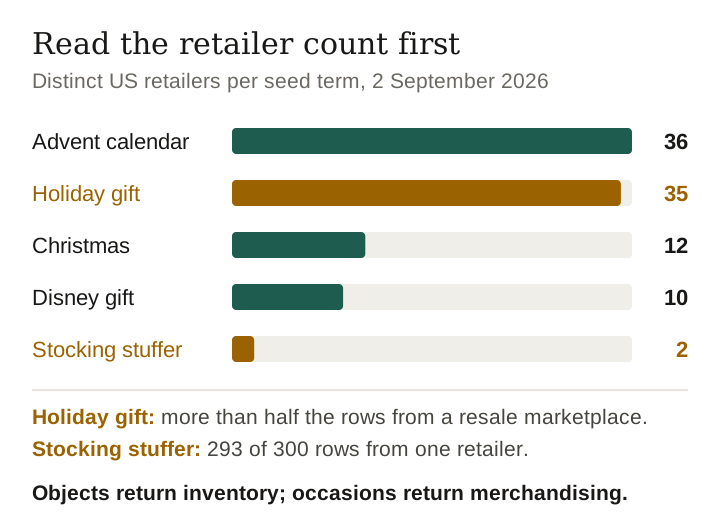
No. On 2 September 2026 the Q4 catalogue was live and deep. Advent calendars returned 199 usable US listings across 36 distinct retailers at a $34.00 median. Christmas products returned 285 across 12 retailers at $29.99. Broad holiday-gift searches returned listings from 35 retailers at $28.89.
The warning that changes a content plan: “stocking stuffer” is not a category, it is one retailer’s merchandising label. Of 300 rows returned for that term, 293 came from a single deal retailer, and after filtering only 31 usable listings from two sellers remained. A gift guide built on that seed term is a guide to one shop.
What is actually live on 2 September
| Seed term | Usable listings | Distinct retailers | Median | Middle half |
|---|---|---|---|---|
| Advent calendar | 199 | 36 | $34.00 | $20.00 – $53.99 |
| Holiday gift | ~400 raw | 35 | $28.89 | $13.00 – $51.82 |
| Christmas | 285 | 12 | $29.99 | $18.43 – $45.00 |
| Disney gift | 170 | 10 | $31.12 | $25.00 – $45.00 |
| Stocking stuffer | 31 | 2 | $19.00 | $19.00 – $19.00 |
CJ product API, US advertisers, in-stock filter, 2 September 2026. Prices checked 2 September 2026
Retailer count is the column to read, not median price. 36 retailers means a real category with competing supply; two means a merchandising label. The $19.00 median for stocking stuffers is not a market price, it is one retailer’s price point repeated.

Two seed terms that will waste your afternoon
“Stocking stuffer”
293 of 300 rows from one deal retailer, and a middle half with no width at all because almost every listing carried the same $19.00 price. This term describes how one shop groups its cheap items, not a product category that exists across the market. If you want a stocking-stuffer guide, build it from a price ceiling — “under $15” — and search real product types.
“Holiday gift”
35 retailers looks healthy until you notice that more than half the rows came from a resale marketplace, where every listing is a single item that disappears when it sells. A guide built on those links is a guide that breaks in November, which is precisely when it will get its traffic.
The case for building it now
- The choice is at its widest. Seasonal inventory is deepest before the season, not during it. The colour, size and design you want to feature is available now and may not be in six weeks.
- Your links get tested by real traffic before they matter. A guide published in September has eight weeks to reveal its broken links, its wrong prices and its sold-out items. A guide published in mid-November does not.
- Search takes time to find a page. Google’s own documentation, Ask Google to recrawl your URLs, says that “crawling can take anywhere from a few days to a few weeks”, and that asking for a crawl does not guarantee the page is included in search results at all. You can check your own runway: a few days after you publish, paste the page’s address into the URL Inspection tool in Google Search Console and read whether it is on Google yet. A guide published in mid-November can spend the weeks that matter waiting.
- Discounting is already running. 66% of Christmas listings and 54% of advent calendars carried a price below their own list on 2 September, at median cuts of 28% and 33%. The season’s pricing behaviour has already started.
Keep reading
How to build one that survives to December
- Prefer restockable retail over single-item resale. A marketplace listing is one object. Between 24% and more than half of the Q4 rows we pulled were marketplace listings depending on the term.
- Date every price you print. With half to two thirds of the category already discounted, an undated price is wrong within weeks.
- Search objects, not occasions. Advent calendar, ornament, mug, snow globe, figurine. Not “stocking stuffer”, not “gifts for her”.
- Check retailer count before you commit a section. If a whole section of your guide rests on two sellers, one programme rejection removes the section.
- Re-check the links in the week before you expect the traffic. Publishing early only works if you come back.
What we cannot tell you
We also cannot tell you when your own audience starts shopping. That is in your analytics, it varies enormously by niche, and it is a better input than any general seasonal-timing advice including ours.
Frequently asked
Is September too early for a Q4 gift guide?
No. On 2 September 2026 advent calendars were live at 36 distinct US retailers and Christmas products at 12, with medians of $34.00 and $29.99.
What is the best seed term for a holiday gift guide?
Object terms, not occasion terms. “Advent calendar” returned 36 retailers; “stocking stuffer” returned two, because it is one retailer’s merchandising label rather than a category.
How much does Q4 inventory cost right now?
Medians on 2 September 2026: advent calendars $34.00, Disney gifts $31.12, Christmas products $29.99, broad holiday gifts $28.89.
Is holiday stock already discounted in September?
Much of it. 66% of Christmas listings and 54% of advent calendars carried a price below their own stated list, at median cuts of 28% and 33%.
Method and scope
- Listing counts, retailer counts, medians, quartiles and discount shares: CJ product API, US advertisers, in-stock filter, pulled 2 September 2026.
- Usable listings are US-dollar-priced rows remaining after removing non-US banners, duplicates and off-category matches such as books and event tickets.
- Crawl timing: Google Search Central, Ask Google to recrawl your URLs (page last updated 10 December 2025), read 29 September 2026. It gives a range, not a promise.
- We hold no historical price series and make no prediction about November prices.
Last verified 2 September 2026 against live US retailer listings; Google’s crawl-timing documentation read 29 September 2026.
How this page was made. Drafted with AI (Claude); not yet independently re-checked. How we work