LinkToLooks · Guides · Creator Desk
Creator Desk
How to monetize old Instagram posts
Part of: Instagram for creators
Old Instagram posts can be monetised because affiliate links are attached at the destination, not at the moment of posting: a product identified in a 2022 photograph can be linked today and pay commission tomorrow.
The constraint is not the platform. It is that every post has to be looked at, every product identified, and every retailer matched — one at a time.
On this page
Why a back catalogue is worth anything
Most creator income is tied to the post that is live this week. A back catalogue is different in three ways that matter:
- It keeps being found. Old posts surface in search, in profile browsing, and in the recommendation surfaces long after they leave the feed.
- The purchase intent is already proven. Someone landing on a two-year-old outfit photo and asking where the skirt is from is a warmer lead than anyone who saw today's Story.
- The work is already done. The photograph exists. The only missing piece is the link.
The arithmetic of 400 posts
Take a creator with 400 posts. Not every post contains a linkable product — some are text, some are people, some are places. In outfit-led and home-led accounts, a reasonable working assumption is that between a third and a half of posts contain at least one identifiable object, and that a post containing one usually contains two or three.
We are deliberately not putting a precise percentage on that, because we have not measured it on real creator accounts and will not publish a number we invented. What we can measure is the other half of the problem: whether the objects are linkable at all.
| Category | Linkable? |
|---|---|
| Belts | yes, deeply |
| Hair clips | yes |
| Baby tees | yes |
| Cargo trousers and skirts | yes, but one seller holds nearly all of it |
| Jelly bracelets | resale only |
| Hoop earrings | resale only |
| VCRs | no — nothing to link |
What this shows: the failure mode of back-catalogue linking is not usually the platform or the post. It is that the object in the photograph has no live retail behind it. Across the categories we pulled today, that ranges from a category with several advertisers competing to one with no listings at all.
Keep reading →
Where it actually breaks down
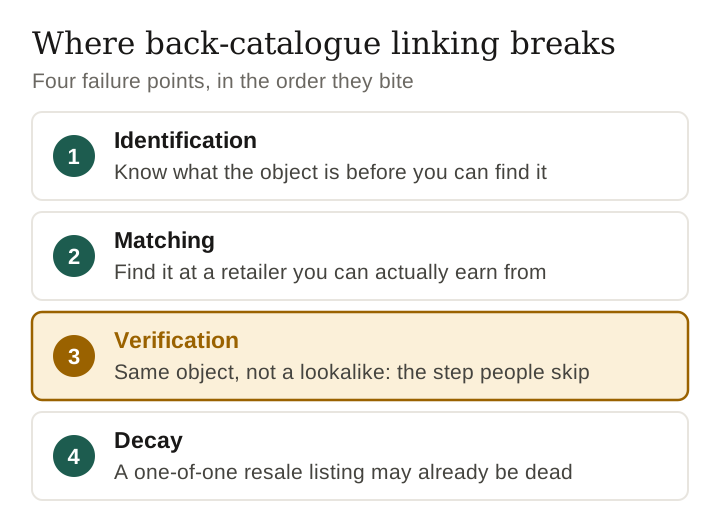
Four failure points, in the order they bite:
1. Identification
You have to know what the object is before you can find it. Your own posts are the easy case — you owned the thing — but two years later, plenty of creators genuinely cannot remember the brand of a bag they photographed once.
2. Matching
Finding the object at a retailer you can actually earn from. A product that exists on five sites and none of them in your programmes is not linkable, however identifiable it is.
3. Verification
Confirming the listing is the same object and not a lookalike. This is the step that gets skipped, and it is the one that produces the angry comment. A near-match linked confidently is worse for you than no link.
4. Decay
Resale listings are one-of-one. A link to a marketplace listing you matched last month may already be dead, and a dead link on an old post is worse than an unlinked post because it looks abandoned.
Doing it by hand, properly
If you are working through a back catalogue yourself, this is the order that wastes the least time:
- Sort by traffic, not by date. Your analytics will show which old posts still get views. Link those first; the rest may never repay the effort.
- Do one category at a time. All the belts, then all the shoes. You stay inside one set of retailers and one mental model, and you get much faster at it.
- Write down what you could not link. The list of objects with no retail behind them is itself useful — it tells you which programmes to apply to next.
- Re-check quarterly. Resale links die. A calendar reminder is unglamorous and it is the difference between a catalogue that earns and one that rots.
This is genuinely slow work, and it is the reason most creators never do it. We are not going to claim a number of hours saved by any alternative, because we have not measured one.
Platform features checked 1 September 2026. Instagram changes what creators may do several times a year; anything on this page describing a feature is true as of that date and should be re-checked against Instagram's own help pages before you rely on it.
Old posts, asked plainly
Can you add affiliate links to old Instagram posts?
Yes. Affiliate links resolve at the destination, so a product identified in an older post can be linked now and pay commission on a purchase made tomorrow.
Is it worth linking a back catalogue?
It depends on whether the objects have live retail behind them. In today's pull, belts had live listings from several advertisers while VCRs had none at all.
What is the hardest part?
Verification. Matching a photograph to a listing that is genuinely the same object, rather than a lookalike, is the step people skip and the one that costs them trust.
Which old posts should I link first?
The ones still getting views. Sort by traffic rather than by date; a post nobody visits will not repay the work of linking it.
Sources
- Category depth: CJ Affiliate product feeds, US advertisers, queried 1 September 2026.
- NetInfluencer on Instagram's March 2026 affiliate tagging in Reels for how tagged products are attached to a post. Trade press, not platform documentation.
More for creators →
Read next
How to add affiliate links · Under 10k followers · Who holds resale inventory
How this page was made. Drafted with AI (Claude); not yet independently re-checked. How we work