LinkToLooks · Guides · Reference Desk
Reference Desk
Is it Fiesta, or is it just called Fiesta?
“Fiesta” is a brand, a shape range and a colour name that other makers use freely — and a third of what a search returns is the wrong one of the three.
Check three things in this order: the profile, a solid single-colour glaze right to the edge, and a named maker. Genuine Fiesta is made by the Fiesta Tableware Company of Newell, West Virginia — the Homer Laughlin China Company until it sold its food-service divisions in 2020. If a listing names a different manufacturer, or names none at all while calling a colour “Blue Fiesta”, it is a lookalike.
We pulled 104 live US listings whose titles contain the word Fiesta on 2 September 2026. Seventy-one were genuine Fiesta sets or pieces. The rest included porcelain sets by another maker in a colourway called Blue Fiesta, printed fabric sold by the yard, a graphic t-shirt and a book.
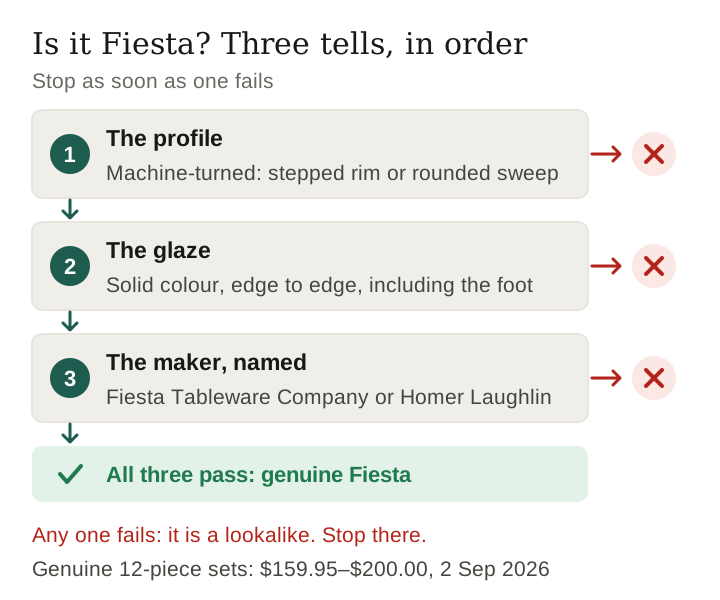
The three tells, in order
Someone holding a plate wants a decision, not a history lesson. Take these in order and stop as soon as one fails.
1. The profile
Both current Fiesta shapes read as machine-turned. Classic Rim carries a stepped, concentric band around the rim — the Art Deco motif the line launched with in 1936. Bistro Coupe drops the rim and keeps a rounded, unbroken sweep. A plate with a flat featureless rim and a decal in the middle is not Fiesta, whatever the colour is called.
2. The glaze
Solid colour, edge to edge, on every surface including the foot. Fiesta has never been a printed-pattern line. A floral transfer, a gold band or a two-tone body means you are looking at something else.
3. The maker, named
This is the tell that settles arguments. Current Fiesta is made by the Fiesta Tableware Company; pieces made before 2020 carry the Homer Laughlin name. A listing naming any other manufacturer alongside the word Fiesta is describing a colour, not a brand.
What the lookalikes actually are
This is not hypothetical. Every row below came out of the same search on the same morning, and every one would be returned to a shopper typing “fiesta dinnerware”.
| What the listing says | What it actually is | Live price |
|---|---|---|
| “Blue Fiesta 16 Piece Round Porcelain Dinnerware Set” | A 16-piece porcelain set by another maker. Fiesta here is the colourway name. | $49.99 |
| “Elama Blue Fiesta 16-pc. Porcelain Dinnerware Set” | The same set, sold under its actual brand name — Elama. | $75.59 on 2 September 2026 |
| “Safdie & Co. Electric Marble 16 Piece Dinnerware Set, Service for 4, Fiesta” | A marble-print set. Fiesta is a trailing keyword. | $40.99 |
| “Fiesta Shirt Mens XL Mint Green Graphic Tee” | A t-shirt. | $15.00 |
| Printed cotton sold by the yard | Fabric, from a print-on-demand textile seller. | $20.00–$30.00 |
Rows quoted verbatim from live US listings pulled 2 September 2026. Prices checked 30 September 2026: every row was listed again at the same price except the Elama-branded set, which the feed no longer returned, and the fabric, now $20.00–$30.00 a yard
The economic tell is as reliable as the visual one. A genuine 12-piece Fiesta set held a $159.95–$200.00 line across four national retailers on 2 September 2026, and the same line on 30 September. A 16-piece “Fiesta” set at $48.73 is not a bargain on the brand; it is a different product. More pieces for a third of the money is the loudest signal in the category.
Vintage or modern?
A second question hides inside the first, because Fiesta has two production eras with a twelve-year gap between them. The original run was 1936 to 1973. The line returned in 1986 and has run continuously since.
- Body. Pre-1986 pieces are semi-vitreous pottery. Post-1986 pieces are vitreous china, and the reference we read notes the newer body shrinks more in firing, so modern pieces are noticeably smaller than vintage ones in the same shape.
- Colour. Some glaze names only ever existed in one era. Chartreuse, Forest, Rose and Gray belong to 1950–1959. Lapis, Meadow, Daffodil, Peony, Sky and Jade are current-production names we saw on live listings this morning.
- Wear. A vintage piece that has been used carries utensil marks in the glaze; a warehouse-fresh reissue does not. A supporting tell, not a deciding one.
Keep reading
The red-glaze question
It comes up every time, so here is the sourced version. The original brilliant red glaze took its colour from uranium oxide. Red production ended in 1944 when the US government took control of uranium stocks, and resumed in 1959 using depleted uranium — described in our reference as carrying about 60% of the radioactivity of the natural material — running until 1969.
Two practical consequences. A vintage red piece is either pre-1944 or 1959–1969, which is the tightest date bracket any Fiesta colour gives you. And modern red, reintroduced after 1986, has nothing to do with it. We are not going to tell you whether a vintage red plate is safe to eat from; that is a question for a health authority, not a shopping desk.
Frequently asked
Who makes Fiesta now?
The Fiesta Tableware Company of Newell, West Virginia. It was the Homer Laughlin China Company until 2020, when it sold its food-service divisions and kept the retail business, the Fiesta line, the factories and the headquarters.
Why is one 16-piece Fiesta set $49 and another 12-piece set $160?
Because the cheap one is not Fiesta. It is a porcelain set by another maker in a colourway called Blue Fiesta. Genuine 12-piece Fiesta sets ran $159.95 to $200.00 across Macy’s, Wayfair, JCPenney and Belk on 2 September 2026.
How do I tell vintage Fiesta from a modern piece?
Body and size. Pre-1986 pieces are semi-vitreous pottery; post-1986 pieces are vitreous china and fire smaller. Colour names help too: Chartreuse, Forest, Rose and Gray are 1950s-only glazes.
Is Fiesta still being made?
Yes. Our reference records more than 40 glazes currently available, and we saw current-production sets live at four national US retailers on 2 September 2026.
Sources and scope
- Company history, production eras, glaze chronology and the uranium red timeline: Fiesta (dinnerware), Wikipedia, read 2 September 2026.
- Listing counts, prices and retailer names: CJ product API, US advertisers, in-stock filter, pulled on 2 September 2026. 104 de-duplicated US-priced rows whose titles contain “Fiesta”.
- We have not handled, tested or eaten off any of these products. Our checks are on listings and published references.
Last verified 30 September 2026 against live US retailer listings in the CJ product feed; the company history was read on 2 September 2026
Keep reading
How this page was made. Drafted with AI (Claude); not yet independently re-checked. How we work