LinkToLooks · Guides · Reference Desk
Reference Desk
Fiesta colours and eras, dated
Colour is the fastest dating tool this line offers. Four glazes narrow a piece to one decade, and one narrows it to a nine-year window.
Fiesta ran 1936–1973, stopped for twelve years, and returned in 1986. That gap is the backbone of every dating question about the line: a colour belongs to one era or the other, and a handful belong to a single decade inside the first.
The vintage palette began with five glazes in 1936 — red, cobalt blue, light green, deep golden yellow and old ivory — with turquoise added in 1938. Since the 1986 relaunch our reference counts 340 glaze colours produced, with more than 40 currently available.
The vintage palette, 1936–1973
Six glazes carried the line for its first twelve years. Four more arrived in 1950, and the last redesign in 1969 replaced the palette entirely before production ended.
| Colour | Years | What it dates |
|---|---|---|
| Red (orange red) | 1936–1943, 1959–1972 | Two separate windows — see the uranium note below |
| Blue (cobalt) | 1936–1950 | Pre-war or immediately post-war |
| Green (light green) | 1936–1950 | Same window as cobalt |
| Yellow (deep golden) | 1936–1969 | The longest-running original |
| Old Ivory | 1936–1950 | Pre-1950 only |
| Turquoise | 1938–1969 | Post-1938, so never the earliest pieces |
| Rose (dark brownish pink) | 1950–1959 | One decade |
| Gray | 1950–1959 | One decade |
| Forest (dark green) | 1950–1959 | One decade |
| Chartreuse | 1950–1959 | One decade |
| Medium green | 1959–1969 | Nine years; the collector’s window |
| Mango Red, Turf Green, Antique Gold | 1969–1973 | The final redesign, to the end of the run |
Colour chronology from the published company history, read 2 September 2026.
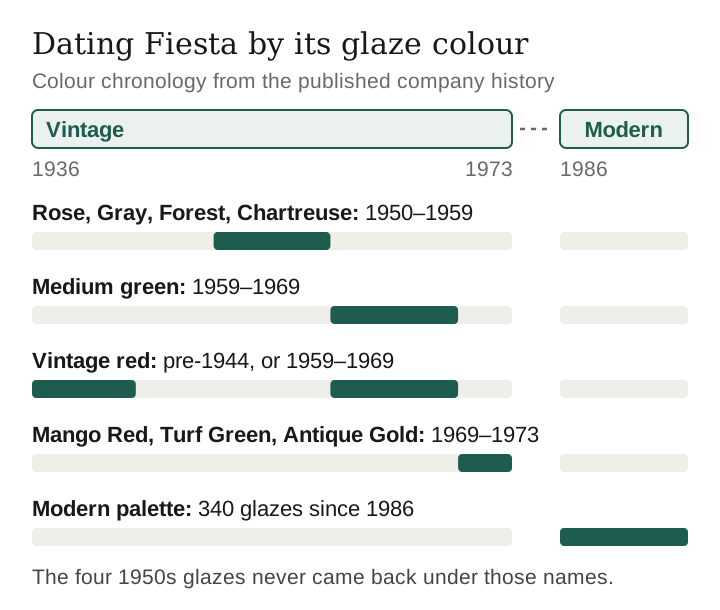
The four 1950s glazes are the most useful thing on this page. Rose, Gray, Forest and Chartreuse ran for nine years and never came back under those names. A piece in one of them is a 1950s piece, full stop, with no further evidence needed.
Why red has two windows
The original red glaze took its colour from uranium oxide. During the Second World War the US government took control of uranium stocks and confiscated the company’s supply, so red production ended in 1944.
It resumed in 1959 using depleted uranium, described in our reference as carrying roughly 60% of the radioactivity of the natural material, and ran until 1969. So a vintage red piece is either pre-1944 or 1959–1969 — the tightest bracket the palette gives you, and the reason red pieces are dated more confidently than any other colour.
Modern red, reintroduced after 1986, is unrelated to any of this. We are not offering a safety opinion on vintage red glaze; that belongs to a health authority, not a shopping desk.
The modern era, 1986 onwards
The relaunch opened with Rose, Black, Cobalt, White and Apricot in 1986, and the palette has rotated ever since. Counting to date: 340 glazes produced, 40-odd current.
That churn is why colour dates a modern piece badly and a vintage piece well. But it also means the current names are checkable, and here are the ones we saw on live US retailer listings on 2 September 2026:
- Lapis, Sky, Turquoise, Jade, Meadow
- Scarlet, Poppy, Peony, Lavender
- Daffodil, Butterscotch, Linen, White, Ivory
- Peppermint Frost (seasonal, seen at one retailer)
The body change nobody mentions
Pre-1986 Fiesta is semi-vitreous pottery. Post-1986 Fiesta is vitreous china. The published history notes a practical consequence collectors use constantly: the newer clay shrinks more in firing, so a modern piece is noticeably smaller than a vintage piece of the same shape.
If you are matching a modern replacement to a vintage set, expect it not to sit flush. That is the material, not a manufacturing fault.
Frequently asked
What years was Fiesta made?
1936 to 1973, then a gap, then 1986 to the present.
Which Fiesta colours are the most datable?
Rose, Gray, Forest and Chartreuse, all 1950–1959. Medium green, 1959–1969, is the next tightest.
Why did Fiesta stop making red?
The glaze used uranium oxide, and the US government took control of uranium stocks during the war. Red ended in 1944 and returned in 1959 using depleted uranium, running to 1969.
How many Fiesta colours have there been?
Our reference counts 340 glaze colours since the 1986 relaunch, with more than 40 currently available, on top of the twelve or so vintage glazes.
Sources
- Production eras, colour chronology, the uranium red timeline, the 2020 company change and the body change: Fiesta (dinnerware), Wikipedia, read 2 September 2026.
- Current glaze names in circulation: CJ product API, US advertisers, pulled 2 September 2026.
- We have not handled or tested any piece described here.
Last verified 2 September 2026 against the published company history and live US retailer listings pulled
Keep reading
How this page was made. Drafted with AI (Claude); not yet independently re-checked. How we work