LinkToLooks · Guides · Creator Desk
Creator Desk
How do you actually get accepted as an affiliate creator?
Part of: For creators
Affiliate applications are reviewed by a person looking at a live property, and most rejections are about what that person could not find rather than about how good your content is. This is the sequence, what reviewers are actually checking, and — unusually for a page on this subject — a live account of it from someone who has not been approved yet.
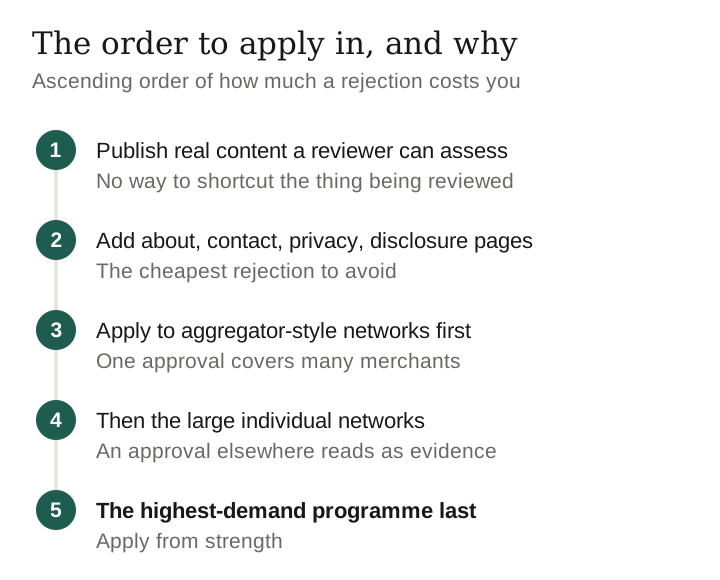
The order to apply in
| Order | What to do | Why this position in the queue |
|---|---|---|
| 1 | Publish enough real content that a reviewer can tell what your site or account is about, and keep publishing while you apply. | Every application is reviewed against a live property. There is no way to shortcut the thing being reviewed. |
| 2 | Write the pages a reviewer opens first: what you cover, who you are, how to contact you, and a visible disclosure policy. | Missing about, contact and privacy pages are the cheapest rejection to avoid and one of the most common. |
| 3 | Apply to the aggregator-style networks first. | One approval covers many merchants, so a single acceptance turns a large fraction of your existing links live. |
| 4 | Apply to the large individual networks next. | These review more strictly and an existing approval elsewhere reads as evidence. |
| 5 | Apply to the highest-demand programme last. | Apply from strength. The programme you most want is the one where a rejection costs you the most time to re-approach. |
The principle underneath that table is worth more than the table: apply in ascending order of how much a rejection costs you. Approvals are evidence. A programme that has already accepted you is the strongest thing you can bring to the next reviewer, and the programme you want most is the one to face last.
What the reviewer is actually checking
| What a reviewer is checking | Sourced from |
|---|---|
| Whether the property is genuinely live and being updated, rather than a shell built to hold links. | General review practice |
| Whether the content could expose the network or advertiser to claims or reputational damage. Amazon reserves termination where it believes it "may face potential claims or liability" or that its "brand or reputation may be tarnished". | Amazon Associates Operating Agreement, section 6 |
| Whether the account is connected to a previously terminated one. Amazon lists previous terminations of affiliated accounts as grounds. | Amazon Associates Operating Agreement, section 6 |
| Whether anything about the property is deceptive or fraudulent. Amazon lists use "for deceptive, fraudulent or illegal activity" as grounds. | Amazon Associates Operating Agreement, section 6 |
| For creator platforms, audience and cadence. LTK states it looks for a public social profile, a high number of engaged followers, and content posted regularly, and that its ideal applicant posts daily. | LTK public creator page |
The rejections that are entirely avoidable
- No about page, no contact route, no privacy policy. A reviewer cannot approve a property whose owner they cannot identify. This costs nothing to fix and is the most common avoidable failure.
- Applying before there is anything to review. A property with a handful of thin pages gives a reviewer nothing to say yes to. Publish first.
- Links already in place that go nowhere. Dead links on a property under review read as abandonment.
- No visible disclosure practice. A network is taking on your compliance risk. Showing that you already disclose properly removes a reason to decline.
- Reapplying immediately after a rejection, unchanged. Fix the thing, keep publishing, and come back with something different to look at.
Where we are, which is the honest part
LinkToLooks has been approved by no affiliate network. We are working through the sequence above ourselves — aggregator-style network first, the large individual networks after, and the highest-demand programme last — and we are not applying to any of them until the property can stand a reviewer's-eye pass: a clear subject, real content that answers real questions, working links, an about page, a contact route and a disclosure on every page.
We are telling you this because every other page answering this query is written by someone with an approval to show off, and their advice is shaped by survivorship. Ours is shaped by being in the queue. Take from that what you like.
Last verified 1 September 2026. Reviewer-criteria quotations are from the Amazon Associates Operating Agreement, section 6, and from LTK's public creator page. The application ordering is our own operating doctrine, stated as such rather than as an industry standard. LinkToLooks holds zero network approvals as at this date.
Frequently asked
How do I become an affiliate creator?
Publish a property a reviewer can evaluate, add the about, contact, privacy and disclosure pages a reviewer looks for, then apply in ascending order of how badly you want each programme — aggregator networks first, the highest-demand programme last, so you approach it with approvals already behind you.
Why do affiliate applications get rejected?
Most often for what is missing rather than for content quality: no about or contact page, too little published content to assess, dead links, or no visible disclosure practice. Networks also decline properties that could expose them to claims or reputational risk.
How many followers do I need to become an affiliate?
It depends entirely on the programme. Retailer networks assess a live property rather than a follower count. Creator platforms do use audience: LTK states it looks for a public profile, a high number of engaged followers and regularly posted content.
Can I reapply after being rejected?
Generally yes, but not unchanged. Fix what was missing, keep publishing, and reapply with something materially different for a reviewer to look at.
Which affiliate programme should I apply to first?
An aggregator-style network, because one approval turns a large fraction of your existing links live. Save the programme with the largest link demand for last, when earlier approvals can act as evidence.
Sources
- Amazon Associates Operating Agreement — section 6, the termination grounds quoted here, including potential claims or liability, brand or reputation being tarnished, deceptive, fraudulent or illegal activity, and previous terminations of affiliated accounts.
- LTK, creator page — the stated criteria of a public social media profile, a high number of engaged followers, and content posted regularly with an ideal applicant posting daily.
Read next
How creators actually get paid · Affiliate disclosure rules for creators · Affiliate programmes for toy creators
How this page was made. Drafted with AI (Claude); not yet independently re-checked. How we work